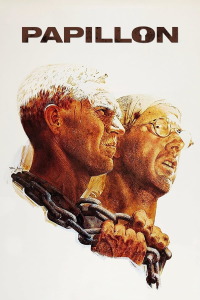
Review of Papillon (1973) by Mike C — 03 Jan 2012
Papillon is a film I hadn't seen for approximately 30 years, so I was eagerly awaiting the Blu-ray release. I was a different person back then and my tastes have evolved a great deal since first seeing the film. What was a masterpiece in my memory is now simply a good film.
The story is set in a prison in French Guiana and is based on the true story of Henri Charriere. He was known as Papillon because of the butterfly tattooed on his chest. Steve McQueen plays the role and does an excellent job.
The other key character is Louis Dega (Hoffman), who is a forger and not well-equipped to fend for himself in prison. He hires Papillon for protection and promises to finance Papillon's escape attempt. It proves to be a wise decision.
On reaching the prison, the new inmates are given a welcome speech. They are told that their first escape attempt would result in two years of solitary confinement being added to their sentence. A second attempt would mean five more years in solitary. Extreme cases would result in death by guillotine.
Nearby islands contain prison work camps and Dega and Papillon are sent there. The swampy conditions are full of natural dangers such as crocodiles and snakes. Any escapees are hunted by former prisoners for a reward. Papillon makes an early attempt and is quickly recaptured, resulting in the promised two years in solitary confinement.
The rations in solitary are barely enough to support human life and Dega bribes guards to smuggle Papillon extra food. When this is discovered, the warden wants the name of the person sending him food. Papillon refuses and is put on half rations. This is equivalent to a death sentence, but Papillon eats whatever creatures stray into his cell and manages to survive the two-year ordeal.
When he recovers his strength, Papillon makes another escape attempt. Dega and another prisoner join him and they arrange to leave the swamp by boat. The three set sail for Honduras. On reaching land they eventually become separated and Papillon is forced to fend for himself. This leads to an extended sequence, largely without dialogue, where Papillon lives with some of the indigenous population. It's a happy time for him and is a stark contrast to his life in prison.
I won't reveal any more of the story, but there are a few more twists and turns before it ends.
The story is essentially about the strength of the human spirit and the desire to be free. Papillon has to endure harsh conditions, but something inside him makes him go on. It also shows that some criminals are not all bad. The friendship between Papillon and Dega is powerful and lasting. The final sequence shows both the friendship and Papillon's determination to live as a free man.
This review of Papillon (1973) was written by Mike C on 03 Jan 2012.
Papillon has generally received very positive reviews.
Was this review helpful?