Review of Pan's Labyrinth (2006) by Omna S — 16 Apr 2018
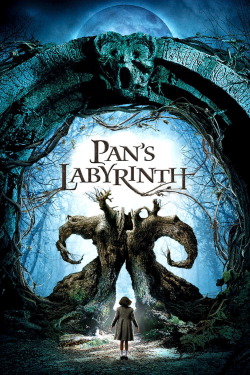
Pan's Labyrinth, an exotic fantasy film directed by Guillermo del Toro, takes the audience on an exhilarating ride through Ofelia's adventurous yet mysterious life. Set in 1944, in post-civil war Spain, it tells the story of a young girl, Ofelia, and her pregnant mother as she goes to live with her step-father, Captain Vidal, a cruel captain of the Fascist army. The film revolves around her encounters with the mysterious faun who gives her three exhausting tasks to prove herself to be the princess of the underworld and get to meet her real father. Although at first glance it may appear to be an ordinary fantastical film with mystical creatures, the creatures are much significant representatives of the real world. The film evades lingering false consciousness pertaining to fantasy and transgresses boundaries between that which is real and that which is unreal. This blurring of boundaries is not only present in contextual levels but is also delivered through form. Del Toro showcases military tensions in fascist Spain and the aftermath of the civil war on its citizens as they oppose the regime. Through the usage of time as a symbol and the presence of various genres and references to other works, the film comes about to be heavily reliant on postmodernism. Pan's Labyrinth utilizes elements of false consciousness coupled with evasion of boundaries and postmodernism to provide a real-life dimension to a film that could be easily "dismissed as child's play beyond serious study" (Butler 2).
The presence of supernatural creatures embodies the "treatment of children by society, with the creatures encountered by Ofelia [played by Ivana Baquero] being representations or transformations of 'political power'" (9). Furthermore, 'The Pale Man' is portrayed as a devourer of children and figuratively, a societal representation of a figure who manipulates children's innocent minds. On a formal level, Del Toro draws inspiration from Francisco De Goya's art as his painting, Saturn Devouring His Son showcases Saturn, fearful his sons will overpower him, consuming each of them.
In another instance, Del Toro also utilizes De Goya's painting, The Third of May, 1808: The Execution of the Defenders of Madrid in a scene where Captain Vidal, played by Sergi López, shoots a falsely-suspected spy and as the victim's father lashes out at Vidal, the state of mind of the citizens unravels. As evident by the title of the painting, the citizens are shown to be against the Franco Regime and attempt to overthrow the authoritarian ruler. Therefore, both the painting and the scene illustrate an overall theme of a rebellion by the repressed in the film. Likewise, Ofelia and Mercedes represent the repressed citizens under the Franco rule. Through this, Del Toro also illustrated that the repressed rebels don't have to be adults and that children can also oppose and stand up for themselves.
The color scheme of the film also draws influence from Francisco de Goya's paintings and upon further analysis, it is not surprising that the film contains multiple references to his paintings as De Goya is notable for paintings pertaining to Spanish wars and their aftermath on the ordinary citizens. Hence, in this manner, Del Toro not only transgresses boundaries between reality and fantasy but also evades the false consciousness about fantasy films containing no more significance than being merely children's imaginations. It opens the minds of the audience to look past the status quo and accept that fantastical elements are visually-appealing ways to portray much more deeper thoughts about the events taking place in the real world. The viewers may then conclude that Del Toro also transgresses boundaries between fiction and non-fiction as fictional elements are being used to infiltrate the non-fictional world. Furthermore, the paintings and the film also invoke an open dialogue between one another, thereby transgressing temporal boundaries that confine the paintings and the film to a particular era. In addition to this, false consciousness is also relevant to the ending of the film. Albeit, typically in fantasy films, the evil is killed but it is arguable if the ending was indeed a happy one as Ofelia got to see her parents and return to her palace but at the same time, there are multiple lives claimed throughout the film. Hence, false consciousness about the clichéd endings in fantasy films is clearly evaded in Pan's Labyrinth.
Time encapsulates itself as a recurring symbol in Del Toro's film. Captain Vidal would constantly look at his pocket watch and even comments, early on in the film, how Ofelia and her mother are exactly fifteen minutes late. The usage of the hour glass when Ofelia is trying to accomplish one of her tasks and the timeliness involved in the tasks further illustrates the importance of time in the film. Furthermore, towards the ending of the film, Captain Vidal asks Mercedes to tell his son the exact time he was killed which shows how Captain Vidal was imprisoned by time in the entire film. Moreover, the fact that the film is told in reverse initially and later goes in chronological order reflects on the time-bending capabilities of the film. In addition to this, boundaries between genres are also clearly infringed as Del Toro utilizes elements of horror, mystery, adventure in a war-like context cumulatively told through a fairy tale. The presence of time distortion and the usage of multiple genres is clearly indicative of Pan's Labyrinth being a postmodern film. In addition to this, the presence of pastiche through the usage of paintings as influences for the film is another identifier of postmodernism in the film.
Despite being a fantasy film, Del Toro's Pan's Labyrinth, exercises elements of false consciousness, transgression of boundaries, opposition by the oppressed and postmodernism elements, formally and contextually, to give rise to a story that is much more than mere imagination. It is a powerful mystification of the real world that ensures the audience leave the theatre with an eye-opening perspective on fantastical thrillers.
This review of Pan's Labyrinth (2006) was written by Omna S on 16 Apr 2018.
Pan's Labyrinth has generally received very positive reviews.
Was this review helpful?