Review of Page One: Inside the New York Times (2011) by Adam L — 27 Jul 2011
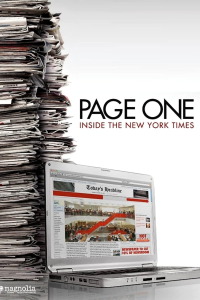
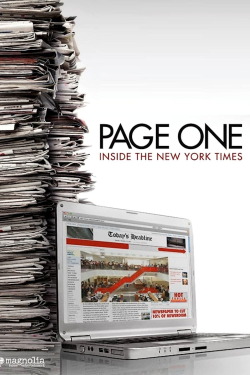
Page One: A Year Inside the New York Times (***).
For as long as Iâ(TM)ve been paying attention to and reading newspapers, the New York Times has always been the gold standard in print journalism, the bible of newspapers, so to speak. The thoughts of a time when a paper like this, one that has shaped so much of what has transpired in this country for so long, could simply disappear, is a specter that hangs over the proceedings in the documentary film, Page One: A Year Inside the New York Times. Its a scary time indeed for many major newspapers and the possibility that the Times could bite the dust like so many others have in recent years gives us pause. Thatâ(TM)s why this new film is more timely than ever and should be seen by any one with a passing interest in journalism. The film may not be perfect but it is illuminating.
First, Iâ(TM)ll start off with what is wrong with the film and that would be its lack of focus. It canâ(TM)t seem to decide whether it wants to give us a look at the inner workings of a paper or just profile the staff of the paper. David Carr, a former junkie who has turned his life around and is now a reporter at the media desk, turns out to be the filmâ(TM)s main focus. The filmâ(TM)s early scenes depict the inner workings of the paper but once the film begins to follow Carr around, the rest of the film seems to suffer and take a back seat to Carr. Still, its interesting to see Carr at work, chasing stories. His working methods are interesting to say the least.
What does work in the film is its discussion of the changing of society and how we are receiving the news these days. As the film so succinctly points out, todayâ(TM)s generation of kids believe that information should be free. The thoughts of someone actually paying for news seems antiquated in their eyes and yet the question is, can we really blame them? Perhaps its just a sign of the times as they have been raised in a society that get its information for free.
The film also covers the rise of wikileaks and its increasing importance in the world of news reporting. Even though it may offer no real solutions to the problems that print journalism is facing today, it explores these issues in an interesting way but also manages to keep things simple enough so that the average Joe can understand the importance of a paper such as the New York Times in our society.
The filmâ(TM)s director Andrew Rossi was offered total access to the Times for one year while he made the film and he has done a credible job when all is said and done. What we have is a film that, though it may not be as compelling as one might hope for, still manages to straddle the fine line between informing and entertaining. Thatâ(TM)s something that those in the newspaper business these days know all too well.
Page One: A Year Inside the New York Times (***).
For as long as Iâ(TM)ve been paying attention to and reading newspapers, the New York Times has always been the gold standard in print journalism, the bible of newspapers, so to speak. The thoughts of a time when a paper like this, one that has shaped so much of what has transpired in this country for so long, could simply disappear, is a specter that hangs over the proceedings in the documentary film, Page One: A Year Inside the New York Times. Its a scary time indeed for many major newspapers and the possibility that the Times could bite the dust like so many others have in recent years gives us pause. Thatâ(TM)s why this new film is more timely than ever and should be seen by any one with a passing interest in journalism. The film may not be perfect but it is illuminating.
First, Iâ(TM)ll start off with what is wrong with the film and that would be its lack of focus. It canâ(TM)t seem to decide whether it wants to give us a look at the inner workings of a paper or just profile the staff of the paper. David Carr, a former junkie who has turned his life around and is now a reporter at the media desk, turns out to be the filmâ(TM)s main focus. The filmâ(TM)s early scenes depict the inner workings of the paper but once the film begins to follow Carr around, the rest of the film seems to suffer and take a back seat to Carr. Still, its interesting to see Carr at work, chasing stories. His working methods are interesting to say the least.
What does work in the film is its discussion of the changing of society and how we are receiving the news these days. As the film so succinctly points out, todayâ(TM)s generation of kids believe that information should be free. The thoughts of someone actually paying for news seems antiquated in their eyes and yet the question is, can we really blame them? Perhaps its just a sign of the times as they have been raised in a society that get its information for free.
The film also covers the rise of wikileaks and its increasing importance in the world of news reporting. Even though it may offer no real solutions to the problems that print journalism is facing today, it explores these issues in an interesting way but also manages to keep things simple enough so that the average Joe can understand the importance of a paper such as the New York Times in our society.
The filmâ(TM)s director Andrew Rossi was offered total access to the Times for one year while he made the film and he has done a credible job when all is said and done. What we have is a film that, though it may not be as compelling as one might hope for, still manages to straddle the fine line between informing and entertaining. Thatâ(TM)s something that those in the newspaper business these days know all too well.
Page One: A Year Inside the New York Times (***).
For as long as Iâ(TM)ve been paying attention to and reading newspapers, the New York Times has always been the gold standard in print journalism, the bible of newspapers, so to speak. The thoughts of a time when a paper like this, one that has shaped so much of what has transpired in this country for so long, could simply disappear, is a specter that hangs over the proceedings in the documentary film, Page One: A Year Inside the New York Times. Its a scary time indeed for many major newspapers and the possibility that the Times could bite the dust like so many others have in recent years gives us pause. Thatâ(TM)s why this new film is more timely than ever and should be seen by any one with a passing interest in journalism. The film may not be perfect but it is illuminating.
First, Iâ(TM)ll start off with what is wrong with the film and that would be its lack of focus. It canâ(TM)t seem to decide whether it wants to give us a look at the inner workings of a paper or just profile the staff of the paper. David Carr, a former junkie who has turned his life around and is now a reporter at the media desk, turns out to be the filmâ(TM)s main focus. The filmâ(TM)s early scenes depict the inner workings of the paper but once the film begins to follow Carr around, the rest of the film seems to suffer and take a back seat to Carr. Still, its interesting to see Carr at work, chasing stories. His working methods are interesting to say the least.
What does work in the film is its discussion of the changing of society and how we are receiving the news these days. As the film so succinctly points out, todayâ(TM)s generation of kids believe that information should be free. The thoughts of someone actually paying for news seems antiquated in their eyes and yet the question is, can we really blame them? Perhaps its just a sign of the times as they have been raised in a society that get its information for free.
The film also covers the rise of wikileaks and its increasing importance in the world of news reporting. Even though it may offer no real solutions to the problems that print journalism is facing today, it explores these issues in an interesting way but also manages to keep things simple enough so that the average Joe can understand the importance of a paper such as the New York Times in our society.
The filmâ(TM)s director Andrew Rossi was offered total access to the Times for one year while he made the film and he has done a credible job when all is said and done. What we have is a film that, though it may not be as compelling as one might hope for, still manages to straddle the fine line between informing and entertaining. Thatâ(TM)s something that those in the newspaper business these days know all too well.
Page One: A Year Inside the New York Times (***).
For as long as Iâ(TM)ve been paying attention to and reading newspapers, the New York Times has always been the gold standard in print journalism, the bible of newspapers, so to speak. The thoughts of a time when a paper like this, one that has shaped so much of what has transpired in this country for so long, could simply disappear, is a specter that hangs over the proceedings in the documentary film, Page One: A Year Inside the New York Times. Its a scary time indeed for many major newspapers and the possibility that the Times could bite the dust like so many others have in recent years gives us pause. Thatâ(TM)s why this new film is more timely than ever and should be seen by any one with a passing interest in journalism. The film may not be perfect but it is illuminating.
First, Iâ(TM)ll start off with what is wrong with the film and that would be its lack of focus. It canâ(TM)t seem to decide whether it wants to give us a look at the inner workings of a paper or just profile the staff of the paper. David Carr, a former junkie who has turned his life around and is now a reporter at the media desk, turns out to be the filmâ(TM)s main focus. The filmâ(TM)s early scenes depict the inner workings of the paper but once the film begins to follow Carr around, the rest of the film seems to suffer and take a back seat to Carr. Still, its interesting to see Carr at work, chasing stories. His working methods are interesting to say the least.
What does work in the film is its discussion of the changing of society and how we are receiving the news these days. As the film so succinctly points out, todayâ(TM)s generation of kids believe that information should be free. The thoughts of someone actually paying for news seems antiquated in their eyes and yet the question is, can we really blame them? Perhaps its just a sign of the times as they have been raised in a society that get its information for free.
The film also covers the rise of wikileaks and its increasing importance in the world of news reporting. Even though it may offer no real solutions to the problems that print journalism is facing today, it explores these issues in an interesting way but also manages to keep things simple enough so that the average Joe can understand the importance of a paper such as the New York Times in our society.
The filmâ(TM)s director Andrew Rossi was offered total access to the Times for one year while he made the film and he has done a credible job when all is said and done. What we have is a film that, though it may not be as compelling as one might hope for, still manages to straddle the fine line between informing and entertaining. Thatâ(TM)s something that those in the newspaper business these days know all too well.
This review of Page One: Inside the New York Times (2011) was written by Adam L on 27 Jul 2011.
Page One: Inside the New York Times has generally received positive reviews.
Was this review helpful?