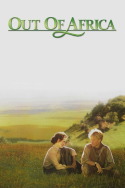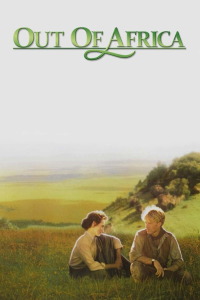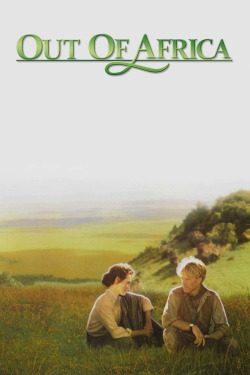
Review of Out of Africa (1985) by Shawne ~ — 30 Aug 2008
I suspect that [b]Out Of Africa[/b] is one of those films that has earned a classic status on the basis of its pedigree rather than an objective evaluation of the film's merits: come on, how could a movie directed by Sydney Pollack and starring modern film legends Robert Redford and Meryl Streep [i]not[/i] be a classic? So, in a sense, the years that have passed since the film's release - 23, to be precise - have been kind in bestowing upon the film a rosy glow of nostalgia and general acclaim. Unfortunately, the years that have passed also show the movie up to be what it really is... a melodramatic, moody soap opera set in the windswept plains of Africa, dripping with elegaic romance and sombre self-reflection on the part of characters who are essentially colonialists making a life for themselves among a people they do not understand. Perhaps it's because movie audiences these days are used to something a little more fast-paced; even costume dramas boil these days with a fervour and pace that, say, huge epics like [i]Gone With The Wind[/i] never did. [b]OoA[/b] is very much a movie in that tradition - and unfortunately, wasn't very successful in reviving interest in such glacially-paced, knowingly worthy costume drama (beyond the mainstay Merchant Ivory production line, that is).
In the early 20th century, Dutch heiress Karen Blixen (Streep) - when she realises that she will not, after all, come into her inheritance and thus has no real power - seeks a way out of a cosseted life and marries Hans (Klaus Maria Brandauer) out of convenience and mutual benefit rather than true love. She moves with him to Kenya where he is set on establishing a coffee plantation and she tries to acclimatise to the unfamiliar territory and people - a familiarity and intimacy she cannot find with Hans, though not for want of trying. Then Karen meets the free-spirited Denys (Redford), a big game hunter whose life on the plains and among the African wildlife opens her eyes to a spontaneity she has never known... and a love she's not sure can be sustained away from the thrill of the wild and the hunt.
There is a lot in [b]OoA[/b] to appreciate - the film is a smart, studied look at the position of the white man (in this case, white woman) in colonial Africa. The class and gender system against which Karen must struggle to do right by her plantation workers is a thoughtful sideline to the romantic meanderings of the plot, as are Karen's attempts when she first arrives in Africa to first familiarise herself with her new surroundings and then to master them. The central romance in the film is also beautifully drawn out in a safari that Denys convinces Karen to take with him - never has there been a sexier moment of connection that involves little more than shampoo and wet hair.
It is on this trip that the two main characters test each other's boundaries and learn each other, and although slow-paced, it benefits greatly from - of course - the casting. Streep and Redford have a striking, powerful chemistry that underlies their dialogue: which is essential, really, since for the most part, the dialogue is sparse and not particularly memorable. Streep artfully smoothes away Karen's harder edges as the show progresses, so that her loneliness and vulnerability shine through the determined facade she presents to her husband and workers alike. Redford, meanwhile, wears a rakish grin as if he were born to it, and lends Denys an air of solemnity and genuine love for his environment and life that transcends frivolity. You can [i]believe[/i], fortunately, that these two people grow to love each other in a desperate way, even if this desperation is always kept simmering just under the surface, barely detectable on their faces and in their words - even when they have already consummated their relationship.
Unfortunately, the film is genuinely far too long for its own good: at 150 minutes, the story moves at a deliberately measured pace, so slowly that you can't really be blamed for drifting off at points in the film. Moments of genuine tension are rare: Karen's brief encounter with a wild lion (much funnier as retold by Streep years later) and an unusually lively New Year's sequence are brief splashes of bright bright colour amidst a generally muted palette. In the end, for all of Streep and Redford's skill and chemistry, the love story at the heart of the film also loses some of its emotional impact for the tepid way in which it plays out.
[b]OoA[/b] is certainly a worthy film, if ever there was one - it's a mature love story, weighted down even further by themes of colonialism and white (wo)man's guilt that would probably put off film-goers weaned on punchy, slapstick satire. And of course, the film is old-fashioned as they come: so if this is your kind of thing, you will love it. Otherwise, it's probably more likely that you will admire the whole enterprise and appreciate the sentiment behind it. Streep and Redford's romance, too, will have charmed you in a way you had never expected by the film's denouement. But will you come away from this film professing it as an unmitigated classic? On that count, at least, I have my doubts.
This review of Out of Africa (1985) was written by Shawne ~ on 30 Aug 2008.
Out of Africa has generally received positive reviews.
Was this review helpful?