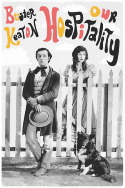
Review of Our Hospitality (1923) by Edith N — 21 Jan 2013
Really, the Framing Device Isn't the Point.
Buster Keaton nearly died on any number of occasions, if you read the trivia about making his movies. This is because he did his own stunts, and he relied on making the story as impressive as possible by dangling of cliffs or buildings, or floating down rivers, or whatever else he deemed visually interesting and at least theoretically relevant to the plot. Even without being the same kind of crazed perfectionist Charlie Chaplin was, he risked a fair amount during the making of his films. Indeed, he is one of the three members of the triumvirate of Great Silent Film Comedians, along with Chaplin and Harold Lloyd. Unfortunately, since I tend to prefer wordplay with my comedy, I don't have that much of an interest in Great Silent Film Comedians, though I certainly appreciate the artistry involved. I also find it impressive how much Keaton risked for his craft, even if I don't always care about the results.
The plot here doesn't much matter, but we'll describe it anyway. In the long-ago South, feuds were just a thing that happened. In particular, we are here dealing with the feud between the McKay and Canfield families. One stormy night, John McKay (Edward Coxen) and James Canfield (Tom London) kill each other. McKay's wife (Jean Dumas) takes her son, the last of the McKays, to her sister's place in New York, where she dies and he grows up to become Buster Keaton. One day, he receives a letter telling him to come home and claim his inheritance. On the train South, he meets a lovely young woman (Natalie Talmadge), who of course turns out to be the daughter of Joseph Canfield (Joe Roberts). Joseph had wanted to end the feud until his brother was killed, but now, he considers it the family's sworn duty to kill Willie McKay. At first, they can't because he is a guest in their home, and that would violate hospitality. And then, things just get silly.
I will say that the recreation of the historical train is fairly impressive, but the scenes on it go on far too long. We get the First Hobo hitching a ride under one of the cars, a wacky joke about how soot looks like blackface, a play on the fact that the tracks aren't fastened in place the way they later would be, and so forth. And most of it is at least moderately amusing, but really only moderately so. It also has little or nothing to do with the story. I suppose it's one of the hazards of silent comedy; we can't really show Willie and the girl (of course she never gets a name) getting to know one another, because that would be a lot of boring title cards. So instead, we pad with whimsy. As I said, it's to do with why I'm not a huge fan of silent comedy over all. Some of the sight gags, in this scene and elsewhere, did genuinely make me laugh, but I also laughed when I was reading possibly more than was meant to be there out of one of the title cards.
It seems odd, I know, to speak of padding in such short films, but I've done it before and with even better cause. (Ed Wood, I'm looking at you!) However, the plot and the shenanigans of this movie never quite seem to come together. There's the funny running gag of Willie's shooting off the gun of Whichever Canfield Son It Is every time he gets the chance (the movie is set long enough ago so that the first step to reloading is pulling out his powder flask), and that actually ties into the plot. But the most impressive part of the film is a lengthy sequence involving Willie's floating down a river with a rope tied around his middle, and it doesn't have much to do with the story. I mean, there's the obvious fact that it was filmed in the mountains of California, not anywhere that even really looks Southern, but there's also the fact that it doesn't move the story along. It's yet another place where the story grinds to a halt. It's impressive, and even entertaining, but it doesn't have anything to do with anything.
Another thing which bothered me is frankly not the fault of the movie. It's Kino again--well, most silent movies available on DVD are available from Kino and no one else. Even Criterion doesn't release many. This particular disc also comes with [i]Sherlock Jr.[/i], an okay film that I didn't consider worth reviewing. So it is only here that I will note that [i]its[/i] score, written in 1993, includes a play on the Bond theme. There is another place where it uses instruments that did not yet exist in 1924. I know this is fiddly of me, but it really bothers me about the Kino releases. The scores often sound to have been recorded on someone's Casio keyboard. It's silly, given that it can't be all that expensive to just use a piano. Most of these movies would have had scores written for them, though I admit not all of them. To be honest, I'm not entirely sure how you'd check on that. But either way, it wouldn't be difficult to reproduce the kind of score that actually would have been used, and Kino seldom seems interested.
This review of Our Hospitality (1923) was written by Edith N on 21 Jan 2013.
Our Hospitality has generally received very positive reviews.
Was this review helpful?