Review of One Hour with You (1932) by Edith N — 22 Nov 2012
How Is It the "Dearest Friend" Always Misses the Wedding?
There is a rule in this time of comedy that the woman has to trust the woman who will come to attempt to break up her marriage. She must trust the woman completely. She must see nothing wrong with her husband spending hours around the other woman unsupervised. It must come as a great shock to her that anything might ever happen between them--not just that her husband would betray her but that her friend would betray her. That's fine. I have lots of friends who would never consider making a play for Graham, whether they're attracted to him or not, because he and I are in a relationship. However, this beloved, trusted friend must always be someone with whom the husband is unfamiliar. I introduced Graham to my best friends long before I introduced him to anyone in my family. Yet somehow, this "dearest friend" must always be someone who hasn't been in the picture, even if they live in the same city.
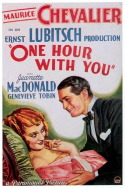
In this case, the loving couple is Dr. Andre Bertier (Maurice Chevalier) and his wife, Colette (Jeanette MacDonald). They have that calm congenial kind of French marriage that is only acceptable because this is a pre-Code film. (Heck, they share a bed!) He's madly in love with her, but that doesn't stop him from being aware that Paris is full of lovely women. It stops him from doing anything about it, but these are the sacrifices we make for those we love, [i]n'est-ce pas[/i]? And then one day, she invites her dear friend Mitzi Olivier (Genevieve Tobin) over for lunch. Mitzi is having difficulties with her own husband, Adolph (Charles Ruggles), so she decides to make things difficult for men in general, or at least that's how it appears. She does seem to take a genuine interest in Andre, however, and regardless of her friendship with Colette, she decides that she will seduce him. Andre, in turn, falls for Colette.
Oh, if Andre actually slept with Mitzi, that would be awful of him. It just isn't right. On the other hand, it's pretty low of Mitzi to go after him so determinedly in the first place. Andre also knows that it probably won't do a lick of good to tell Colette what's going on. She doesn't want to know anything bad about her friend. There's a distinct implication that she wouldn't believe Andre if he did tell her. She would probably accuse him of blowing things out of proportion. It's a little harmless flirting, and he's trying to make it seem like she's, oh, lying in wait for him in the garden or something! This attitude largely seems to me based on the fact that Colette doesn't appear to have seen her dear old school chum in some years, and she just remembers her as an innocent girl. Then again, when she's catching up with Mitzi, it also involves going over a list of men, and the only one still in her life is her husband. So I suppose it shouldn't be all that much of a surprise at that.
I have no real problem with Andre's attitude toward women in general, however. Like most Chevalier characters, he loves them all. He loves Colette in particular more than women in general, but he still does love women in general. When Mitzi hits on him before either of them know who the other is, he's polite, but he's blunt about being married. She's attractive, he's taken, and that's all there is to be said. I would imagine some women would be displeased at Andre's appreciation for female beauty, but I don't think they have any reason to be. Not only does he really love Colette, he doesn't want to come between her and her best friend. He makes it clear that he doesn't want to spend time with her, but he implies that it's just because he doesn't like her. He makes it a problem with him, not a problem with her. It's really chivalrous of him, though I don't think Colette or Mitzi would see it that way. Paris is full of beautiful women, but as long as he's married and everyone respects that, why not look?
The pre-Code era lasted a few years beyond this, but Ernst Lubitsch was with this movie pretty much done with sex comedies. It's worth noting that this film was described in the credits as "with the assistance" of George Cukor, who would become one of the major directors in Hollywood for the next few decades, with [i]his[/i] last really great picture being [i]My Fair Lady[/i] in 1962. Cukor would become known as a "woman's director," but the women in his movies were seldom as open in their sexuality as the women in Lubitsch films. Eliza Doolittle has a moment, but only a moment. He briefly worked on [i]Gone With the Wind[/i]--as indeed who did not?--but Scarlett, too, is mostly ashamed of being interested in sex. Paula Alquist of [i]Gaslight[/i] is an innocent. Tracy Lord was accused of being a goddess, and surely part of that was chastity. The Bonners loved each other in [i]Adam's Rib[/i], but Amanda Bonner is in many ways an anomaly. There just wasn't a place for Lubitsch-style women in Cukor-era Hollywood.
This review of One Hour with You (1932) was written by Edith N on 22 Nov 2012.
One Hour with You has generally received positive reviews.
Was this review helpful?