Review of One Flew Over the Cuckoo's Nest (1975) by Cinefiles — 28 Apr 2015
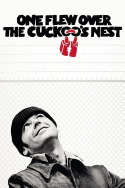
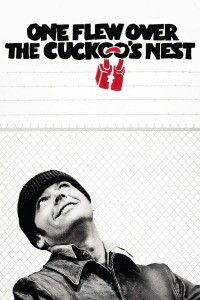
Arguably, some of the issues addressed by One Flew Over the Cuckoo's Nest are not as relevant in 2006 as they were in the mid-1970s, but that realization in no way diminishes the film's dramatic impact. This was the second English language film for Czech-born filmmaker Milos Forman, who would go on to win two Oscars (one for this movie and one for Amadeus), and was the picture that catapulted him onto the A-list for directors. The negative aspects of mental health care impugned by One Flew Over the Cuckoo's Nest are largely no longer in place today (electroconvulsive therapy is rarely used, frontal lobotomies are not performed), but the film's other themes are germane. On the surface, the movie is about the struggle of wills between patient R.P. McMurphy (Jack Nicholson) and Nurse Ratched (Louise Fletcher). Beneath the surface, it's about the attempts of an autocratic force to squash the individual.
Jail is a frequent residence for McMurphy, whose latest conviction is for statutory rape. Rather than spending time behind bars, he decides it might be easier to serve his time in a psychiatric hospital, so he "plays mad." The plan works, but McMurphy soon discovers that life isn't so great in an asylum. The rules are looser, but some of the privileges he associated with prison - like being able to watch the World Series on TV - do not apply. Undaunted, McMurphy begins to make himself the most popular man in the ward, appealing to types as diverse as the diminutive, talkative Martini (Danny DeVito) and the tall deaf-mute American Indian, who is known as "The Chief" (Will Sampson). There to thwart McMurphy at every turn is Nurse Ratched, whose methods of treatment are so proscribed by rules and regulations that she can't see she's sometimes doing more harm than good.
The most evident conflict throughout One Flew Over the Cuckoo's Nest is that between Ratched and McMurphy. They are natural antagonists. She's a strait-laced, by the book individual and he's a freespirit and rule breaker who pushes the envelope at every opportunity. (The reason he's in prison is evidence of that - having sex with a 15-year old.) For much of the film, they probe one another, each winning minor skirmishes. As the narrative accelerates toward its conclusion, McMurphy risks all in a final gambit. When he loses, we know it's over for him. For all that she is the film's villain, Ratched is not inherently malevolent. She's cool and unemotional, but she believes what she is doing is for the betterment of the patients. She's one of those individuals who does bad things while thinking she's doing good. That makes her more complex and interesting than a character who represents evil incarnate.
The film's ending is unsurprisingly its strongest aspect. McMurphy's fate, presented in such an uncompromising manner, is like a punch to the gut, and the last true act of friendship shown to him by Chief brings a tear to the eye. The final scene is meant to be cathartic, but it doesn't seem that way. Although it's accurate to say that freedom has been attained by both Chief and McMurphy (albeit in different ways), it's hard to see the conclusion as anything but a cloud with a silver lining. For a film that is inspiring and upbeat for most of its running length, this change in tone leaves the viewer disoriented.
Ken Kesey, who wrote the book upon which the 1963 Broadway play and the subsequent movie were based, was displeased with the screenplay credited to Bo Goldman and Lawrence Hauben (Milos Forman also had a hand in writing it). He felt it detoured too far from what he had written, and refused to participate in publicizing the finished product. Nevertheless, One Flew Over the Cuckoo's Nest became one of the most celebrated movies of the 1970s, winning the "Big Five" Academy Awards (Actor, Actress, Director, Picture, and Screenplay) and being nominated for an additional four. Although the picture has not aged as well as some of its contemporaries, its themes remain germane, the story has lost none of its punch, and the performances retain their freshness. Viewed 30 years after its release, One Flew Over the Cuckoo's Nest remains a very good motion picture, although one that perhaps just misses the pinnacle of greatness where its reputation suggests it resides.
This review of One Flew Over the Cuckoo's Nest (1975) was written by Cinefiles on 28 Apr 2015.
One Flew Over the Cuckoo's Nest has generally received very positive reviews.
Was this review helpful?