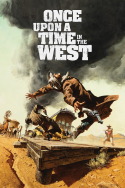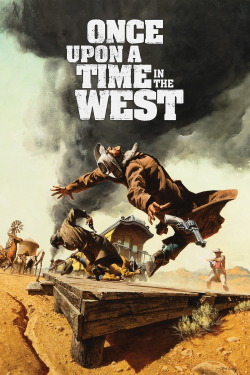
Review of Once Upon a Time in the West (1968) by Thomas G — 15 Feb 2010
Violence can sometimes be the weakest theme you can use in a film. Sometimes it can be the greatest element in a film. Filmmakers can exploit it, and use it to oblivion like Michael Bay or Roland Emmerich. Then you have people like Sergio Leone. He is a man that seems to be more concerned with the mood and tensions that potential violence can bring, not with the act of the violence itself. It is obvious to see where Quentin Tarantinoâ??s inspiration comes from, or where the Coen brothers discovered the tactic of leaving most of their climactic bloodshed off screen in their best picture winner No Country for Old Men. The opening credits are a dead giveaway to what you are in store for with Once Upon a Time in the West. Three men wait around for a train, scratching their heads, staring into space, playing around with a buzzing fly, etc. Harmonica (Bronson) comes in, and the shootout, if you want to call it that, is fast and swift. Standing at a whopping 2 hours and 45 minutes, Once Upon a Time in the West is a film requiring a certain type of taste and patience. Do not expect action; do not expect the story to spill its guts right away. Leone is working methodically here, flirting with self indulgence like all great minds, but nevertheless crafting a spaghetti western that never fails to pay ode to the ordinary man of old.
The setting is Flagstone, a fictional town in the American Old West. The film displays two central conflicts that intersect with one another. In one story you have a man named Brett McBain (Frank Wolff), the owner of Sweetwater, a land that contains the regions only source of water supply. Morton (Gabriele Ferzetti) discovers this and quickly hires Frank (Henry Fonda, playing against character type) to kill the man and his family in order to acquire the precious territory. Brettâ??s new wife, Jill, played by the lovely Claudia Cardinale, comes into town shortly after the massacre. She is now the official owner of the land. Moreover, you have a lone gunman nicknamed Harmonica (Charles Bronson) and a renegade bandit Cheyenne (Jason Robards) who find a common enemy in the form of Frank. Both seem to have their own agendas, but collaborate with Jill to conspire against Frank.
What you have here is your standard plot for any old throw back western. Leoneâ??s characters betray one another throughout the epic, and each of them has a history that pertains to the story at hand. Jill is captured by Frank and begins to use her sexual tendencies to withdraw herself from capture. Frank begins to take a liking and makes a deal with Jill rather than with Morton. This action captures the timeless theme of greed. Sure it is a common one but is effective enough here to warrant being called anything other than ordinary. You begin to feel like this same greed fate will bestow on Harmonica, what with a betrayal of his own and such. Leoneâ??s work here is usually praised for its visual style, which I will get to shortly, but I think one of the elements not appreciated enough is his storytelling. At first it is a tad frustrating. You are not sure what to make of characters like Harmonica, who at one time roughs up the innocent Jill. On the other hand, you have Chyenne, a dirty, broken down man who orders Jill to â??make coffeeâ?? upon his first arrival in her house. Little by little Leone lifts the blindfold covering our eyes. It is deliberate, but pays off in wonderful ways.
The cinematography here is simply outstanding. You have withering shots of the barren desert landscape, close ups on certain characterâ??s faces giving off the most powerful of emotions. But its Leoneâ??s greatest achievement in interlocking the barren mood of his setting with these long, stretched out cinematic stills that engross viewers, especially ones who are in love with this kind of art in film. Most of the time this experiment works, helped out from the perfect score from Ennio Morricone, but other times it is less effective, resulting in a minor flaw too apparent to not mention. This plays similarly to another western classic titled High Noon. In that Gary Cooper vehicle, director Fred Zinnemann spends nearly all of the screen time building suspense and crafting his theme of the ordinary, lonely man. No real action occurs until the very end. Most critics find a high when watching these long, drawn out art scenes. I usually do too, but in both Leone and Zinnemannâ??s film, there were at least two moments where I found myself uninvolved with the sequence created, more concerned with what will happen next rather than what is happening at that very instant.
On the contrary, there is some sublime performances streaming throughout this production, and one cannot overlook the wonderful talents put forth. I am unsure if this is my favorite performance because it is my favorite character, but I was usually glued the screen when Charles Bronson was center stage. Harmonica is at the epicenter of Leoneâ??s message; the dying breed of the old school hero. Bronson breaths mystery and ambiguity into this character, portraying a man without emotion, only interested in soothing the deep and dark burdens he carries in his face day by day and night by night. Henry Fonda, whose resume included up to this point playing the â??goodâ?? guy, much like the way Denzel Washington broke routine and played a villain in Training Day, is forceful and an animal as Frank. Claudia Cardinale is adequate playing what I think is both an eye candy role as Jill, and a symbol for oppressed women in the west. Again, although it is not a rare undercurrent, it is successful all the same. Finally, Jason Robards is solid enough as the wanted bandit Cheyenne, tuning into the scriptâ??s appreciated sprinkles of humor.
Standing back and looking at this film on the whole, I cannot really find myself calling it the masterpiece everyone else seems to be marking it as. However, nor will I ever call that remark a hyperbole of any kind. Leone has crafted an exceptionally well suited tribute to Hollywood westerns with Once Upon a Time in the West. Recognizing the filmâ??s various themes and motifs, the railroads for a passing of a time and water for bringing that passing of a time a right to live in the first place, Leone has undeniably created a triumph of codes and honor among men. However, unlike classic westerns I love, such as Butch Cassidy and the Sundance Kid, Unforgiven, and to a lesser extent, James Mangoldâ??s take on 3:10 to Yuma, Once Upon a Time in the West never struck that hidden emotional chord it needed to strike. However, as Jill supplies water to the rail workers and Harmonica rides off into the sunset, we feel a sense of goodbye. Goodbye to not only the man strong enough to stand up for his own honor, but to a past time where a man was able to simply dig in, gun holster ready, and face his enemy face to face. As Frank learns towards his ending tenure, dignity does indeed go a long way.
This review of Once Upon a Time in the West (1968) was written by Thomas G on 15 Feb 2010.
Once Upon a Time in the West has generally received very positive reviews.
Was this review helpful?