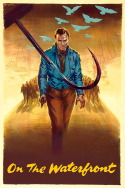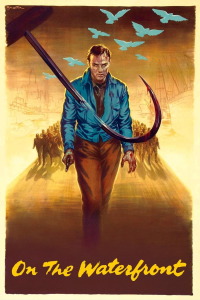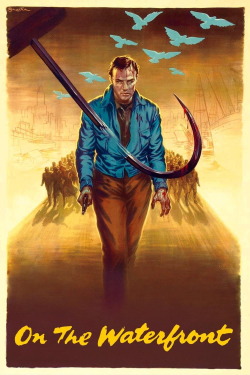
Review of On the Waterfront (1954) by Cameron J — 24 Mar 2013
"Get in, get out, of the rain, I'm goin' to move on up to the Waterfront!" Hey, it could be worse, I could reference "Down On the Corner", or rather, "Down On the Waterfront", which wouldn't fit, because these poor and beaten union workers aren't quite as spirited as Willie and the Poor Boys, seeing as how the times portrayed in this film were so tough that this film features two of the "12 Angry Men". Actually, maybe that's not the best testament to the weight of this film's subject matter, because I doubt that anyone who was working on this film was all that angry, seeing as how the only 12 things that fell upon this film were Oscar nominations. I know that Elia Kazan must have been mighty happy, because around this time, he was in some serious trouble with people in the film industry, just because he did some little thing like, well, falsely sell out many of his friends and colleagues as communists during the Red Scare. Hey, Kazan may have been a total jerk, but he sure knew how to make some good film, and I reckon that means that he must have been getting about as many directorial tips from Marlon Brando as Brando was getting directorial tips from him, because Brando was so far along the edge that I think that I probably should count again after stating that there are only two of the "12 Angry Men" in this film. That film does seem like the kind that Brando would be in, and if he was there the final product would have been much tighter, because all you need to do to settle a jury debate is have Brando toss down his opinion, then everyone would agree, for you do not say no to Brando, partially because he might end up collecting twice his salary and leaving the project on the spot. Like I said, he wasn't exactly the nicest dude to work with, but he sure could carry a good film, like this one, though not so much so that you could completely look through issues, of which, there is a quite a bit in this effort.
There's plenty of meat to this drama, especially for 1954, being just fleshed out enough for you to gain a fairly firm grip on the depths of this story and its characters, and yet, with that said, I can't help but feel as though this film should have spent a bit more time cooking things up, at least enough for your investment to go reinforced to the point of obscuring the near-glaring conventionalism that taints more than a few spots within this generally refreshing film. At the very least, more time spent meditating upon the depths of storytelling would have helped in softening the quantity of hurried spots in this plot's structure, because at just under 110 minutes, this conceptually quite layered drama is very rarely a bit too swift in its flow, and never too hurried when it does, in fact, get carried away with conciseness in development, sometimes to an offputting point that momentarily disengages, though not quite as much as the moments that hardly feel frantic. Like the hurried spots, this film's slow spots never go so far as to be all-out dull, but when momentum slows down and atmosphere dries up, quite a bit of blandness enues, choking up kick within resonance, and leaving you vulnerable to slipping out of the final product, at least for a few moments. The pacing issues within this film, by their own individual rights, stand to be more problematic, but stand they do, and just firmly enough to spark a kind of inconsistency in pacing that leaves storytelling to get a bit repetitious after a while, and lose a bit of its kick, of which there is only so much even when you don't take pacing issues into considering, seeing as how, during this film's era, you could only go so long with effective genuineness before losing a bit of grit. The film was a bit ahead of its time, and boasts plenty of aspects that remain compelling to this day, yet there are still some issues with resonance, whether they be seen through the occasional subtlety lapse, or through a consistent degree of superficiality that was distinctly 1950s. There's most certainly not enough of this superficiality for the final product to fall flat as barely compelling, and decidedly underwhelming, but there are indeed subtlety issues to go with pacing issues and, to a certain degree, exposition issues, thus making a film that may be well-executed enough to reward, but hands on the hinges of underwhelmingness. Of course, slips through these hinges and underwhelming don't come into play enough to make the final product underwhelming on the whole, for although this films has quite a few flaws, - however limited in quantity they may be - it has enough going for its impress dramatically, or at least visually.
Speaking of 1950s limitations, we're talking about a film that's too black-and-white, and too backed by improvable photographic technology, for its own good, so it's not like we're looking at a visually stunning film, or even something along the lines of "Citizen Kane", but through all of their shortcomings, the tastes of cinematographer Boris Kaufman (Jeez, the guys who made "12 Angry Men" must have been big fans of this film), whose lushly clever plays with lighting absorb about as much crisp detail as you can gather from a film this under-colored, especially when the black-and-white limitations of this film's visual style are actually put to get use to compliment grit, often in something of a noirish fashion. Kaufman's efforts catch your eyes time and again, as surely as Leonard Bernstein's efforts catch your ears time and again, for although what follows an upstanding opening track is a collection of mostly rather conventional musical pieces that don't quite live up to the sweep that starts this show out with a bang, Bernstein's score is consistently commendable, if not rather beautiful, boasting enough subtle, but graceful spirit to color up entertainment value, if not compliment the soul of this film's substance value. Artistic touches like Kaufman's cinematography and Bernstein's score are, at this point, not too much better than not really all that worth writing home about, but the reasonably distinsuished visual and musical stylistic choices that help in defining this film color up the final product's atmosphere in a fashion that helps you in further gaining a grip on the vaue within this film's subject matter. In execution, this film's story concepts don't entirely recieve the meaty justice that they deserve, even though they're actually not all that terribly weighty on paper, but the subject matter behind this drama is undeniably worthwhile, especially when it is, in fact, brought quite well to life by quite a few offscreen talents, especially director Elia Kazan, whose direction isn't all that strong, but still sharp enough to grace this film with an audacity and gritty range that was seldom seen at this time. Sure, the film's dramatic aspects have their shortcomings, being faced with plenty of limitations, as well as plenty of more consequential issues, but when it's all said and done, the final product doesn't quite fall through to underwhelming, being padded as rewarding by inspired storytelling, as well as, of course, inspired acting. I won't go so far as to call the acting in this film absolutely upstanding on a general standard, but for this time, we were looking at some pretty influential performances, which still stand as commendable to this day, with Marlon Brando being particularly compelling, delivering on an assured and layered presence that defines the Terry Malloy as a flawed and mysterious, yet ultimately human force. As you watch Brando gradually evolve his role, you'd be hard pressed to not be engaged, perhaps even thoroughly, and while not everything about this drama is as compelling as Brando's performance, which, even then, feels a bit underwritten in certain places, natural and consequential shortcomings go battled back just enough for the film to stand as flawed, but crafted with enough compelling confidence to compel.
Overall, thin spots in development leave you to meditate upon the conventional areas in this film's storytelling, while uneven pacing that is much too often bookended by spots that are either too hurried or too slow leaves repetition to set in and do damage to resonance, which is further tainted by subtlety issues that could barely be helped at the time, but still stand firmly enough to almost drive the final product into the underwhelmingness that just can't quite obscure what is done right in this ambition film, which boasts enough attractive sharpness in its photography and score, and inspiration in its direction and acting to color up worthy subject matter that makes "On the Waterfront" a once-refreshing and still-compelling dramatic thriller.
3/5 - Good.
This review of On the Waterfront (1954) was written by Cameron J on 24 Mar 2013.
On the Waterfront has generally received very positive reviews.
Was this review helpful?