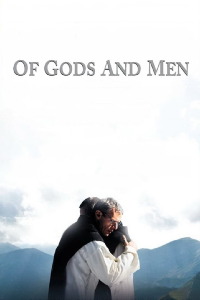
Review of Of Gods and Men (2010) by Lynda B — 25 Feb 2011
3.5 Stars out of 4.
War is always a wage on values. Same goes for the scenario in Of Gods And Men, about 9 Trappist monks caught between their allegiance to God and the safety of themselves in war torn Algeria. The year is 1996 and Islamic fundamentalists are trying to impeach the FNL government. The monks, led by Christian (Lambert Wilson, the Frenchman from The Matrix Reloaded) coordinates daily eucharists and congregations for them to be dutiful to the almighty.
But the Civil War comes closer, putting each monk under pressure. French director Xavier Beauvois (The Chameleon) takes time to gather the points of view of all the monks, to emphasize these Trappists as a brotherhood not despotic. Christian realizes quickly that he cannot make the final decision because everyone relies on each other, and no matter what, they stick together. Of Gods And Men is primarily about keeping religious values in check while confronted by an event losing its own.
These monks are of great variety. Some are funny, some talk often, and some just stare - in particular the amiable Amédée (Jacques Herlin). These monks do not just worship as angels, but work in the outer world, move about their village and maintain the garden to their monastery. This monastery represents so much for this village. It is like its pantheon, symbolizing security and peace. Algeria cannot provide those two at the time, so this monastery is like this untouchable.
Well, until the monks are accosted by Islam terrorists, who apologize for their incursion on the monastery on Christmas. An ironic scene on the power of values. Violence is pertinent, but not in Christ's wake.
Of Gods And Men is told with a patient build, a steadily gliding camera, and the dialogue is conveyed with much silence. This makes sense because Trappists draw a vow of silence when they are initiated. The film though is very suspenseful and dramatizes with an intonate pitch, and is emotionally unraveling. The reason Beauvois immerses us so greatly is the film's incredible ability in making these monks not evangelists but men. The tragedy is they become religiously indoctrinated in order to enhance their spirit and state of living, but are forced under the circumstances that only offer death.
The gruelling option is either: stay with God and perish or flee like renegades in the night.
All these performances are very strong. Each monk represents thoughts, nuances, and fears of his own, and to manifest this, Beauvois has an excellent scene where he gathers all the monks around their table and gives each and every one a closeup where he can express his opinion on whether to remain at the monastery or not. Some of them want to, others do not - but they are for all different, complex reasons.
Of Gods And Men was filmed in Morocco at a 40 year-old Benedictine monastery. The crew spent weeks rebuilding and renovating it in order to give it an authentic, less emaciated look. This is important if Beauvois wants to employ the idea of the monks living a calm, assuring religious life fortuitously disassembled by forces outside of God's hands.
It takes Of Gods And Men a bit to warm up to. For a short bit, the film is conventionally paced and rather tediously driven. Especially in its opening twenty minutes, when Beauvois's shots ruminate along the landscape and only subtly penetrate the characters. This was all build up for the film's dramatic, melancholic yet oddly beautiful crescendo where Christ becomes evanescent and suffering interminable. There is even a dangerously symbolic moment when the monastic doctor Luc (Michael Lonsdale) presses against a painting of Christ's bosom, as if listening for a heartbeat. Luc was known to use a stethoscope.
But the film is riveting. When the monks poignantly sit savouring a Last Supper, weak tears trickle down their chins, and a stereo plays a plaintive song that might sound uncannily familiar. Beauvois gives the monks equal attention by pushing in to intense Dreyer-esque closeups of their woeful faces, with the camera positioned differently in all, placing each monk in his own world and state of ruefulness.
The last shot of the film is transcendental (minor spoiler): we observe the monks walk through a blizzard and into, as signified by a long shot, an uncharted space of oblivion. Perhaps Heaven. We know these monks were exterminated, as a response to the FLN's hostage exchanging with the Islamists. I admired how Beauvois avoided a brutal beheading, shrewdly ignored pay off, and created a euphemism of such an unjust tragedy.
This was a film meant for Martin Scorsese. Of Gods And Men brings so much relevance and authenticity to these monks, that their religious allegiance is only secondary to their true character. Scorsese would love Beauvois's ability to humanize the ethereal and show tender appreciation for the crisis in trying to not be a sinner in a sinner's world. These are characters whose realities interject their religious reveries, and must spend most of the film putting their existence and values on a pedestal. This Mean Streets director would be wowed.
I was mostly. After watching Of Gods And Men, I felt totally fulfilled. It is not quite a masterpiece, but for once a film explains the life of religious characters not through their perfections, way of worship, or god-like passions, but their humanity. This is a humanist movie. I understood the culture of these men, who just happened to value an ethereal being. God was their comfort and gave them courage through tribulation. This is a great story of devotion to a belief and a brotherhood. We all, religious or not, can embrace that.
This review of Of Gods and Men (2010) was written by Lynda B on 25 Feb 2011.
Of Gods and Men has generally received positive reviews.
Was this review helpful?