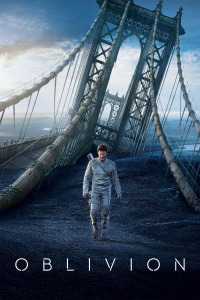
Review of Oblivion (2013) by Jacob G — 06 Oct 2014
Oblivion is a slow wheeze of a movie, painting textures of things that don't really need painted, while expecting audiences to accept things just because they say so.
And it all just sort of drifts by, slowly adding little details, little bits of tension, little bits of this and that, but none of it quite feels enough.
At least Oblivion is beautiful on-screen and even though the little bits of this and that feel too little, what is there feels interesting and like we want to know more.
The biggest mistake Oblivion makes is building a decent viewer rapport between Cruise and Riseborough, his "wife"/"co-worker" teammate in this only-two-humans-on-the-planet scenario. Their relationship is an interesting one, fractured and imperfect, but engaging as she keeps to the company line and Cruise views himself something of a loose cannon.
But then, the event predicted from the first scene: Cruise's character re-encounters his old wife, someone a glimmer of a memory that had been wiped years ago. Suddenly the film dynamic changes. Less loyalty towards Riseborough's character, more interest in Kurylenko character.
And this would be totally fine if Cruise and Kurylenko had any kind of rapport on screen. But they don't. Kurylenko's character doesn't exist to be her own character, she exists for how she adds to the plot that Cruise finds himself in. That is to say, from the very first flashback in that very first dream-heavy scene, Kurylenko's purpose is not to be a character, but to drive Cruise towards the desired outcome.
It's no surprise, then, that their on-screen chemistry is poor. At least the filmmakers recognized this and kept her screen time to a minimum. (That's right, the game-changing love interest has her screen time limited; that says all you need to know about this movie.).
Kurylenko isn't the only female character that is given the shaft here. The first half of the movie is all about the aforementioned Riseborough. She is actually given texture as a character and someone near to Cruise. There's that snap, crackle, and pop when she's on-screen. The greatest disservice to her character isn't so much that she gets dropped by Cruise the second he has an alternative (granted, an alternative he had already been married to), but that her character almost completely drops out of the movie in the second half.
It's not that both halves of a movie need to snap with a specific character, but it's really ideal if either the second half is weighted that direction, or that character isn't dropped like a hot potato the second her plot-crucial role is over.
This review of Oblivion (2013) was written by Jacob G on 06 Oct 2014.
Oblivion has generally received positive reviews.
Was this review helpful?