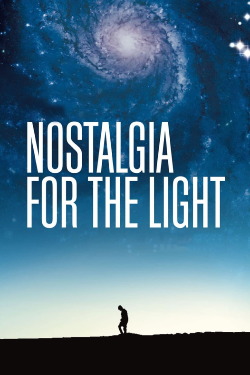
Review of Nostalgia for the Light (2010) by Lisa D — 22 Oct 2012
A Desert at the Edge of Time.
Yes, okay, this is the second movie I've reviewed in a week that involves knowing something about the dark history of South America of the twentieth century. However, is that wrong? Should we have such an isolated, insulated view of history that we don't know what happened in our own hemisphere in our own lifetimes? (Those of you under twenty are somewhat excused!) It's not quite so bad as when I had to explain to someone who had lived in the United States for his entire life what McCarthyism is, but I do feel that we as a nation would be better served by paying a little attention to what goes on around us. And this is, of course, leaving out discussion of complicity in the various coups and civil wars. Certainly I think more people should know what role the CIA had in destabilizing many of the governments to our south, simply because we were afraid of a Communist foothold in Latin America.
The Atacama Desert is the driest place in the world. The air is thin and still. This makes it an ideal place to conduct two different kinds of searches into the past. It is an ideal place for astronomy, which is looking into the past because of the speed of light--by the time you see the light, the thing which produced it has moved on. It is an ideal place for archaeology; the bodies of the dead mummify, and their artifacts do not decay as easily as they do elsewhere. The saltpeter mines are largely preserved--and, director Patricio Guzmán tells us, were also used as concentration camps during the regime of Augusto Pinochet. Prisoners in these camps spent some time looking at the stars, but then they were forbidden to; they might use astronomy to escape. Now, their relatives comb the desert for what remains of the Disappeared they might find. Astronomer Gaspar Galaz points out that the Chilean people are more comfortable looking into the distant past than the recent past, which they want to let go.
It must be tempting to wish the dead would stay dead. Vicky Saavedra and Violeta Berríos search the desert for the remains of their loved ones, because they want certainty. However, for those who do not have Disappeared friends or family, there is a rejection of any responsibility for those acts. One of the special features on the disc includes an interview with a military man, a man who was part of the coup, who claims he doesn't want to compare the pain of the tortured with the pain of the torturer but proceeds to pretty much do just that. He acknowledges that he was part of the coup, that he still believes it was the right thing to do, and there he sits, looking comfortable and well pleased with himself, agreeing that he was part of the whole thing. The problem with just wanting to move on is that you never quite address what caused the thing to happen in the first place. You also create a class of people who never saw their grievances addressed and might want to take matters into their own hands.
And yet the comparison to astronomy almost makes you wonder what the point is. In the desert, they are finding scraps of bone so small that they cannot say for sure what kind of bone some of them are; in the desert, they are tracing the calcium content of stars. Calcium is not a very high percentage of a star's makeup, but those traces of calcium are still greater than all the bones of all the people on Earth, much less those fragments in the desert. One of the former prisoners, Luís Henríquez, says that the time in the camp that he spent studying astronomy let him feel free, even as he was imprisoned. In the cosmic scheme of things, the imprisonment of a human body is nothing. The universe does not care. On the other hand, the Pinochet regime wasn't exactly fond of science, and the fact that it wasn't fond of foreigners, either, also hampered the amount of science done. Science, after all, is about cooperation, and the Pinochet regime wasn't big on that, either.
They are building a radio telescope, there in that dry place. It is to look at traces of the Big Bang. (In Spanish, "[i]Big Bang[/i].") Even just looking at the Sun is looking eight minutes into the past; looking at the more distant stars is looking farther and farther. The Big Bang was billions of years ago. The earliest remnants of humans in the Atacama Desert can be traced to ten thousand years ago or more. There are the remains of camps build over a hundred years ago. There are the scraps of bone from within a human lifetime. One of the women searching for her loved one is seventy; when she and those like her die, how much effort will be put into searching the desert sands for the remains of those who left so little trace of themselves? We are told that the remains of many of the Disappeared were just dropped into the sea; even if the sea had left traces, it cannot be searched. It can be argued that the present does not exist; in the Atacama Desert, we search many types of the past instead.
This review of Nostalgia for the Light (2010) was written by Lisa D on 22 Oct 2012.
Nostalgia for the Light has generally received very positive reviews.
Was this review helpful?