Review of Nosferatu (1922) by Daniel T — 07 Aug 2010
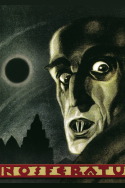
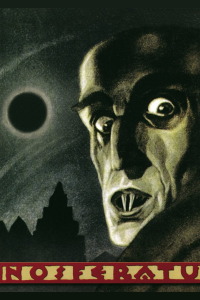
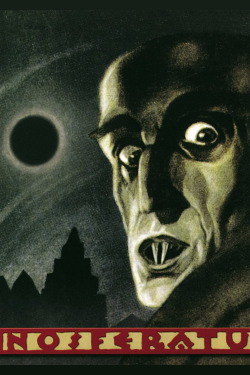
One of my earliest and most haunting memories was catching a glimpse of Nosferatu entering the bedchamber of his paralyzed female victim. The two protuberant white eyes gleaming in the darkness; sharp cheekbones threatening to rip apart the monster's skin; a long, sharp tooth poised in silent suspense. I was young then, and this vision jolted me with raw fear. But the horror was in the way he stood there, waiting. I could see his appetite etched into his face. I believed then that this was a real vampire before me. Not an actor. You can imagine the anguish.
"Nosferatu," directed by F.W. Murnau, was made in 1921. Yes, it is a very old film. If you are like me, then it usually takes a little effort and patience to put up with these silent dinosaurs of film antiquity. The film can be scratchy, the light too bright, and the acting quite jerky and over the top. "Nosferatu" has some of these moments, to be fair. But, it also claims perhaps the greatest and most frightening definition of the vampire as we know it. Contemporary films on the creature have replaced his grisly, bloodsucking nature with an emphasis on physical beauty and soapy drama. Here, I omit "Let The Right One In." That was an excellent modern take on the vampire, which brought the mythic terror back to its true macabre roots.
In many ways, "Nosferatu" reminded me of another great German film called "Aguirre, the Wrath of God". Both are technically "movies," but more accurately can be called hallucinatory plunges into nightmarish dreamscapes. The territory of the id, as Freud would point out. We see hills and blurry trees with strange men on carriages. Light obscures and splotches the diminutive figures. The character's lengthy voyages to and fro seem strangely circuitous. All of this churns and broils to a static atmosphere, held in limbo by that menacing mug of Nosferatu himself.
The story is about a man and his wife, both young lovers on the verge of a happy married life. The man, named Hutter, is eager to rise in the ranks of his profession as a courier/real estate/something and he is assigned by his superior, an eccentric named Knock, to negotiate a housing deal with Count Orlok, a wealthy man from another land.
Of course, as you can predict, Hutter makes the journey and it's no surprise that Orlok is, in fact, Dracula himself. Hutter finds this out soon enough when he cuts himself at dinner and Orlok basically licks his finger dry. What ensues is some very uncomfortable hospitality, a strange awakening, a frightening epiphany, and a suspenseful climax. Perhaps a little sexist in nature, the film is really about Orlok's attempts to sink his lusty fangs into Hutter's "beautiful" fiancee back home. I would say the story is not too original, but wait a second: this is 1921. It probably was THE original. Still, the whole thing's quite predictable.
There are some faults that my modernist persona can't overcome. First, there is no blood. No blood! We are talking about vampires here! Blood is their business! I understand the censorship this film must have had for the era, but any vampire film should have at bare minimum a trickle of red liquid. (Or dark liquid in a black/white film). All we ever see is two very faint punctures on the victims' necks. Perhaps Orlok likes to keep things clean. Still, though... no blood?
Second, the score is almost laughable at times when it shouldn't be. I don't even know if the original version even had a musical score, but the one I heard was too playful and too happy. Mainly consisting of upbeat chimes, the music really threatens to undo the stifling atmosphere the film works so hard to conjure.
However, it must be said that Orlok/Dracula, played by Max Schreck, is still mesmerizing and horrifying after all these years. Under heavy makeup, the actor gives a jarring performance that revels in the slow tension of Dracula's approach. Here, fast acting has no place. Schreck takes his time on the screen and he captivates us every second of it. Your eyes will be glued to the screen as his shadow makes the iconic ascendance up the staircase, clawed fingers extending in the silhouette. This is Freddy Krueger before Freddy Krueger was even born. There is also another scene in the final minutes that scared the bejeezus out of me. I am not even sure I saw what I saw, even after several rewinds. What I saw, or thought I saw, was a mirror. And in that mirror was supposed to be a reflection of a pretty woman. But what I saw was something else. Something monstrous. Demonic. And I never got an answer.
"Nosferatu," omitting all the praise and classical status it has garnered over the years, is a better-than-average horror flick. It may not satisfy today's moviegoing audience, but for avid film buffs eager to appreciate one of the most unsettling and atmospheric pictures of film history, it's a nightmare that one must surrender to. Hurry now. Count Orlok approaches...
This review of Nosferatu (1922) was written by Daniel T on 07 Aug 2010.
Nosferatu has generally received very positive reviews.
Was this review helpful?