Review of Nosferatu (1922) by Edith N — 21 Aug 2012
And Finally, the Original.
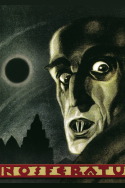
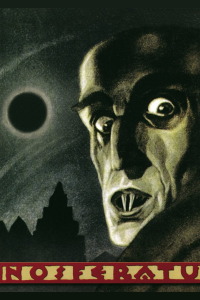
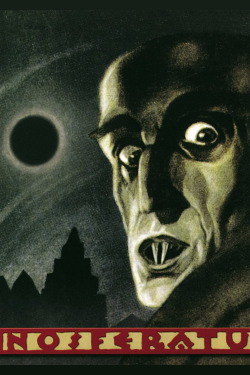
I have inexplicably been working my way backwards through this film's history. The first variant I saw of it was the "real" history of its making, 2000's Oscar-nominated [i]Shadow of the Vampire[/i], which I saw as a relatively new movie. Then, back in December, there was the 1979 Werner Herzog remake starring Klaus Kinski and an untold number of mistreated rats. Now, at long last, I have come to the original. And in many ways, this is the true original--one of the very first vampire movies ever made. The idea that vampires are killed by sunlight first appears in this movie, because F. W. Murnau was so determined to convince Bram Stoker's widow that this was totally not the same as her husband's famous--and at the time, still copyrighted--book. She had denied permission to use it, and indeed, if she'd had her way, I never would have seen this movie at all, because she wanted all copies destroyed as part of the settlement of her successful lawsuit.
Therefore, we all know the story and would even if I hadn't already reviewed two versions of this movie and a couple of versions of [i]Dracula[/i]. We know that Hutter (Gustav von Wagenheim) will be sent by his boss, Knock (Alexander Granach), to a mysterious castle to woo a mysterious client to buy a house in their quiet little town. This is, of course, the ominous Graf Orlok (Max Schreck), feared of the locals, who suggests to Hutter that they stay up all night talking, since Orlok goes to bed at dawn and sleeps like the dead. Not all ends well with Hutter, who wants nothing more than to return home to his beloved wife, Ellen (Greta Schröder), whom the count says has a lovely neck. There is also the mystery ship whose crew all dies and a plague whose source no one can determine. In the end, a good woman must sacrifice herself and keep the fiend distracted so that he has not gone into hiding when the cock crows with the dawn.
I'm not entirely sure why I like the Herzog better, but I do. Perhaps it is that acting styles have changed over the last ninety years, and everyone working on the Herzog was able to put forth a performance suited to film, not stage. It's also true that I find myself distracted and unable to concentrate on lengthy silent dramas. This is, I hasten to assure you, a failing on my part and not the part of the movies. There is a school of thought which holds that the greatest movies ever made are the last of the great silent films, because they weren't as distracted with things like sound and colour. I am not of that school. However, I do think there was an understanding of what film could do which was not matched for many years as each new technological innovation changed what film really meant. Understanding sound film was different from understanding silent film. Understanding colour film was different from understanding B&W. Maybe someday, someone will truly understand 3D in the same way!
The film was intended to be shown tinted, and I know that. And maybe it's, well, Kino at work again, but I found the tinting badly done and distracting. The film, at least in the version I watched, starts with a detailed explanation of how they pieced together the highest quality version they could, especially given that the negatives were destroyed by Florence Stoker. I do appreciate that even the Criterion Collection would be doing their best with what they had. However, I did not feel that the tinting was as well done as Murnau would have wanted or had done. Murnau was an artist, and I think he would join with me in some good, old-fashioned grousing about Kino production values. Oh, I feel sure he'd be pleased that it was preserved even as well as it had been, given that there was supposed to be pretty much no trace of it left. On the other hand, I think the bad tinting was one of the reasons I got so distracted; I'd look away from the lime green intertitles, and I wouldn't look back until plot had gone by.
I think in many ways, the trend of the last century or so has been to weaken our vampires in some pretty notable ways while making them stronger in strange ones. Modern vampires don't have the control over animal life that Graf Orlok had. On the other hand, the idea that going out in the Sun would kill them was new to Murnau. It's worth noting, indeed, that the thing which ultimately killed him is the thing which drives the whole plot of [i]Twilight[/i]--a pure, innocent woman (though not sexually, given that she's married!) distracts him so much that he stays the whole night with her and is caught out in the daylight. However, Graf Orlok was about as far from sparkling as possible. He harkens back to the older tradition of the vampire as a corpse that hadn't rotted all the way. Or, as when portrayed by Willem Dafoe, lived forever but not with eternal youth. No matter how young this vampire was when he was turned, he just wasn't going to fit in with high school students. Even in Forks.
This review of Nosferatu (1922) was written by Edith N on 21 Aug 2012.
Nosferatu has generally received very positive reviews.
Was this review helpful?