Review of Noah (2014) by Nightreviews — 28 Mar 2014
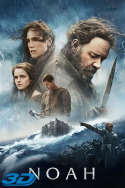
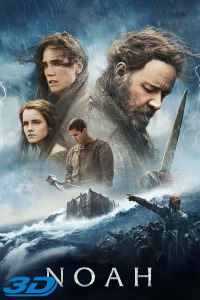
Controversy is sure to ensue following the release of the Bible’s greatest and most epic story found in the Old Testament involving Noah and his arc. Visionary director and passionate auteur Darren Aronofsky has always been fascinated with the character of Noah, and the inner workings of a man tormented by the voice of God and conflicted by his own voice of reason. For the sake of skeptics, religious groups, and devout Catholics, I intend to avert my review very far away from any religious claims or criticism for the film Noah, and instead intend to only offer criticism on the film itself, regardless of its strong Biblical undercurrent. Visually, Noah floats adrift many previous films that share a similar look (The Road, Tree of Life, The New World) but unfortunately sinks in a preposterous commentary set amongst mythological creatures, accepting fate and the age-old argument of man versus God, man versus nature, and man versus himself.
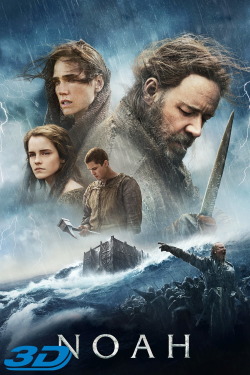
Aronofsky’s Noah begins with the Bible’s first chapter of creation and the story of Adam and Eve. As temptation lures Eve to evil, along with Adam, spawn Cain, Abel, and Seth proceed their parents to a new life. Cain kills Abel, and what begins is the regression of man’s propensity for evil, death, and murder. Noah (Russell Crowe) is one of the last of Seth’s bloodline, and he along with his family, including his wife Naameh (Jennifer Connelly) and his three sons, seem to be the only last remaining decent people during a time where descendants of Cain believe that natural survival instincts like killing and hunting are crucial to man’s survival in the world.
Aronofsky is a man fascinated with the inner workings of famously tormented individuals, and this project has been one of his greatest passion projects since beginning a career in film. Born to conservative Jewish parents, Aronofsky attempts not take any biased religious approach to his newest film, and instead focuses on the human element through an artistic lens. Insert ‘The Watchers’, mythological creatures/fallen angels who are imprisoned on Earth and betrayed by man, Noah, only momentarily floats as a forced visual studio epic that it never needed to be.
With The Wrestler, Black Swan and yes, even The Fountain, Aronofsky challenged the aesthetic of his narratives with the power of his lead performers. Mickey Rourke, Natalie Portman and Hugh Jackman are all prisoners to the shattered worlds they live in and must confront their demons and life itself to overcome adversity. With Noah, one of many vexed characters in the Bible, Aronofsky never challenges his fate by elevating the choices of a man to the fate predestined by a Creator. Instead, and unlike any of the other characters in Aronofsky’s films, Noah gives into accepting his fate of death, an unlikely characteristic for the director’s leads and the man depicted early in the film. Crowe, who is unable to tap into the mind of a man and be led into acting sanctity like Aronofsky’s previous actors, shows why he was the director’s third choice to play the character behind Christian Bale and Michael Fassbender. Crowe’s depiction of Noah is hardened much like ‘The Watcher’s’ outer rock form. Not to mention he delivers a sloppy performance of a man who is the only person who can hear the Creator’s voices in his head–often being eluded as a crazy person and not as the chosen one to hear The Creator’s celestial voice.
Like any other good Aronofsky character, Noah suffers from premonitions. He envisions the destruction of the world. With the help of his wise and all-knowing grandfather Methuselah (Sir Anthony Hopkins), Noah heeds to the Creators visions and builds an arc. Focused less on the creation of the arc itself, offering no type of montage to an arc that seemed to have lasted a least a decade to construct, Aronofsky directs his focus to man, the greatest evil the Creator has formulated–yet, it is a human being that puts together The Creator’s plan. Throughout, by adding a very strong artistic take to a story that is resonant in the minds of religious individuals, once the inclusion of imagination and artistry is injected into anything Biblical, doubt crashes the mind like waves on a reef. Much like oil and water, two fluids that don’t mix, art and religion are two very subjective and delicate areas to combine together. Just ask Mel Gibson, whose reimagining of the crucifixion of Christ, The Passion of Christ, will surely be met with a much larger commercial welcome than Noah.
After the uproar of its first trailer, Paramount Pictures conducted various private secret screenings of different versions of the film, including Aronofsky’s cut of the film, although he was signed to have the final cut of the movie out for distribution. Repulsed and deeply offended, Aronofsky got wind of the studios deception, and allowed the studio to reconsider and agree to release the film as the director had intended, with his cut intact.
This review of Noah (2014) was written by Nightreviews on 28 Mar 2014.
Noah has generally received mixed reviews.
Was this review helpful?