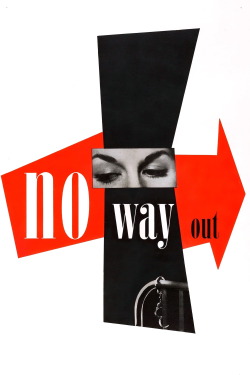
Review of No Way Out (1950) by Edith N — 23 Jul 2012
Before He Came to Dinner.
Probably one of the hardest things an actor can do is portray a character even the actor agrees is totally loathsome. There's only so far you can go in cleaning up offensive language before your character no longer has the emotional impact necessary. Even if you would never say those words as yourself, you have to say them in order for your character to ring true. And apparently, Richard Widmark apologized to Sidney Poitier between takes, because they were friends, and he couldn't stand saying such awful, awful things to his friend over and over all day. However, the power of the film would be diminished if he didn't, and both men knew it. It's also true that there is a desirability to playing loathsome characters. Bette Davis knew it, which is why she chose the role she did in [i]Whatever Happened to Baby Jane?[/i] Joan Crawford didn't, which is why she couldn't understand why Bette Davis got so much attention for the role. After all, Bette was playing [i]the bad girl[/i]!
Poitier here is Dr. Luther Brooks, who is just starting his residency at County Hospital. In, you know, some county or another. He is the first black doctor ever to do his residency there, and he starts out working in the prison ward. Two brothers are brought in--Ray (Widmark) and Johnny (Dick Paxton) Biddle. They were in the process of committing a small-time robbery, and both men were shot in the leg. Luther realizes there is something seriously wrong with Johnny, more wrong than his simple gunshot wound. He is in the process of doing a spinal tap to confirm his suspicious when Johnny dies. Ray accuses Luther of murder. Whatever state they are in does not require an autopsy in such cases, and they need the family's permission. (More on this anon.) Ray won't give it, and so Luther is working under a cloud. Luther and his boss, Dr. Dan Wharton (Stephen McNally), discover that Johnny had listed a wife on earlier hospital records as a next-of-kin. They seek her out; she divorced Johnny, and she is now living as Miss Edie Johnson (Linda Darnell). Can she persuade Ray and help avert the terrible race violence waiting to break out?
Seriously--if there's an accusation of murder, what kind of state wouldn't require an autopsy? Luther eventually applies the clever plot of turning himself in, because having a suspect in custody [i]does[/i] require an autopsy, but that whole aspect of the plot doesn't make any sense to me. I suppose that Ray subconsciously must have believed Luther to be innocent, because if he didn't, why wouldn't he leap at the opportunity to [i]prove[/i] that it was murder and get Luther locked up? The only way the autopsy could be expected to go against what he believed was if he was wrong, and Ray does not strike me as the kind of person plagued by conscious doubt about much of anything. He also strikes me as the sort of person inclined toward showing everyone exactly how right he was. Leaving aside that the state's law doesn't make any sense, Ray's decision makes even less sense. He says that Johnny suffered enough without being cut up, but it doesn't ring true.
Of course, without it, we don't have a reason for Linda Darnell to come sauntering through the story. She has to be the Girl From the Wrong Side of the Tracks; Edie Johnson grew up next door to the Biddles and needs to be the one who understands them. She even speaks sign language, because the third Biddle brother, George (Harry Bellaver), is a deaf-mute, I guess because it's how they make certain other scenes work. She is indeed lovely, and her emotional journey gives the movie a little more depth than it might otherwise have had, but her character really makes the least sense. I totally believe in the hospital administrator who is proud of himself for admitting an actual Negro as a resident (Stanley Ridges, I guess). Really, I find most of the characters themselves totally believable. However, the way the movie puts them into the situations they're in does not completely work for me.
Watching this movie without seeing any of the publicity information about it would lead you to believe that Sidney Poitier should have had top billing. There are two reasons he did not. The first was that this was his feature film debut. He was an uncredited extra in a crowd scene, he was in a documentary short, and I've read that there were some shorts for the US Army Signal Corps. However, leaving that aside, this is really the first film to introduce Sidney Poitier to the general population. The other, alas, is that Sidney Poitier was black. Despite the fact that the film is about how blacks are people, too, and despite that this film also showed Luther's home life (Ossie Davis's film debut, in fact, as his brother--and the first of many times he played opposite his real-life wife, Ruby Dee), it's a simple fact that it was even harder then than now for a black lead to sell a film to general audiences. Without Sidney Poitier, however, it would have taken even longer before that was possible.
This review of No Way Out (1950) was written by Edith N on 23 Jul 2012.
No Way Out has generally received very positive reviews.
Was this review helpful?