Review of Nixon (1995) by Cameron J — 23 Mar 2012
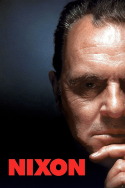
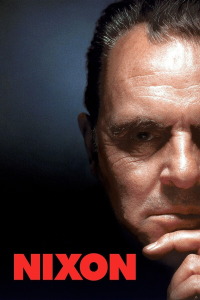
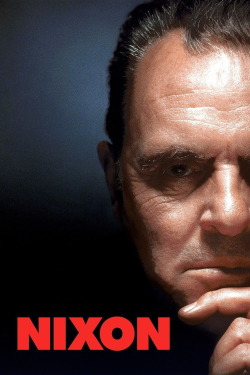
He's a perfectly competent actor, he's buddies with Oliver Stone and he looks so much like Nixon that it's completely unfathomable that no has ever gotten him to play the dude, so how in good Grace Kelly's name did they not get Tommy Lee Jones to play Nixon? Eh, well, even though he doesn't have his natural voice or face... or eyes... or hair (I think that widow's peak is running a little too long), Hopkins is perfect to play Nixon, because he's alway been known as that kind of sly, clever dog, and now he's finally playing good ol' Tricky Dick. I'm sure some people would say that he's also great casting, because Nixon's about as evil as a serial killer, and to those people, I say shut up, you liberals, you probably don't even know a whole lot about his presidency... like me, but luckily, this film really clued me in, especially since I saw the extended version. Three-and-a-half hours, it better teach me some stuff, which is why it's releaving to see Stone attached to this project, because he managed to make a three hour to three-and-a-half hour - in the case of the director's cut - long, repetitive dialogue piece like "JFK" really work, because he packed it with so much info... plenty of which was inaccurate. Okay, maybe I should double-check my sources if I'm going to be praising this film for accuracy, because Stone already slipped up when he thought Hopkins could pass for Nixon. Well, I will give him this: He was right, because although Hopkins doesn't at all look the part, the guy knows how to transform into any role. Still, while that makes this film all the better, that doesn't completely drown out the misstep in the casting, let alone the missteps in the actual film.
The film features a scene in which Nixon listens to the recordings of his famous slip-up, and then flashes back to the lengthy, career-destroying conversation in question, and that whole scene is absolutely brilliant and effective, or at least it would be, if the film didn't open with that. The story is rarely told in a non-linear fashion, but when it is, it really doesn't feel like it fits, as Nixon's story is one of building to major highs, only to descend into major lows, and I know that it sounds like a nitpick, especially when you consider that the non-linear storytelling is only occasional, but when you see the film, the non-linear storytelling lands a hard blow to the resonance of the hook and leaves the film to, for quite some time, retain that feel of a history lesson that's just covering facts, whether than flowing like the story that it is. To add insult to injury, this out-of-order storytelling is sloppy to begin with, transitioning back and forth through time with a major flashback feel, whether than story shift feel, which leaves you really thrown off when these shifts in story begin to well outstay their welcome as flashbacks. Now, if that's not enough inconsistency in storytelling for you, switch to linear storytelling is jarring; but don't get me wrong, that's the way this story should be told, so I should be glad that it's mostly told in that fashion, but even Oliver Stone's linear storytelling is a mess, changing focus too drastically at points while feeling somewhat thrown-together and repetitive to continue, if not intensify the history lesson feel of the film, for although there is meditation, there's too much substance and too many facts - some of which are superfluous - packed into one scene, alone, that meditation finds itself diluted, and the dramatic effectiveness of the substance with it. Richard Nixon's is a story well worth telling, but this film is as much a history lesson that we can hear anywhere as it is the dramatisation that Nixon deserves, and the final product comes out both too long and not long enough, falling just a little bit short on the meditation, resonance and consistency that, if orchestrated carefully enough, could have given us a powerful film. As it stands, well, it's still really good, through all of its missteps. Stone is not at all the greatest filmmaker, yet he's perfectly competent enough to keep a film this mammoth and messy going and largely through style.
Now, Stone's random occasional cuts to black-and-white didn't work in "JFK" and don't work here almost as certainly as all of the transparent images, newsreel footage and flashback montages that were in a flashback-driven, investigative mystery-thriller like "JFK" don't work in this film, yet those moments of overstylizing come and go while the brilliantly effective style remains constant. Robert Richardson does it again, shooting the film a kind of subtle grit and grain in the color to lay down a broad tone that can still be isolated very quickly and very effectively to add a dash of tension to any subtley heavy situation, and where Richardson's cinematography supplements the resonance of the film visually, John Williams' score supplements it audibly. With all of the George Lucas', Richard Donners' and - woah boy - Steven Spielberg's, it's pretty overlooked that Oliver Stone is another director that knows how to get John Williams to put together some of his best work - which is saying a lot -, yet lo and behold the men have quite the taste in music between them, and sure enough, the score in this film is boastful and blasting with, at times, a powerful epic sweep to help greatly in pumping this film with the theatrics needed to both engage the audience and make up for whatever pieces of resonance collapse under the weight of messy storytelling. However, as spotty as Stone's storytelling gets, he carries this film and makes it as good as it is more than he squanders the potential behind this ambitious project. True, very often, he's overemphatic about the facts to the point of diluting dramatic aspects, but when he does give the film that human touch, he cuts deep, whether when he's meditating on the grit of rocky politics or simply telling the story of Richard Nixon, a human of great ambition, brilliance and struggles, yet a human nevertheless, being flawed and often overwhelmed by circumstance, both as a politician and a moral man. Stone paints an honest portrait of Nixon that we've rarely, if ever seen before, and while this massive defining of the legend stands to cut deeper, Stone still strikes a chord that gives us much insight into one of our most notorious leaders, yet Stone doesn't paint that portrait alone. Again, Anthony Hopkins, as far as appearances go, is so amazingly miscast, it's awe-inspiring and painfully glaring... for less than five minutes out of this well over 3 long hour study on this one person, and that's no exaggeration, because although he doesn't look the part, Hopkins becomes Nixon immediately, not only adopting all of his traits and mannerisms, but that kind of humanity and atmosphere that defined Nixon, and he does it all with an intense and layered lead presence comprised of charisma, emotion, anguish and authority that leaves any piece of pretending in his portrayal of someone he is most certainly not to just wash away as you find yourself hypnotised by Hopkins' haunting, effortless bypassing of not only the glare of the miscast, but of his own stardom that he very much deserves, an opinion supported greatly by this testament to his awesome acting abilities.
Overall, the film's storytelling is inconsistent in focus, yet consistent in messiness, being overly matter-of-fact to the point of damaging the film's resonance and leaving it to get very repetitive very often, yet you're gripped through and through by, if nothing else, the dazzling cinematography by Robert Richardson and sweeping score by John Williams, as well as by many fine and sometimes glowing moments where Oliver Stone really delivers on the resonance and effectiveness this insightful and provocative dramatisation, though not quite as much as leading man Anthony Hopkins, who transcends the glaring miscast by effortlessly transforming into both the layered former leader of America and the compelling leader of this film, thus leaving "Nixon" to stand as a very entertaining and fascinating study on the highs and lows of President Richard Nixon.
3/5 - Good.
This review of Nixon (1995) was written by Cameron J on 23 Mar 2012.
Nixon has generally received positive reviews.
Was this review helpful?