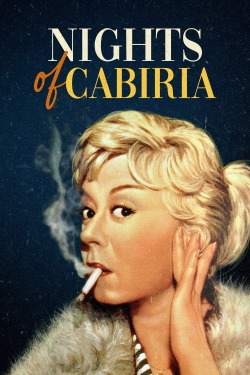
Review of Nights of Cabiria (1957) by Ken S — 04 Jul 2009
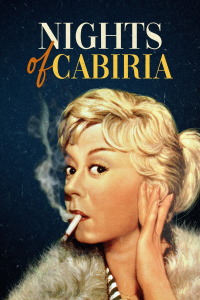
"Nights of Cabiria" is one of Federico Fellini's early neo-realist films, and also one of his best. But despite it's praise amongst critics, and even a win for "Best Foreign Language Film" at the 1957 Academy Award ceremony, it is often overshadowed by "La Dolce Vita", a film which came just three years later and recycles many of the same situations. While "La Dolce Vita", along with "8 1/2", are the definitive Fellini masterpieces, one must also consider "Nights of Cabiria" right along with such prestigious company if only for the unforgettable performance of the lovely Giulietta Masina.
As the film begins, we meet Cabiria (Giulietta Masina, Fellini's wife), a naive high-spirited prostitute. In the opening scene, she's walking with her boyfriend, Giorgio, along a river bank. He steals her purse and pushes her in, leaving her to drown. This sets up each episode throughout the rest of the film - the wide-eyed Cabiria is a tragic figure, one who trusts too easily and whose hopes are often stomped. Masina's performance is a bit like a clown, one that's often been considered to have been an homage to Chaplin's Little Tramp. A character like hers in similar situations could've easily made for a comic figure, but we care for Cabiria so deeply that we suffer with her, share her anguish, and shake our heads when she falls for another scam.
The film, like "La Dolce Vita", is episodic. The first of the episodes deals with Cabiria meeting a famous movie star (Amedeo Nazzari) who invites her to his mansion. Cabiria taunts her prostitute co-workers from his fancy car, and walks through his house as if she were a kid in a candy store. The night is going lovely until Jessy turns up, the girlfriend he had dumped just before meeting Cabiria. He tells Cabiria to hide in the bathroom while he gets rid of Jessy. He and his ex-girlfriend rekindle the relationship and make love while Cabiria sleeps in the bathroom with the dog.
Following that is a scene cut from the original release that involves Cabiria meeting a good Samaritan who feeds the homeless living in the caves of Rome. Although Fellini fought to keep it in the film, it was removed for a number of cited reasons - from the Roman Catholic Church saying it portrayed the church as unresponsive to the needy, to others saying it simply lagged the film down and was too cruel. The sequence is certainly harshly realistic and full of despair, however it's an incredibly memorable and revealing episode that is more than fitting with the rest of the film. How wonderful it is to be able to see it now.
To describe for you the rest of the episodes would spoil the spirit of the film - by this point, we're so taken in by this character that we follow along each exploit with a great sense of awe and hope. When things go wrong, her heartbreak is ours. It's a film to be discovered on your own, an adventure more compelling and satisfying than any action epic. I'm not sure whether I prefer this film or "La Dolce Vita", but both films are certainly two of the finest i've ever seen.
This review of Nights of Cabiria (1957) was written by Ken S on 04 Jul 2009.
Nights of Cabiria has generally received very positive reviews.
Was this review helpful?