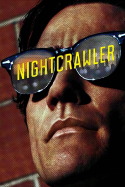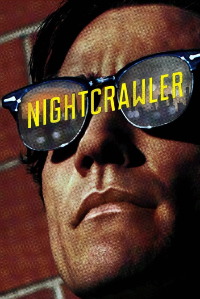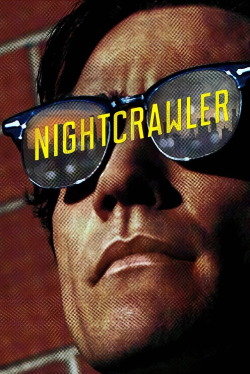
Review of Nightcrawler (2014) by Shiira — 09 Jan 2015
Two intoxicated old newsmen, a producer and the anchorman he just fired, in Network, nurse their last drinks at the bar, commiserating over the slipping standards of broadcast journalism. As a riposte to Howard Beale's avowal of an on-air suicide, in jest, the UBS news division head envisions The Death Hour, a weekly series whose content is wholly violent, wholly sensational.
"Suicides, assassinations, automobile smashups," Max jokingly brainstorms, never dreaming that his drunken ramblings outlining a telecast of blood-soaked spectacle would one day turn out to be an uncanny bit of prophetic extrapolation, a bar-lowering that allows somebody like Louis Bloom, a freelancing videographer, to be an invaluable media cog.
Louis' bosses are death merchants, ratings-driven professionals who fulfill the UBS producer's longago pitch for a "great Sunday night show for the whole family." Nightcrawler can be seen as the third film in an unofficial trilogy about the dumbing down of the news, the unassailable culmination of Beale's rant to the studio audience that television had supplanted books and newspapers as the primary medium of intellectual discourse.
The penultimate film, Broadcast News, released a decade after Network, screenwriter Paddy Chayefsky's divination that entertainment value would eventually encroach on the erudite nature of hard news proved to be true, finds encapsulation in the scene where Jane Craig, a Washington bureau producer, sounds the alarm on broadcast news content when she presents a domino demonstration clip at a conference for local reporters.
Whereas, in Network, the studio audience watching a degraded version of the news was the hoi polloi, denizens raised on Bugs Bunny, therefore rankling the old vanguard who still controlled the medium, in Broadcast News, we can see, quite pointedly, how the generation gap closed during the interim between both films.
The Bugs Bunny aficionados were now the gatekeepers, industry insiders, who, to Jane's disappointment, are not "mad as hell" about the infiltration of fluff bombarding the airwaves, when the seminar attendees clap in approval after the final domino falls.
At this juncture, the late-eighties, it would seem by the light-hearted genre(the rom-com) that is chosen to document the news program's fluid aspect in filmic amber, networks and their affiliates were, as of yet, not the whorehouses that Frank Hackett had purported UBS to be.
Broadcast News ends on an optimistic note, a note suggesting that the trend could still be reversed. Tom Grunick, newly minted as the face of the news division, at his press conference, defers the programming duties to a civic-minded heavyweight.
This conceit, in which a narcissist like the telegenic, yet uninformed newsman would be an advocate for hard copy that matters, now, in retrospect, seems more absurd than an anchorman being assassinated by network honchos because of low ratings.
Tom is all about style over substance. Jane Craig doesn't exist anymore. Diana Christensen does. Once thought to be an implausible invention of a scribe with an overheated imagination, the bloodthirsty woman behind The Mao Tse Tung Hour, the UBS hit show documenting the terroristic maneuvers of the Ecumenical Liberation Army, lives on in Nina Romina, the news editor for a low-rated L.
A. morning show, who embodies and widens Diana's vision of broadcast news as spectacle. Chayefsky, who would die in '81, never lived to see the ultra-violent direction that Hollywood would take; he never saw the big-budgeted studio films with high body counts, the count so high, audiences would become desensitized to the human collateral damage.
In Bad Boys 2, neither we nor the filmmaker, in a chase scene between off-road vehicles, stop to consider the welfare of the Haitian peasants as the Hummer and Range Rover plow through their tarpaper shanties.
Nightcrawler satirizes a different generation, The Terminator Generation, raised on the "event movie". Better than Man Bites Dog, the psuedo-doc about a film crew who follows a serial killer at work, Nightcrawler gets its message across about audience complicity towards violence because unlike the grainy B/W, cinema verite style of the Belgian import, the filmmaker uses the film language of the Hollywood blockbuster.
Situated outside a glass-walled Chinese restaurant, Louis records a furious exchange of gunfire between the police and the suspects of a home invasion. The rectangular glass front, meant to represent a movie screen, provides a clue as to why people tune into the graphic imagery that apparently turns up on local mornings news shows in big cities.
It's entertainment. It's The Death Hour. When Ben, in Man Bites Dog, murders an entire family in their home, we're horrified because it looks real. Here, violence, looks fun behind Louis' camera eye. Innocent bystanders die in the shootout, but we don't care.
We've seen it in the movies.
This review of Nightcrawler (2014) was written by Shiira on 09 Jan 2015.
Nightcrawler has generally received very positive reviews.
Was this review helpful?