Review of Night of the Seagulls (1975) by R.c. K — 09 Nov 2007
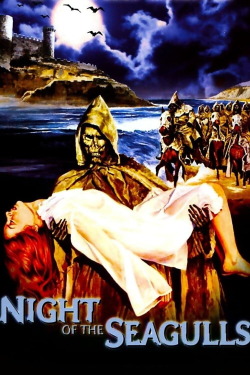
Aha! A literal translation of title for the final film in what is widely called Amando de Ossorio's "Blind Dead series." Often it is also called the best of the series, or at least the best of the sequels.
Well, let's not beat around the bush: I'm inclined to agree. We have some stumbling blocks in this film, admittedly, but fewer than usual.
There's a much stronger story this time, with less background to be established for the knights (they're actually a tad bit more mysterious this time, no longer stated to be excommunicated knights who worshipped blah blah etc) by dialogue, we instead see a much clearer flashback. It's familiar, as we inevitably expect at this point, with a topless woman being sacrificed by a group of stern, stoic, silent knights, her heart pulled forcibly from her chest--but this time placed in the stone mouth of an ugly, squat toad-like statue (ooh! shades of Lovecraft!). We also even have a bit of story with the woman sacrificed--she and her husband are moving into a new home and find themselves lost in the fog and far from where they should be when the knights decide to take her for their sacrifice. There is then a scene which involves crabs--this one is set very near the sea--which I was most definitely not expecting and took me a bit by surprise (as much as anything can anymore, anyway).
Now we're dealing with Dr. Henry Stein (Victor Petit) and his wife Joan (María Kosty), who are moving into a small fishing village for Stein to take up practice there. They are largely ignored when they first arrive, asking repeatedly for directions to the doctor's house and recieving no response whatsoever. Finally physically impressing himself on someone, Stein is given an answer and they find the old doctor (Javier de Rivera) moving out, telling them quietly not to stay, to move on as soon as possible. Henry walks the doctor to his destination, and Joan finds someone looking in her window--the village idiot, basically (remember Murdo in El ataque de los muertos sin ojos? like that) named Teddy (José Antonio Calvo) who wants shelter from the abusive villagers. He's overacted (as these characters always are) but at least with enough consistency and honesty to overlook it if you aren't a total snob. He seems overly frightened so Joan takes him in, and she and Henry begin their first night when Joan begins to hear singing and chanting, then the sound of seagulls as they try to sleep. "Seagulls? At night?" Henry wonders aloud.
We start to get the idea after this, when Joan goes to buy groceries from a local shop, that the villagers are hiding something and do not want outsiders to disturb them, plainly telling Joan she and her husband should leave. A local girl named Lucy (Sandra Mozarowsky) takes pity on Joan and asks for a job as an assistant with her, which Joan agrees to, but almost finds her offer rejected when she asks Lucy about the strange singing custom she and her husband decided was a tradition to bring good fishing hauls. This next night, a girl comes begging for help, but the villagers drag her from the doctor's door, her disappearance pushing the Steins to try to figure out what's going on, and debate whether to simply move out.
Atmosphere and acting in this one were a good notch above usual, and the overall composition and editing were stronger than usual, forming a more cohesive, professional whole than the other films. The knights were more fully visible this time, with strong makeup/masks under their hoods, and some effects and such that are new to this mythos (though I maintain there IS no central mythos, especially in light of some endings...). We have stronger, more sympathetic characters (yay! no rape!) with actual good intentions and motivations--before we usually had people looking for friends or self-interested, and often abrasive. Not grating, annoying or UNsympathetic, but more sort of, "Well, it's a human and not a terrible one, I would PREFER if they lived..." Not so, this time. A doctor and his wife who are trying to help a village through his profession and only become angry at their treatment when pressed or when they feel someone is being denied treatment that needs it. Teddy is a little over-the-top, but clearly a child-like intellect and interest in the well-being of others. Lucy works to try and bridge the gap of view and opinion between the village she has grown up in and the strangers who don't understand it.
So, a strong little film, and a good way to end the series, though I preferred the endings of La noche del terror ciego and El buque maldito--but this one works very well in its own context.
This review of Night of the Seagulls (1975) was written by R.c. K on 09 Nov 2007.
Night of the Seagulls has generally received mixed reviews.
Was this review helpful?








![[REC] (2007)](https://cdn1.cinafilm.com/static/img/movie/5996792e/125/1-rec-2007.jpg)