Review of Nashville (1975) by Andrew N — 19 Sep 2012
4 Stars out of 4.
"This isn't Dallas, this is Nashville. They can't do this to us here in Nashville! Let's show them what we're made of. Come on everybody, sing! Somebody, sing!".
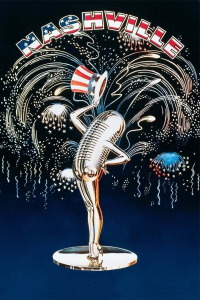
Those words are the final cries and pleads of Robert Altman's Nashville, a tragic musical painted in the facade of happiness. This is a musical that seems nonexistent today, where people sing in a fake cordial tone and release their inner depression more prominently. Even tune in Nashville is a soulful commentary, nowhere close to the likes of Brecht buy layered in its own gap of reality.
Director Robert Altman (Shortcuts) tells Nashville through 40 different stories using 24 actors. His films, Nashville most notably, are known for the ensemble to create this semblance of blissful community and friendly interaction. Sometime Altman goes so far out of his way to unite his actors, he'll have a car pile up. Nothing like ensemble in a pile up.
He would also use overlapping dialogue to bring about the presence of the 'other people' and also instil a sense of chaos. We can barely hear what some of these characters say as a result, and that is the point. What they think and say barely matters anymore, because they express themselves as if nothing does and everything is swell.
Altman, I think, is creating satire here. Nashville is imagined as this utopian city, shot in sunny weather, manifesting it as picturesque. But since this was just over a decade after John F. Kennedy's assassination and only a few years after Watergate, the American people had little faith in their government's stability. When a self-absorbed radio report for BBC named Opal (Geraldine Chaplin) arrives at Nashville's Parthenon, a political convention, she hypnotically associates the yellow school buses as "menacing, threatening ... with hollow, vacant eyes." Apparently America's education system was so peculiar it is bestial.
The convention is held for Replacement Party candidate Hal Philip Walker, who is never seen throughout the film, creating a feeling of pointlessness and pretentious gathering at the rally. He is called the "mystery man" and has one three primaries and if he took Tennessee it would prove Nashville can pick their presidents. They were partially responsible for Nixon.
Henry Gibson plays the country singer Haven Hamilton, a facsimile of Roy Acuff, Hank Snow, and Porter Wagoner. He introduces most of the performances, which were sung as live concert footage. There is a feeling of boredom yet anxiety amongst the people as they idle quietly in the audience as if anticipating another assassination. At the arrival of hyper-feminine Barbara Jean (Ronee Blaxley in her first film role, and a mimic of Loretta Lynn) she collapses from the heat and the people scatter in worry but more so wonder and excitement if something 'dramatic' has occurred.
The film takes place in studios, outdoors, bars, hotel rooms, and back to the Parthenon for one last tragic farewell. The roles involved are endless, but every one of them are important, interesting, and heartfelt. Shelley Duvall, a singer herself, plays L.A. Joan who spends most of her time hilariously wearing several wigs, making her the symbol of American artificiality. Keith Carradine seems to be more real but is undercut by his chronic using of women, insolence, and has-been success in his one-album band Bill, Mary, and Tom, which reminds me of Peter, Paul, and Mary. The rest of them? The list goes on, and they are all equally fantastic.
Altman, a cinema virtuoso, is against causal narrative and never expects his characters in Nashville to learn anything in the end. Why should they? It would be a resolution to a story of America that still has not found one. The fact that these characters do not come off as individuals, but collectives is what Altman loves. In 1970s America, it seems people were losing their individuality and gathered together to feel some cordiality.
This quest for entertainment becomes so desperate, it ironically ruins lives. For example, Connie White (Karen Black) is the rival of Barbara Jean and is determined she will become famous. Her singing though is so awful it disrupts the tacky happy-go-lucky tone of the previous numbers. But here singing is way more sincere because it proves she is not perfect. She is human and, at her best, vulnerable. In a scene, she tries to sing to a group of men but her voice is so off-putting, she is forced to undress to a piano ditty while the men hoot and holler. In this scene, her dreams are crushed and Connie is just another character.
I don't think one of the characters in Nashville could sustain the film individually. They are not drawn out to the point that they are psychologically engaging or actually complete. This is not a criticism but it could have been. Altman creates his characters on a map, giving them coordinates that link to the next character and furthermore.
Therefore, all the characters echo a general sense of humanity, in all its different forms. Even Elliott Gould, from Altman's NASH, arrives and is seen as himself not a character. He wanders like a doofus, but is a celebrity. Nashville has this way of mocking populism in American culture, because, in a way, the journey to "be famous" could have hilarious or, on the other hand, tragic results.
At the conclusion, an assassination takes place. It is the death of a prominent character who was one of the few singers who sung the truth - her truth, her feelings. Her death (though it is not directly shown) conveys realism and puts us all in our place. This scene is the slap in the face, where Nashville is no longer this pseudo-utopia. When you think about it, Nashville needed to end on tragedy. I did not like Altman's final shot though. I understand it is meant to mock conventional Hollywood endings and the cheap optimism dominant in commercial films, but at the same time, Nashville felt equally so. It just seemed to "end', when I wanted more of a conclusive punch.
Scary enough, Nashville's ending is a clairvoyant to John Lennon's death in 1980 - the murder of a peace-promoting celebrity. Altman received a call from The Washington Post and they asked him if he felt responsible. Altman was stunned and replied: "well I don't feel responsible, but don't you feel responsible for not heeding my warning?" But what Lennon's murder proves about the world and the film Nashville is that assassinations do not occur out of ideas, but to draw attention to the assassin. This statement parallels the likes of Columbine and Van Sant's Elephant, which is much about assassins who just wanted to be noticed.
Much of Nashville is about getting noticed, while rolling through the punches, pointlessly keeping your head up and trying to be buoyant? But why conform to that silliness? Altman, with his filmmaking, never conforms to conventions so his filmic grammar creates its own argument. The music is not meant to escape into fantasy, but remind us we are in reality (the aforementioned 'live footage' gives the film this ironic idyllic look of Woodstock and its promulgation of the hippie counterculture). No longer do easy riders exist. Hendrix, Morrison, and Joplin are dead. Easy rider motorcycles are out of fashion. America is losing their sense of style.
So that is Nashville, a satire that I thought was the real deal. Just how I thought Network was a realistic interpretation of 1970s journalism. That is the fascination. Watching movies back then and analyzing them the opposite way. To think the reverse, is not wrong but interesting. It makes us realize that we may see the world differently now, in another perspective, and that Nashville itself is a timely, ever-lasting piece of work.
The film won an Oscar for Carradine's number "I'm Easy", which reminded many of a Kris Kristofferson tune. It would go up for Best Picture and lost to One Flew Over The Cuckoo's Nest. What a shame. Nashville is the best depiction of America, which is so funny for that to be so because it paints America as this pretty picture. The very key point though is that there is a poignance beneath this happiness and America is in constant regret. My opening quote by Hamilton says it all: "Come on everybody, sing! Somebody, sing!" It proves in a world of fear and lamentation, the music never stops.
This review of Nashville (1975) was written by Andrew N on 19 Sep 2012.
Nashville has generally received very positive reviews.
Was this review helpful?