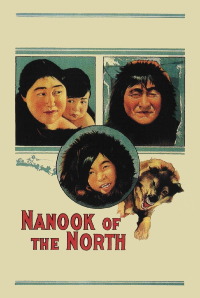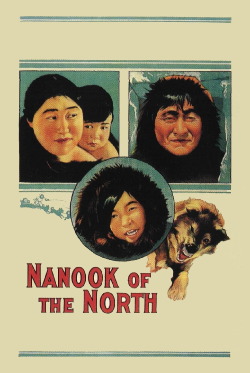
Review of Nanook of the North (1922) by Pavandeep S — 20 Apr 2008
Watching this, it sometimes feel a little dizzying as you see images of people of an era no longer existent. To see them hunt, build igloos, fish and even to eat their walrus raw, it really was utterly fascinating to see it now. The only thing I knew of Eskimos is their distinctive way of acknowledging love, by using their noses. I'm not going to say that I know much more, but the images recorded by Robert Flaherty, made for everyone and anyone, records the actions of Nanook and it allows me to see them, as literally as a visual text.
Film as a recording medium has lots of potential and I'm sure Robert Flaherty saw that, as an explorer, he could presage the destruction of certain traits among human beings. Imagine if film existed in the age of Shakespeare, imagine how much more we can save, how much of humanity is there to record in moving images. For that reason, the director guessed right, as in recording this, we see a unique culture, isolated, but recorded in its spatial reality and so, we can see for how objective the film or subjective the content is.
It is very obvious from the outset that the director is pro-Nanook. The opening titles shows his appreciation for them, and his continual trips there shows his love for them if nothing else or maybe it was just his sense of adventure. Even still, we see how he lets his opinions influence this film. Even though we see their savage instincts, like their eating a meat raw, it doesn't disgust us as the director takes care to show how massive the job of hunting food is, the immense struggles and even the days of famine due to animal appearing. Let's say the scene of the walrus. The inter-titles show the words that Nanook has news of a walrus being sighted. We then see him gather his mates and heading thither. We are constantly barraged with words that tell us how hard the hunting process is, example being the inter-title of 'There is always a sentinel awake, because on land they are weaker as compared to their strength on sea' just as we see one Eskimo heading towards the Walrus to catch it unawares and then the long epic struggle to grab that one walrus followed by the rescue attempt by its mate and the eventual slaughter and consumption of said carcass. Robert Flaherty therefore knows how to shoot his subjects to interpret it according to his own subjective ideas than letting it be thought of by the audience.
I find that the lack of objectivity in this film to be utterly bizarre. I've been led to think that being on a middle line is always better, but yet, I find the methods employed to defend his personalized opinion very useful. He lets us observe them, lets us understand them, but never does he goes towards the Michael Moore method by letting it be sort of strained. He really knows how observation prove the old adage that a picture is worth a thousand words and I think that's another reason for this documentary to be studied.
The sparse usage of landscapes was intriguing, as I noticed it was used mostly at the end of the documentary, where the barren, cold and empty spaces gave of an eerie and yet beautiful vision of that part of the world. I found it to be effective as it made the documentary beautiful, it placed the nail on the coffin for us to really grasp the meaning of these people's lives and their struggles living, literally, on the edge and hopefully, to one day, when life is temperature-controlled and we can zap from place to place, we will know the pains of our forefathers.
Whether this is the best documentary, probably, but I can say, that Flaherty's unique style of observation characterized by his heavy and painful desire, which is apparent, to preserve and to let us empathize with these people is one interesting thing to learn if nothing else. Flaherty's love for his subject, Nanook's desire for him to stay longer, this beautiful emotions play a huge part in the success of this documentary, it really comes out well, with the shots and even in looking at Nanook himself, looking at him sleep at the end and at looking at his life, preserved on flammable nitrate celluloid.
This review of Nanook of the North (1922) was written by Pavandeep S on 20 Apr 2008.
Nanook of the North has generally received very positive reviews.
Was this review helpful?