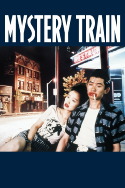
Review of Mystery Train (1989) by Ofir S — 14 Apr 2012
Memphis as Metaphor.
In general, you just don't want to be a Steve Buscemi character. Something is probably going to go very badly for you. Most of them start kind of down to begin with, and it's only a matter of working out how much of it is their own fault. This is a Steve Buscemi who is more sinned against than sinning. He's trying to do someone a favour, and it all kind of goes to Hell for him. Coupling this with a Jim Jarmusch picture, and you're just waiting to see exactly how wrong things go. Jim Jarmusch films seem to be about skating on the edge of total and utter desolation, and Steve Buscemi characters seem about to drop off that edge no matter what film they're in. And the Memphis which appears in this movie is a city whose best days are long since gone, meaning that there is no way for his character to find a way out despite the actor and director; it's a perfect storm of being crapped on.
This is three stories. First, "Far From Osaka," concerns two young adults from Japan, Mitsuko (Youki Kudoh) and Jin (Masatoshi Nagase). She's an Elvis fan and he's a Carl Perkins fan, and they're on a rock-'n'-roll pilgrimage through Americana. They visit Sun Records, where the tour guide speaks far too fast for their marginal English to keep up. They walk past the desolate hulk which was Stax Records. And they end up renting a room at a fleabag hotel with desk clerk Screamin' Jay Hawkins and bellboy Cinqué Lee (brother to Spike). In "A Ghost," Luisa (Nicoletta Braschi) is in Memphis for reasons never entirely made clear as part of the process of transporting her husband's body to Rome. She not only ends up in the hotel, but she shares a room with Dee Dee (Elizabeth Bracco). Dee Dee has left her boyfriend and plans to leave Memphis the next day. The third story, "Lost in Space," is about Dee Dee's brother, Charlie (Buscemi), who is called into a bar by Will Robinson (Rick Aviles). Dee Dee has walked out on Johnny (Joe Strummer), called Elvis because of his hair, and Johnny is now waving a gun around in a pool hall/bar. Will wants Charlie to talk Johnny down, but by the time Johnny shows up, it's quite clear that it's not going to happen. And indeed, things with Johnny go from bad to worse. And they, too, end up in that rat trap hotel, though they don't know that Dee Dee is down the hall.
And yet, for all that, there's not a lot of plot. One of the librarians wants me to tell her how the movie ends, because she for some reason didn't get to see it all the way through, but I'm not sure what to tell her. Yes, all right, something goes wrong for Steve Buscemi's character, though I won't go into much detail about what. (Since there is a shot in the night which helps tie the three stories together, we'll just say that it's another movie stained with his blood.) But Mitsuko and Jun just get on the train. Dee Dee moves on with her life. Luisa gets on her plane to Italy. That's pretty much it, and as for what happens to the three guys in their hotel room, well, that's the closest we get to something happening and I won't give it away here. Jim Jarmusch movies, as with trains, are about the destination as much as the journey. I'm not entirely clear on why Luisa is wandering the streets of Memphis the way she is, come to that; she is the only one who seems to have no purpose.
The movie does not come with a commentary track per se; Jarmusch apparently doesn't like watching his own movies once they're made and just recorded a Q&A session. One of the things he says is that they did not deliberately empty Memphis to film. They didn't control much of what happened in the streets around them, apparently, and most of what was captured was just what Memphis was like at the time. History has not always been kind to that great city on the Mississippi. Heck, there was a yellow fever outbreak in 1878 which essentially wiped out the city entirely through death and flight. And, of course, the great era of rock which those kids are coming to commemorate pretty much ended when Martin Luther King, Jr., was assassinated there. There are good things about Memphis, too, of course--after all, it is a city you can see these Japanese characters traveling around the world to visit. But still; the desolation is definitely there.
I sometimes think Jarmusch is inaccessible for the sake of being inaccessible, much though I love [i]Dead Man[/i]. Still, despite a basic lack of plot or connection to this, there's something worth watching. Screamin' Jay Hawkins is actually extremely entertaining in it, despite being in a small role. The way he and Cinqué Lee interact is one of the best parts, almost to the point of making me wish there were a whole film about the two of them. (Too late now, alas.) I mean, why does such a dump have a bellboy in the first place? With rooms at $22 a night, are they really making enough to make it worthwhile? Though I suspect that not all those rooms are rented for the full night, if you catch my meaning. There is very much the impression that he's there just so the night clerk doesn't have to be there by himself all night. He's hoping to be on his way up, and the night clerk is clearly on his way down, and they happen to meet in the night in one of the crummiest hotels in Memphis.
This review of Mystery Train (1989) was written by Ofir S on 14 Apr 2012.
Mystery Train has generally received very positive reviews.
Was this review helpful?