Review of My Man Godfrey (1936) by Devon B — 23 Mar 2011
But What About the Real Forgotten Men?
It's a thing we do in American media. We want our stories at second hand. We don't want to have the people with the real problems as our protagonists. We want someone to be watching them. It's why so many movies about black issues or women's issues or gay issues have protagonists who are straight white males. (Because executives tend to assume that it's their only audience, and for preference fourteen to twenty-nine.) And so this movie, which is really using issues to masquerade a standard screwball comedy, lets us see into the problems of the poor and homeless without actually spending most of the movie dealing with the poor and homeless. We spend almost the entire movie in a Fifth Avenue mansion, because really, it's just more '30s escapism pretending to have a social conscience.
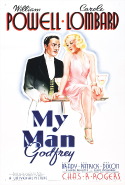
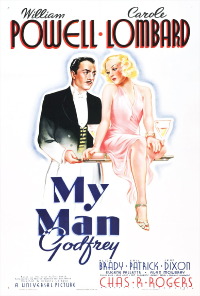
Irene (Carole Lombard) and Cornelia (Gail Patrick) Bullock are your standard wealthy New York socialites. They are sent on a scavenger hunt, and the last thing they need is a Forgotten Man. The sisters go down to a dump by the river (this predates vans) to hire one for $5. Cornelia picks out one Godfrey (William Powell), who pushes her into an ashheap for treating him like someone who exists to do her will. This is a thing she will do throughout the movie to every other character. When he finds out that going with Irene will keep Cornelia from winning, off he goes. She then hires him as their butler, dropping him into a Screwball Comedy Rich Family. There's the sisters; their father, (Eugene Pallette), Alexander; their mother, Angelica (Alice Brady); and her protege, Carlo (Mischa Auer). Who looks like [i]The Daily Show[/i]'s Aasif Mandvi. Anyway, Irene declares Godfrey to be her protege and falls in love with him. And of course Godfrey has a secret.
It appears that this is the first Carole Lombard movie I've ever seen. I know a great deal about her as a person, or anyway I know a great deal about the last year or two of her life. I know about her last wedding, and I know about how she died. I know that Clark Gable's enlistment in the military after her death was essentially a suicide attempt. But I'd never seen her [i]act[/i] before. Here, she is a sweet, charming young flibbertigibbet. From what I know of real-life Carole Lombard, this is acting. She was an . . . earthy woman. Swore like a sailor. Very much into her husband. And so forth. Though apparently, she'd been divorced from William Powell for three years at this point, and he still thought she was perfect for the part. Even though she was far too old for it. Still, the movie draws a great deal on Lombard's easy charm. You wouldn't want to spend much time around Irene, but she's not a bad person.
The problem with essentially every character in the movie is self-centeredness. Even Godfrey, who thinks he has learned humility, instead learns by the end of the movie that he hadn't after all. Irene says at the beginning of the movie that she can't be a part of any game which involves using people like things, but within moments, she's going along with it, and she never goes back. She cares a great deal about beating her sister, and why exactly she falls in love with Godfrey never seems clear. Indeed, it seems a great deal like a crush, something which won't last much beyond the end card. ('36; no end credits.) Alexander Bullock seems just worn out by his family. There's a horse in his library the morning after the story begins, and he's not entirely surprised. And the maid, Molly (Jean Dixon), has been dealing with the family long enough so that she isn't surprised, either. Everyone else is more concerned with their own actions than trying to get by.
It's still funny, of course. Irene is remarkably childish in many places in the way that's entertaining onscreen when done right but generally makes you want to hit the person in real life--or when it's done wrong, which is one of the reasons I haven't seen [i]Twilight[/i]. Godfrey does manage to parlay his disdain for the family into generally amusing William Powell-ness. The mother never stops being anything but a flibbertigibbet, but she isn't a hurtful one. No, she doesn't Learn a Valuable Lesson by the end of the film, but you generally have to have a brain to do that, which is her first problem. Yes, all right, the whole situation is entirely implausible, and I do end up wondering about a lot of the rest of the Forgotten Men--there's the movie's pretend-social consciousness again. I also wonder how long everyone's Valuable Lessons will stick. I mean, again, Angelica never learned one, and I think Carlo learned all he needed to before the movie began. He's getting what he wants out of Angelica, anyway, and there are probably plenty of other patrons where she came from. The others? It'll probably stick a week.
This review of My Man Godfrey (1936) was written by Devon B on 23 Mar 2011.
My Man Godfrey has generally received very positive reviews.
Was this review helpful?