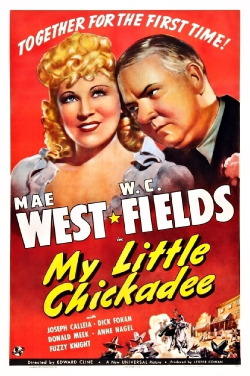
Review of My Little Chickadee (1940) by Blake P — 23 Aug 2016
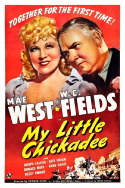
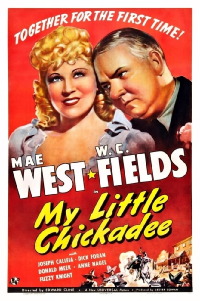
Not that modern audiences figure that a comedy co-headlined by Mae West and W.C. Fields equates instantaneous gold, but their one and only film together, 1940's "My Little Chickadee," is the cinematic equivalent of what Rachel Green's botched trifle might have tasted like in "The One Where Ross Got High." With their individual brands of humor opposite and lacking in cohesion, laughs aren't as prone to abounding as flinching is.
Fields's methods for getting a chuckle out of his audience involve him devising a character, a lovable nincompoop with an eggplant nose and the voice of a gorilla. West, in the meantime, charms by playing Mae West, an incredibly sexual tigress who delivers her every line as if it's the last in an argument and she'd rather die than not get the final word in.
Separately, they're forces of nature, ahead-of-their-time era definers. But together, they mesh with all the chemistry of a fly and a pool of vinegar; they seem to be fighting for the camera's attention, for the affection of consumers, to no avail.
The incompatibility between the two isn't so surprising. Though West wrote the screenplay and was perhaps the most vocally creative person behind the scenes, Fields, despite only penning a single sequence, was given equal credit in post-production. During filming, the latter, incapable of allowing for his female opponent to garner most of the movie's attention, drank heavily, started fights, and refused to deliver a performance devoid of camera mugging.
But regardless of if the pair appears to be starring in two separate movies, the film is a misstep in spite of its stars' disdain for one another. The screenplay, undercooked and heavier on one-liners than a Bond picture running on empty, is a weird disarray of multiple genres, and the acting, especially from Fields and West, is more flavored in dated, chintzy vaudevillian delivery than zesty, in-the-know sharpness. We feel like we're watching a film made by huge stars on the final legs of a prosperous career, doing everything they can to stay relevant. But because the 1940s saw the rise of Preston Sturges and Billy Wilder, comedy maestros who never took the easy way out, the styles of West and Fields seem out of touch in "My Little Chickadee," of another time and another place.
In the film, which is set in the Old West of the 1880s, West is Flower Belle Lee, a Chicago based saloon singer on her way out to the frontier to visit some relatives. But during the ride over is she kidnapped by The Masked Bandit, an infamous criminal with a fondness for gold and grand entrances. Whether Flower Belle and her captor had something going on before the abduction took place is unclear. But hours later, at her aunt's western home, she turns up, completely unharmed. "I was in a tight spot but I managed to wriggle out of it," she purrs after being asked how she got away so quickly.
But when it's inevitably discovered that Flower Belle and her kidnapper have been having a red hot love affair since her safe return, she's banished from town, only permitted to return if she regains her respectability through marriage.
On the train back home, she meets Cuthbert J. Twillie (Fields), a blundering con man. After noticing a hoarding of cash in his bag, Flower Belle comes to the conclusion that she's hit the lottery - she's been ostracized by a community for only a few hours and has already met a rich guy. Since she's a barracuda that wouldn't dream of wasting an opportunity to get ahead in life, she hastily marries Twillie, unaware that he's really a bubble-headed grifter and not a cuddly millionaire.
And the rest of "My Little Chickadee" follows their antics in Greasewood City, where Twillie is appointed town sheriff (only because the region's boss is a criminal and needs a knothead in charge of law enforcement to continue his reign of terror) and where Flower Belle digs deeper in her trying to discovery just who The Masked Bandit really is.
A tidal wave of gut-busting the film could be, but its humor is strangely stagnant. West's usually refreshingly bawdy femininity seems obvious and obligatory - her zingers, renowned for their envelope pushing, incur the wrath of the eye roll - and Fields's persona goes far beyond the limitations of what his little-goes-a-long-way instincts normally allow. I'd hope for anything besides something middling when a pair of comedy legends are brought together for something good, but the odds aren't always in my favor and West and Fields don't mix to make a tasty flavor.
This review of My Little Chickadee (1940) was written by Blake P on 23 Aug 2016.
My Little Chickadee has generally received positive reviews.
Was this review helpful?