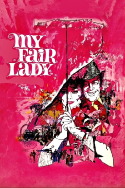
Review of My Fair Lady (1964) by Brett C — 05 Jul 2014
Review In A Nutshell:
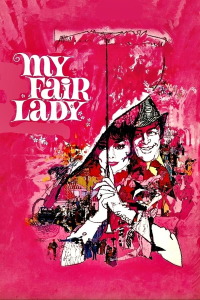
My Fair Lady tells the story of an impecunious Cockney woman that has been taken in by a well off, educated man in order to win a bet, transforming her into a presentable woman fit for the upper class society.
My Fair Lady contains an engaging plot that details the polarising levels of society in London, showing the difficulties of poverty and the snobbish attitudes of the rich and pretentious folk when they interact with the lower class. They would do whatever they can to get away from them, if that means giving out all of your spare change then so be it. This subject has always fascinated me as I have always wanted to learn more about the class division in England, why is it something that is constantly being touched on British films, and why are they so distinguishable from one another? My Fair Lady wasn't the first film I have seen that touches these ideas; others include Educating Rita and The Great Gatsby. These films speak about the need for individuals to belong in a particular society, as they believe it would provide them a life that is more rewarding. But what makes this film stand out is the ability to not make it all about the message, but also about the characters.
The characters in this film are entertaining to watch, true that in some moments they do reach to a point of being too "Hollywood", but I personally feel that it was tamed enough for me to still have a great time with it. The other two films that I have mentioned have a different approach/goal, as they are more concerned with the intended message and ensure that the thematic concerns are on full display, leaving the characters, dialogue and story as secondary priority.
Right from the film's start I was fascinated with the film's two protagonists, Eliza Doolittle and Professor Henry Higgins. The film develops their personalities early on in the film and ensures that they remain appealing until the film's end. We are treated to multiple sequences of the clashing of their personalities, particularly during the film's first hour, and we are given a goal that remains focused throughout, seeing Eliza transform into a "sophisticated" person. I was also impressed on how little the film budged in giving Henry Higgins a complete turn in his principles and values. The man was a complete tool, right from the first instance we see the character and he remains that way throughout the entire film and I like that about him, giving us the qualities of a man that is real rather than desired. We are also treated with a character that is the opposite of Higgins, Colonel Hugh Pickering. Pickering shows sympathy towards Eliza and though he was the one who formulated the idea of a wager, one can see the good intentions that were carried with that wager. He remains a respectable gentleman and gives us a glimpse of a man that everyone should strive to be. It was wonderful to see that not all men within the high society are an obnoxious and unsympathetic man.
The film lost a bit of its steam during the film's middle areas, not being able to shape itself as effective as the film's first and third acts. I was highly satisfied with the way the film ended as it excited the side of me that craves for the cliché emotions and also letting itself not be too explained, it shows us rather than tells us.
The thing that I always pick up on when watching Old Hollywood musicals, is limited the film's scope is. Very few musicals have impressed me with their ability to establish a setting; the one that is most deserving of praise is The Sound of Music. My Fair Lady is a film that is definitely limited in its scope, utilizing sets rather than locations in order to save money. I completely empathise the film's inability to film in locations and use a large cast as studios wouldn't be too comfortable spending too much of their money on one film. Luckily, My Fair Lady's setting isn't as much of a bothersome as compared to Oliver!, that film featured sets that felt too claustrophobic and lacking in any sense of reality, I was too aware that I was watching something artificial. Overall I was content with what the set designers have done for this film. I do want to mention that the costume designers in this film did a top notch job, especially for Miss Hepburn who looks ravishing in that iconic outfit when she was at the races.
The most important part of the musical is its songs, as it would be pointless of telling the story in this medium if the only aspect of it that is unique fails to create any sense of effect, if this is so then might as well craft the story into a traditional film. Not all of My Fair Lady's musical numbers work, as some felt a little lacklustre in its execution. The film's songs were able to emphasise the film's themes and flesh out a bit more of character's personalities; some were delivered in a upbeat and optimistic fashion but features lyrics that are quite depressing and pathetic, almost to the point of losing all sympathy towards the character, and I do speak all of this in a positive tone. The most memorable of numbers include "Wouldn't It Be Lovely", "With a Little Bit of Luck", "The Rain in Spain", and of course "Get Me to the Church on Time".
My Fair Lady features wonderful performances from both Audrey Hepburn as Eliza Doolittle and Rex Harrison as Henry Higgins. They both demonstrated great chemistry with one another and able to show the personalities of their characters without ever reaching near to the point of intolerable. It was wonderful to see Hepburn in a role like this, where I get to see a side of her that is not commonly found in her other films; also putting on an accent which I felt was appropriate given the standards of that time. It is too bad that it wasn't Hepburn's voice that I heard singing, instead it was by the wonderful Marni Nixon. She delivered such a powerful presence with her singing, with most moments edging out Harrison's performance. Later on in the film though, we do get to see Hepburn do what she does best, being fabulous. Rex Harrison was an arsehole in this film, and he performed it very well. It reached to a point where I actually felt hatred inside me, but since this is the film's intention, I see this as a favourable aspect in his performance. All in all it was a delight to watch these actors play their colourful roles without any hint of restraint.
My Fair Lady may not be the most acclaimed musical of all time but it does have its constructive attributes that makes it an important film and something that I would encourage everyone to see. If one has always had a sour perspective towards musicals, try to look past it and give this film a try.
This review of My Fair Lady (1964) was written by Brett C on 05 Jul 2014.
My Fair Lady has generally received very positive reviews.
Was this review helpful?