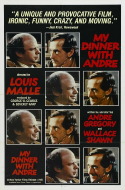
Review of My Dinner with Andre (1981) by Charlie F — 04 Jan 2015
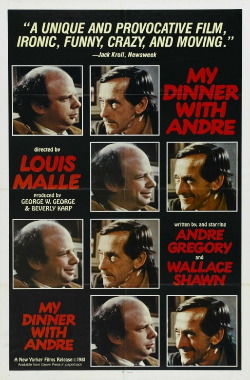
For all of its success at being something unique, a movie that consists almost entirely of two men talking to each other over dinner, "My Dinner With Andre" is also quite masterful in its use of some of the basics of storytelling and screencraft. It is particularly adept in its use of callback. One of the first things Wallace Shawn says to Andre Gregory when they meet at the restaurant, a long-delayed meeting Wallace tells us he has been dreading, is that Andre looks great. Andre replies that he feels terrible. Much later in the film, at a point when this early exchange might have been forgotten, Andre tells Wallace a story of the one person in a crowd who told him he looked terrible when everyone else had been blindly or artificially telling him he looked wonderful. Wallace reacts in his usual manner, with the pained squint and forced smile of someone who is not sure whether the person he is talking to is sane, and who is trying to decide whether to react honestly or with polite artificiality.
The conversation between them is sufficiently strange to provoke that kind of reaction from Wallace, who for most viewers is surely the more relatable of the two with his love of simple pleasures like coffee and electric blankets and his skepticism of Andre's new age mysticism, but the way their back-and-forth escalates is smooth and comprehensible. There are clear themes established through early repetition. Nazism recurs again and again in Andre's dialogue, probably because its brutal enforcement of homogeneity is the antithesis of his utopian vision of complete individual autonomy. The theater is a recurring topic of discussion and an allegory for life, and the two men's close familiarity with specific directors, plays, and artistic schools provide a grounding that keeps their real concerns-life and death and the roles and performances of everyday existence-from becoming formless abstractions. The movie is a unique and arty experiment, yes, but the script is tightly-structured and that structure is adhered to even as the actors steadily ramp up the intensity of their performances.
It is Wallace, as the stoic everyman, who has his foot on the pedals, rather than the more freewheeling and dynamic Andre. For a long time, Wallace's desire to avoid confrontation leads him to react with bemused, fearful, and puzzled silence to Andre's increasingly odd stories and claims of spiritual breakthroughs. This is the uncomfortable, strained conversation that Wallace dreaded at the beginning. Wallace's fear that the dinner would be awkward leads him to behave in just such a way to ensure that it is, through his non-committal or non-sequitur responses that only lead to awkward silences. But what Andre is offering him, he slowly realizes, is the chance to have a conversation that is honest and therefore not a chore. When Wallace begins to react as his own genuine self rather than as an accommodating version of himself, and to tell Andre "what I really think about all this," the conversation becomes more rapid, more elevated in pitch, but also less pained. It's a slow build over the course of the film until Wallace is almost shouting in the middle of the posh Manhattan restaurant, a setting which by this time is almost forgotten. The conversation, now two-way, has become all-absorbing.
The editing, too, is an area in which the great care it took to produce the film belies an adjective like minimalist. Cuts often come mid-word or at least mid-sentence, and this creates the impression of an unbroken conversation instead of one achieved in several takes on different days. There are several camera positions, but zooms are also used when a story of Andre's is particularly emotional and his voice begins to quiver. This helps to generate sympathy for him and to overcome our Wallace-like incredulity. The timing of the cuts also works to create humor, particularly in the early going when we see Wallace's reaction to particularly outrageous pronouncements by Andre.
This film is an unprecedented flight of fancy, but it flies by the grace of a deceptively controlled script and production. It gets down to the brass tacks of existence, not cheaply, but through the creation of two distinctive and likable protagonists. Wallace Shawn and Andre Gregory are attentive to the needs of the audience and proficient with the tools of their medium. They are masters of art.
This review of My Dinner with Andre (1981) was written by Charlie F on 04 Jan 2015.
My Dinner with Andre has generally received very positive reviews.
Was this review helpful?