Review of My Beautiful Laundrette (1985) by Edith N — 05 Sep 2012
The Outcasts of Thatcher's London.
It seems to me that your opinion of this film will largely be shaped by how much you already know about the social context in which it was made. I mean, it isn't just knowing that the white people in London at the time were not always known for being fond of the Pakistani immigrants. Heck, in order to figure that out, all you have to do is be aware that there are both lower-class, native-born people and immigrants in the same story. They have always been in conflict with immigrants, no matter when and where your story is set, unless somehow there are no immigrants. Then, they will probably be in conflict with people from the country. But there's more to the story than just that. There's also the fact that these were years of great conflict within the United Kingdom. Indeed, Daniel Day-Lewis would go on to make another movie set around the time this one was made about some of that other conflict. And that's only the start of things.
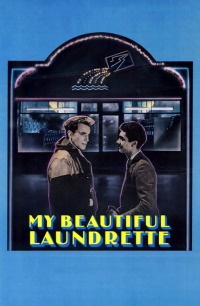
However, here, we are specifically looking at young Omar Ali (Gordon Warnecke). His father, Hussein (Roshan Seth), was a friend of Zulfikar Ali Bhutto. Now, after the death of Omar's mother, he is pretty much just a drunk. On the other hand, Hussein's brother Nasser (Saeed Jaffrey) is a seemingly successful businessman. About his only unsuccessful business is a laundrette (laundromat in the US) in a working-class neighbourhood. It is dingy and in ill repair, and thugs are always hanging around and menacing people. Nasser gives Omar the opportunity to run it, figuring that Omar can't do a worse job. Omar runs into his old friend Johnny (Day-Lewis), and he hires him at least in part just to renew the friendship. He and Johnny steal money from a cousin, Salim (Derrick Branche), who is also a drug dealer. They use the money to fix up the laundrette, kind of going along with the "broken windows" theory. Omar is expected to marry Tania (Rita Wolf), but he is in love with Johnny.
It's hard to express today just how problematic that relationship is. It isn't just that they're both men, though that was a much bigger problem in 1985. It isn't even that it was a bigger problem in their cultures than in the general population of the UK at that time. Johnny's particular subculture and Omar's both shared a fixation on masculinity that made male homosexuality a huge taboo. After all, the engagement to Tania is a major subplot, though Omar isn't particularly enthusiastic on the subject. However, what I think is even more important is that Pakistanis were the Insulted Immigrant Group of Choice in the UK in 1985. It is a curious fact of bigotry that there is one immigrant group which is more hated than any other at any given time and place. While the Mexicans are a perpetual target in the American Southwest, there have also been stretches where it was Guatemalans or Colombians. In 1985 London, it was Pakistanis.
This is a story of illicit relationships. It isn't just Omar and Johnny, though theirs is the most important to the story. Nasser also has a mistress, Rachel (Shirley Anne Field), whom he is supporting. Indeed, he is spending more money on her than he can really afford to, much to Tania's irritation. If the laundrette starts making serious money, he will be able to support both her and his family in the manner to which everyone is accustomed. He needs that in order to feel right about himself. He doesn't think there's anything wrong with having both a wife and a mistress. It's not unexpected for a man of his standing. However, he does believe that he has to be able to do right by both of them. He doesn't seem to have much in common with his wife (Souad Faress, I think) anymore, and indeed she's thinking about going back to Pakistan. However, that's not the point. The point is that she is his wife, and he is responsible for her wellbeing, even if he loves Rachel more.
I don't know if it's necessarily a bad thing that this movie is as dated as it is. After all, that means that the attitudes which shaped it have by and large gone away. It's not as surprising for two men to be in love now. I don't think fascism is as serious a trend in the UK now as then; certainly Johnny doesn't much fit our image of someone who would have been into the movement in that time and place. For one thing, he has too much hair despite being called a skinhead. Honestly, his haircut is at least as dated as anything else in the picture, and a shaved head is timeless. At any rate, the mores and attitudes which made Omar and Johnny's story unsurprising have changed enough so that there was always somewhere they could have gone and been treated just like anyone else, even though they're a Pakistani and a white guy. This is, today, just another love story. I think that's a really great thing, even if it means that a groundbreaking movie is now merely pretty interesting.
This review of My Beautiful Laundrette (1985) was written by Edith N on 05 Sep 2012.
My Beautiful Laundrette has generally received positive reviews.
Was this review helpful?