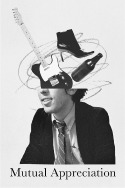
Review of Mutual Appreciation (2005) by Matt C — 06 Dec 2007
What's interesting about Mutual Appreciation is not that it captures the essence of Generation Y, those echo boomers born sometime between 1981 and the mid-nineties, but that it tries so earnestly.
It is, arguably, the first serious attempt at what Reality Bites, Slacker, Kicking and Screaming, Singles, and a host of other early nineties malaise films managed to distill for the X set. While not the first of its genre; "mumblecore", Mutual Appreciation is surely its most prominent; and comes with the street cred to back it up.
The film's fictional band "The Bumblebees" is comprised of real-life Brooklyn rocker Justin Rice, whose on-screen persona, like Jack White, needs only a drummer and "hates Math rock.
" The film is replete with such references, as its characters live in a New York peopled by Alvy Singer, Isaac Davis, and a host of other Woody Allen personae. Though, without a Tony Roberts, Liam Neeson, or so much as a Michael Murphy to counter-balance the needy, insistent intellectualism of its main characters, Mutual Appreciation becomes an exercise in absurdity, and, at the level of satire, manages an undercurrent of irony.
Unfortunately, Mutual Appreciation is not meant as satire. The central question of the film thus becomes, can our generation really be held accountable to the hipsters? Obviously, outside of Williamsburg, various art departments, and the Dave Eggers section of the local Borders, the answer is no.
The film itself centers around the awkwardness and ineffectual conversation of a group of friends whose primary focus in life appears to be laying on floors drinking red wine, sitting on floors drinking microbrewed beer, or making insolent remarks about couches.
The film's core conceit and macguffin is a "performance project," centering around gender role-reversal, a kind of deconstructive Vagina Monologues. Of course, its male characters, emasculated and boyish, already exist as nothing more than the objects of desire for the film's self-assured and insistent females and the device serves only to beat a dead, bisexual horse.
What social condition breeds such men, asks one reviewer, and to find the answer we might turn to other aborted attempts at generational drama; Gus Van Sant's Elephant, the ubiquitous American Pies, Can't Hardly Wait, Beverly Hills 90210, Saved by The Bell, Party of Five, and a host of other lesser-known clones.
Each work existed on screens, both television and silver, during the formative years of today's twenty-something, and, to the receptive viewer, created a kind of fabricultural pattern. The Jock, Geek, Rebel, Wigger, Prep and Brian Austin Green archetypes became more than a dramatic device, they became a convenient sorting mechanism.
If "imitation and replication are the new art for those who subscribe to the fabriculture," the hipster and his ironically masculine beard are, in fact, today's walking, talking Campbell's soup cans.
They may be the product of feminist-inspired after-school specials and of a culture interested in the mythological heights of the Haight. What else could explain the pilgramage to gentrified Brooklyn and the flop-house aesthetic of floor-laying so trumpeted by Mutual Appreciation's in-the-know heros and heroines.
In the end, the ironic distance afforded by the hipster is really tongue-in-cheek self awareness; it's hard to heed the anti-globalization and environmental warnings of a people who've driven hundreds, if not thousands, of miles to bathe in the warm, collective glow of communal art projects and vegan recipe clubs, leaving their hometowns as devoid of intellectual capital as Wal-Mart has of industrial.
This review of Mutual Appreciation (2005) was written by Matt C on 06 Dec 2007.
Mutual Appreciation has generally received positive reviews.
Was this review helpful?