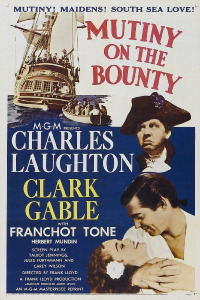
Review of Mutiny on the Bounty (1935) by Forrest P — 30 Jul 2012
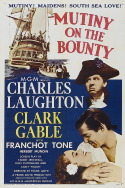
Frank Lloyd's thrilling take on the famous Mutiny On The Bounty may very well be one of the greatest seafaring films every made. Combining superb performances with a surprisingly deep screenplay and a director who knows his way around a ship, and we have a film that hits home in all the right places.
Adapted from a novel written jointly by Charles Nordhoff and James Norman Hall, the screenplay for Mutiny On The Bounty is practically flawless, particularly for such an early film in the Sound Era. The dialogue feels surprisingly fresh and natural, and a lot of the big speeches manage to carry a lot of emotional weight to them.
More than that, though, the characters written into this film are deeper and more complex than I could have foreseen, particularly that of the main villain: Captain Bligh. Bligh has gone down the records for being one of the greatest film villains of all time... and for good reason. Portrayed brilliantly by Charles Laughton, Bligh comes across as not a cruel tyrant, but simply as a relentlessly efficient leader. The way in which commands not only the discipline of the crew but also the swift attention of the audience makes one think that Charles Laughton has spent his entire career portraying only this man (some of his most famous onscreen credits include Witness For The Prosecution and Spartacus).
However, the reason that Bligh not only works as a great film villain, but also as a believable character is because he is depicted as not merely being intolerably cruel. Bligh is a cunning and masterful seaman and captains his vessel with his ultimate goal always prioritized and, yes, a fierceness that cannot be overlooked. It is his punishments, which are seen as being entirely too severe for his crew, that ultimately lead to the mutiny the title suggests.
Of course, it cannot merely be one good character that can save a film; all of the supporting cast must be able to stand toe-to-toe with Laughton without flinching. Enter the films hero, Clark Gable. Naturally, Gable demands complete respect no matter the role he is given, but here he must bring together all sides of a character. His character must understand that the mutiny they plan to do is *wrong*, but he must weigh that against his own understanding of justice. Gable brings forth all of these traits and dilemmas seamlessly.
Frank Lloyd's direction of the picture is also remarkable. As a 21st century audience member, it comes to my complete admiration that the feats on a ship could be portrayed as epically as they were in this film. Lloyd knows where to point the camera and how long to point it, which is fantastically important for a picture such as this one, when every frame counts in order to get the grandeur of the ship, the suffering of the crew, and the inner conflicts of the ship's leaders. His task is not easy, and Lloyd was up for the challenge.
But the simple fact that I keep coming back to with this film is how much better it was than it might have been under different hands. The urge to simplify is stifled. None of the conflicts have simple conclusions, none of the characters have shallow motives, and all the actions have lasting outcomes. What impresses me most about this picture is the depth it presents with its characters and story, and that's what makes it worth watching.
Mutiny On The Bounty is a thrilling and complex affair, worth viewing by anyone.
10/10.
This review of Mutiny on the Bounty (1935) was written by Forrest P on 30 Jul 2012.
Mutiny on the Bounty has generally received very positive reviews.
Was this review helpful?