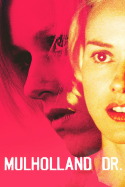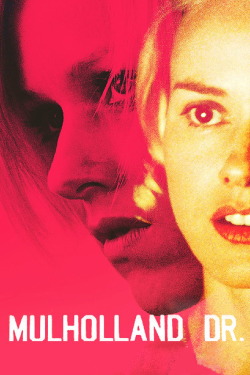
Review of Mulholland Dr. (1999) by Zain B — 26 Apr 2017
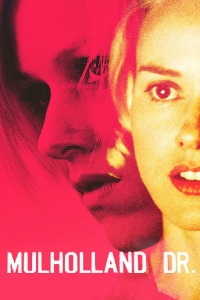
David Lynch shook the world at the start of the new millennium with Mulholland Drive, held by many to be among the greatest film since. The first of its kind in the genre, Lynch described it as a film about "a love story in the city of dreams", but to the first-time viewer it is just as capable of being described as "the triumphs and tragedies of the most popular political family in American history", or something equally arbitrary. Asides from being a splendid film purely in cinematographic terms, Mulholland Dr. was also a prominent political statement on two fronts: first, in its challenge against conventional cinema, and second in its novel approach to capitalism and the American Dream.
Mulholland Dr. tells its story in for the greater part in a "main" line, which is about a woman helping an amnesiac recover her memory. Running in parallel are a sequence of seemingly unrelated vignettes that do not tie into the, until the very end of the film. Many of these marginal notes remain unexplained even then, and their ambiguity is not a flaw, but rather a crucial element in the film's mystery element. The film as a whole does not proceed in an ordered plot, but rather in a combination of dreams and flashbacks. In doing so, Lynch overturned the definition of cinematic narrative, which had hitherto gone unchallenged. The idea that films must follow a temporal plot progression, or indeed that they must display narrative logic at all, was directly called into question with the film's release. What followed was a realization that audiences enjoyed having the opportunity to piece together a plot in absence of an absolute definition: something which occurs to an extent in all mystery films, but never on a scale as large as Mulholland Dr., and certainly not at the level of form.
While the meaning that Lynch intended is known only to himself, a commonly accepted interpretation is that the first part of the film is a dream in which Diane Selwyn dissociates from herself after committing the murder. This is an example of Freud's theory on the unconscious being brought to life: it has all the elements of a dream-work. There is displacement, whereby Diane is incarnated as Betty Elms, the "ideal" Diane before her downfall; and Camilla is split into separate entities, Rita the part that Diane loved and the blonde Camilla the part she despised. There is condensation, whereby the perceived power behind all of Diane's misfortune is embodied as a mafia, complete with the cowboy as the strongman arm; and Diane's desire for recognition and fame is brought to life in the love scene she auditions for. The film is packed with metaphor, including the man behind the diner as the embodiment of Diane's failure, and Diane's corpse in the dream as a foreboding towards her suicide. Color and lighting are used to spectacular effect, creating an ominous suspense around the mafia, an unsettlingly bewildering atmosphere in Club Silencio, and maintaining suspense and darkness throughout the film.
Through Mulholland Dr., Lynch achieved a twofold purpose. Not only did he show that a film in which the primary tool of storytelling is metaphor rather than narrative can be successful, he also used the film as a protest against the American Dream (and by extension, capitalism). Mulholland Dr. is essentially what could be called a "failure story", a testimonial to how the idea of the American Dream benefits only a very few at the end, to the loss of the common man. By portraying Diane as a young hopeful actress, we see how a mere turn of chance results in her never receiving a big break, while Camilla becomes more and more successful. All the while, this affects their strained, forbidden relationship, until jealousy drives Diane mad and she kills both of them. Metaphorically, this is a representation of how competition at the expense of social relationships results in the mutual destruction of both parties.
In its protest against capitalism, Mulholland Dr. attempts to prove that its fundamental tenets are flawed. The idea that anyone can pull themselves up and succeed in the world is challenged in the dream, where it is revealed that the system is tightly governed and rigged by a small group of powerful people who are able to control the flow of wealth. They can blackmail and force Adam into hiring an actress against his imperative as a director. In doing this, Mulholland Dr. slams capitalism as a system which is not truly meritocratic, and provides only an illusion of free will as it guides a person's hand from the background.
In reality, the film provides a novel and alternative way to challenge capitalism, where before Marxist demystification was the only methodology for uncovering the flaws in a system. While both Marxism and the perspective the film provides have a common goal, their approaches are fundamentally different. Marxism argues that mystification is a result of a non-empirical, unscientific worldview, and therefore demystification counters that by laying bare the facts without any distortion - presenting the world as it is; whereas in Mulholland Dr., the methodology relies heavily on metaphor and distortion to unveil the flaws in a system. That reliance means that this new form of demystification certainly isn't Marxist in nature, but perhaps a more easily accessible and understandable one to society at large. Where Marxist demystification may appear very hardline and difficult to accept for the common man (and is also very difficult to accomplish in the first place), metaphoric demystification is a softer, artistic way of opening minds to challenge capitalism themselves.
Mulholland Dr. is an example of revolutionary cinema at its finest, bringing political change to the film industry and to society as a whole. It questions the status quo in cinematic narrative and in economics, all the while maintaining a dark, mysterious atmosphere which leaves the audience wondering so that the individual must find their own answers, and that has secured it a rank among the greatest films of all time.
This review of Mulholland Dr. (1999) was written by Zain B on 26 Apr 2017.
Mulholland Dr. has generally received very positive reviews.
Was this review helpful?