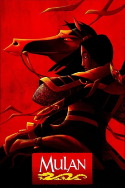
Review of Mulan (1998) by Edith N — 29 Jan 2012
Alas, Poor Marni Nixon Again.
The problem with adapting this story is that, let's face it, it's form a time and place with extremely different values from the time and place it was made. Celebrating the traditional Chinese feminine virtue of modesty doesn't quite work in modern-day Hollywood. (Or Florida, where the animation on this one was actually done.) In fact, the original poem ends much the way most real-world versions of this story have ended--with the woman returning home, her comrades-in-arms still believing that they had served with a particularly boyish young man. Modest beyond what you'd expect possible in a military camp, possibly, but male. It's happened many times over the years. More times than you'd believe. Oh, the traditional Mulan went on to life as a woman, which not all returning cross-dressed soldiers have, but this was a woman trying to bring honour to her family, which meant she did plan to return in the end.
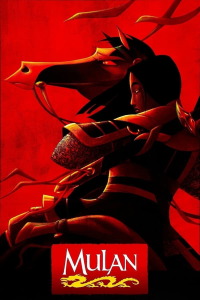
Mulan (Ming-Na with the singing voice of Lea Salonga) is the daughter of the Fa family, and she is having serious trouble doing what's expected of her. Namely, to be quiet, modest, and married. She disgraces herself in front of the matchmaker (Miriam Margolyes) and is told that no one will marry her and she will disgrace her family. But the Mongols are invading, and every family in China is to send one man. Mulan is an only child, however, and her father (Soon-Tek Oh, I think) is old and lame. She begs the help of her ancestors, then chops off her hair and sets off with her father's sword and armour. When she reaches the camp, it is in the company of Lucky Cricket Cri-Kee (Frank Welker) and Messenger of the Ancestors Mushu (Eddie Murphy). She declares her name to be Ping and works hard at being One of the Guys, all the while falling in love with Shang (BD Wong, singing voice Donny Osmond!), her commanding officer. And, of course, fighting the Mongol invasion.
Not that the Mongols were invading at the time the Mulan poem is set, of course, but whatever. We accept certain conventions in our fiction--even if it's our own culture and we should know better. King Arthur is a medieval knight even though he lived at the time of the Saxon invasion. So okay, the Chinese are fighting invading Mongol hordes. This is a historical inaccuracy I can accept. I'm not entirely sure why the leader of the Mongols (Miguel Ferrer, possibly?) is an actual monster, but I suppose that's an artistic convention as much as anything. So your villain has claws. I think a more developed villain is a better villain, and I think that's part of why this movie isn't as good as it could have been, but not everyone agrees with me on either point. And it's certainly pleasant that Disney finally started looking outside Europe for its heroines. Though of course Mulan does not strictly qualify as a Disney Princess, given that she is born common and that her love interest is as well.
I could have done without Eddie Murphy. We have two sidekick animals here, which was almost two too many. At least the cricket doesn't talk. In the deleted scenes, the director talks about how good an actor Eddie Murphy is, but it's worth noting that whoever wrote the trivia section on the IMDb page refers to Murphy's career in past tense. Perhaps inadvertently, but it's telling all the same. I have enjoyed plenty of sidekick animals over the years, but I think most of the best of them don't talk. They were probably trying to recreate the magic, so to speak, of [i]Aladdin[/i], but much as I love the work Robin Williams did there, it came at the expense of maybe just developing the main characters a bit better. Here, it felt as though they thought "headstrong" was enough character development, and the love interest is barely explored at all. Oh, better than some of the princes in other Disney movies, but again, the best princes are the best developed ones. Who cares about Snow White's prince, after all?
The songs are decent enough, and I suppose it's nice that Marni Nixon was getting work--as June Foray's singing voice, yet. The animation style wasn't anything particularly striking, though there are a few beautiful Chinese-style curves in various places. By and large, though, it doesn't much seem concerned with looking all that Chinese. I don't think the symbol on the medical tent was supposed to be the Japanese flag, but it did look like it, which is something someone should have noticed. Okay, and there was the clever bit where Cri-Kee's jumping about the page with ink on his feet sounded like a typewriter, not that much of any kid watching it ever again is going to know what a typewriter sounds like. (Probably already true in 2002!) It's not Disney's weakest effort. Not even close. For one thing, I was actually willing to watch it. But it's not one I would seek out again, and I'm not all that inclined to buy it, Though I don't think they've bothered putting it in the vaults.
This review of Mulan (1998) was written by Edith N on 29 Jan 2012.
Mulan has generally received very positive reviews.
Was this review helpful?