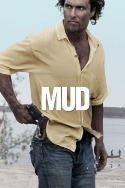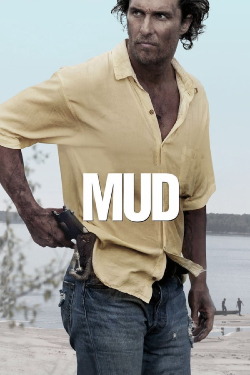
Review of Mud (2013) by Shiira — 05 Jun 2013
It's a white trash family: three brothers, uneducated Southern rednecks all, Arkansas boys who never left town, fatherless boys barely getting by, and still angry. Kid owns nothing but the tent he pitches in the backyard of his older brother, Son, the eldest, the angriest, the only one with shelter, an actual house with a roof, indoor plumbing even.
And then there is boy, the middle child, who lives, literally, in a van by the river, the Mississippi, where Huckleberry Finn and Jim, a runaway slave, and likewise, Mud and Tom Blankenship, floated down to freedom in The Adventures of Huckleberry Finn and Mud, respectively.
As far back as Shotgun Stories(the filmmaker's 2008 debut), the Mark Twain novel, albeit less explicitly, found a way to impact the narrative, as it pertains to race relations among blacks and whites in this filmic South.
Boy, a middle school basketball coach, diagrams plays for his integrated team, schemes, he tells Kid, are based on Nolan Richardson(the first black coach to helm a predominantly white institution in the old South), whose style of ballin he implemented at Arkansas was given the label "forty minutes of hell".
Huck, the precocious boy Twain equipped with a relatively progressive mind, more progressive than what passed as thinking in the 19th century South for the most part, says to himself, "All right then, I'll go to hell," before he tears up the letter he addressed to Miss Watson, his guardian, concerning Jim's whereabouts, deciding that he won't doggedly conform to his brethren's policy of degenerate thralldom.
With his mind made up, in regard to rescuing the slave from human bondage, Huck muses: "Because as long as I was in, and in for good, I might as well go the whole hog," or in other words, an entire razorback, a half-breed pig, whose caricatured likeness serves as the state university's nickname for its sports teams, whom Boy champions, both miscegenation(he once had a black girlfriend, and perhaps, kids) and Arkansas hoops luminaries such as Sidney Moncrief and Corliss Williamson.
Forty minutes of hell, according to Richardson, originally referred to his team's conditioning drills, a system of values, racist values that the generically-named boys buck, and likewise, Huck, who rebels against institutionalized racism, in which nature wins over nurture, as he willfully follows Jim into hell.
Ellis, conversely, in Mud, was raised by progressive-minded Southerners who seemingly turned their backs on the Confederate flag, since the boy's name, a Yankee name, conjures up Ellis Island. The father, a small business owner, sells fresh fish to a largely black clientele, and when his son shows up late for work, he docks the boy ten dollars.
No ensuing protestation comes out of Ellis' mouth about the pecuniary fine, since good service, the boy reckons, is a colorblind matter. Later, in Mud, Ellis and his best friend Neckbone, knock on motel room doors, posing as fishmongers, in order to locate Juniper, but before they reach her, the film poses a question, a dialectical one, as a black man, from his entryway, staring blankly at Ellis and Neckbone, asks the two boys, "Why the hell would I want to buy fish?" After all, Huck, despite being Jim's friend, still insists on the slave serving him, telling the runaway Negro to "pass me along another hunk of fish and some hot cornbread.
" The black man in the room, arguably, is a stand-in for Jim, and he doesn't seem all that impressed that Ellis goes from house to house, handing black customers their bag of fileted fish, according them the same respect as white men.
In their heart of hearts, the black man feels, he and his people will always be, in Twain's own parlance, "n*****s". Wherefore The Adventures... is considered, by some, a racist novel, Minor Threat, a DC hardcore band, was also leveled with the same charge of intolerance, in due part to the song "Guilty of Being White".
Creating even more dissonance, Neckbone wears a Fugazi tee. "You blame me for slavery," Ian MacKaye writes, "a hundred years before I was born," and, perhaps, not coincidentally, both novel(1884) and album(1984) are separated by the same hundred years.
For sure, judging by the askant manner in which the black man from the motel dismisses the boys' harried pitch for fresh catfish, he thinks they are guilty of being white. This reconstructed Jim no longer seems grateful for the kindness of white people, and moreover, doesn't want to participate in a film where slavery is coopted as a metaphor for unrequited love, as in "no man is an island.
". Neckbone, in professing his hatred for snakes, wittingly or unwittingly, conveys an antipathy for African-Americans, since the cottonmouths slithering in the pond are black. When Ellis gets bitten, in an intertextual sense, Jim is avenging the prank Huck pulls which leads to his rattlesnake bite.
This review of Mud (2013) was written by Shiira on 05 Jun 2013.
Mud has generally received very positive reviews.
Was this review helpful?