Review of Mrs Brown (1997) by Alexander C — 12 Sep 2012
A Queen Defined by Her Grief.
I just don't have as much interest in Victoria. She was not quite so stuffy as everyone now believes, of course, but she certainly put forward that impression. When Albert was alive, she was a little over-inclined to defer to him; after Albert died, she spent ten years in near-total seclusion. She wrote, but her journal of the Highlands isn't as interesting to me as Elizabeth I's poetry. Her marriage seems to have been happy, but her children were an utter disappointment--to her too, I'm sure. So much that was interesting was happening around her, and she seems to have been utterly out of touch with all of it. By the time she came around, the primary job of the monarchy was to be interesting, and I don't think she even managed that very well. What's more, during the period covered by this film, the British people had it made quite clear to them how easily they could do without a monarch at all.
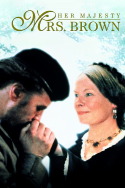
The year is 1861. Prince Albert has died, and Queen Victoria (Dame Judi Dench) is in deep mourning. She is giving over all governance of the country. One of her family's faithful servants, John Brown (Billy Connolly), is brought down from Balmoral to take care of her horse. He decides to take care of her completely, getting her to open up enough to go out riding. Then, she goes back up to Balmoral herself. Brown begins to have more and more influence over her, to the extent that there are to this day rumours that the two were secretly married. Her son, the Prince of Wales (David Westhead), resents John Brown mightily. So, too, do the various ministers and Members of Parliament who are now dealing with republican sentiments. France, after all, did not have a monarchy at the time, and France was closer to London than the Queen. Brown encourages Victoria to stay secluded, believing that it was safer for her that way. The country is going its own way without her, and some people are happier about that than others.
People expect Elizabeth I to have been a proto-feminist, given that she was queen in her own right and felt that she deserved it. In fact, her determination not to marry was in part because she didn't want to share the throne. People are wrong about this. However, Elizabeth lived in an era where there was no such thing as feminism, and we just last night discussed the beginnings of the women's rights movement as personified by Elizabeth Cady Stanton and Susan B. Anthony, who lived at the same time as Victoria. Victoria was actually of the school that women didn't need the vote, because they had husbands to protect them. I'm not entirely sure she believed she should have been the queen. Certainly it was not her decision that her husband not be given the title of king; she wasn't happy about that at all. Maybe that's one of the reasons I don't think she's all that interesting; she was in the right time and place to make advances that she just never bothered making.
However, Dame Judi does well enough by the role. She was nominated for Best Actress for this, but the story isn't really about her. She's much less enigmatic than he is, for one thing. He might or might not be in love with her; he definitely loves her in one way or another. It might be something like the idolization of a subject for a monarch, but I really don't think that's it at all. At bare minimum, he considers himself as much his protector as she is his, for all that she actually has the job of being his protector. (Not that she's doing her job.) The arguing he does with her is worrying about her best interests. He doesn't care if it's best for the country. Everyone else is most interested in the country--well, Bertie is most interested in himself and when he'll get to be king. Perhaps the biggest draw to Brown for Victoria is that he's the only person who seems to be interested in her first and foremost. That's very seductive.
It's a story intended to humanize a monarch of whom most people have a very specific mental image. We think of her as stuffy, as joyless, as miserable and depressed. This is, for at least some of her reign, true. On the other hand, she was a woman who loved very deeply. Whether or not she married John Brown, she loved him so much that Bertie had every tribute she'd had made of him after his death destroyed after hers. The love we see here is almost like the love of an older brother and younger sister, and the movie never really suggests that there's anything else. It's true that it doesn't matter what kind of love exists between a man and a woman; someone is going to assume that it's sexual unless they actually are blood relatives. It's a crying shame in a lot of ways, and it has certainly made life difficult for more than one royal female over the centuries. The curious thing about Victoria is that she was one of the last royals who really didn't have to care what people thought, and she's arguably one of the reasons later royals did.
This review of Mrs Brown (1997) was written by Alexander C on 12 Sep 2012.
Mrs Brown has generally received positive reviews.
Was this review helpful?