Review of Mr. Skeffington (1944) by Edith N — 21 Jan 2012
Really, He Deserved Better Than Her.
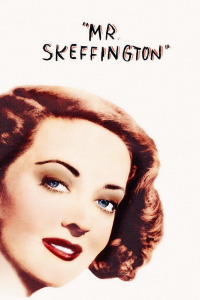
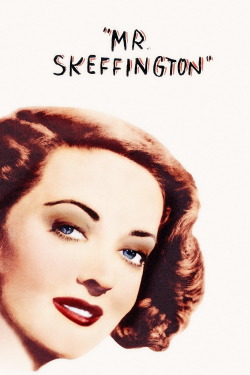
Much of the debate about this movie centers around the simple fact that Bette Davis was not a conventionally beautiful woman. This means, alas, that she was horribly miscast here. She wasn't pretty enough and she projected too much of an air of intelligence, and Fanny Skeffington needed to be beautiful but dumb. Of course, Bette Davis was able to project an air of being hard which was important to the character, but that's really only one out of three. I mean, I think this is that rarest of performances, a role where Joan Crawford would have been better cast, though Joan Crawford wasn't conventionally beautiful, either. Merle Oberon and Hedy Lamarr both turned the part down, but either of them would have been better in it. There are roles which permit for unconventional beauty, but this wasn't one of them. And of course, I'm not calling Hedy Lamarr dumb, but she was better able to make you think she was.
Fanny Trellis is a starving socialite a hundred years ago. Her brother, Trippy (Richard Waring), works for Job Skeffington (Claude Rains)--or did. He embezzled quite a lot of money from him, and Skeffington, unaware of the family's poverty, tells him that he must either repay the money or go to prison. So Fanny marries Skeffington instead. She is beautiful and has many suitors, but she is loyal to her brother. Who gets angry at her over this mercenary transaction and runs off to war. After he is killed, she stops even pretending to have a decent marriage and lets all sorts of men chase after her. Eventually, they divorce, and he and her daughter (Sylvia Arslan then Marjorie Riordan) go off to Europe, leaving her to be the object of pursuit. Only Fanny comes down with diphtheria, which ravages a person's looks, and Fanny's looks had become the only thing she cared about. Looks and money. And now, she isn't adored anymore and doesn't want to live.
Personally, I think that being loving is more important to a person's looks than being loved, and the important aspect of Fanny's character is that she isn't. She adores her brother and is willing to marry for his sake, but I'm not sure she rises above just being fond of much of anyone else, even her cousin, George (Walter Abel). I'm not sure she even cares that much about her daughter. I think she's revealing more of herself than anyone wants to acknowledge when she says she doesn't want a baby because they make you old. No matter how young she is, her age will be marked in relation to her daughter--she is now old enough to have a daughter who is ten, or eighteen, or whatever age Young Fanny is. And when she sees her suitors grow older, she knows that they are seeing the same thing in her. Perhaps if she surrounds herself with people who haven't known her very long, she can pretend that there isn't very long to have known her.
Fanny and Trippy are orphaned at the beginning of the movie, but I have to wonder about their parents. The pair of them are such horrible, horrible people. Fanny is willing to sacrifice quite a lot for his sake. Yes, Job Skeffington is a wonderful person, really far better than Fanny deserves. But there [i]is[/i] the fact that he's a Jew, which limits where Fanny and any children she might have would be received. And she doesn't love him, not that a woman of her social standing could be guaranteed the chance to marry a man she loved at that time in that place. But she had a ton of choices, and she made the one he did for her brother's sake. Which he then scorned her for instead of being decently grateful that she kept him out of prison. We don't know anything about Cousin George's family, either, but it seems that he's descended from a better branch of the family than they are, because through it all, he seems a decent and level-headed person. Young Fanny, if she takes after her mother's side of the family at all, takes after him.
For all that the end of the film must take place not long before the movie was actually made--the words "concentration camp" are actually spoken!--it still seems like a period piece. Fanny has, by the end, retreated into the clothing of her past. Possibly it's the prelude to a full-blown descent into madness, or would be had we not gotten our dreadful tearjerker of an ending. Almost nothing in it ever seems to be from the 1940s. I can't help assuming that the book must have been written before the US got into World War II, because that mention of a concentration camp is also about the closest thing to a mention that there's another war going on. The whole thing feels as though it's set in some amorphous "long time ago," even though major world events are also major plot points. Perhaps this is because nothing really touches Fanny Skeffington unless it's happening in her own living room. Sometimes not even then.
This review of Mr. Skeffington (1944) was written by Edith N on 21 Jan 2012.
Mr. Skeffington has generally received positive reviews.
Was this review helpful?