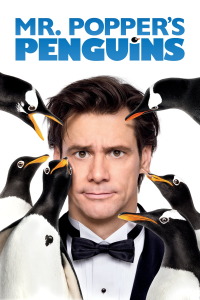
Review of Mr. Popper's Penguins (2011) by Shiira — 03 Jul 2011
Comedy is drama in disguise. It's no wonder that the penguins stand in rapt attention at the sight of Charlie Chaplin's "The Gold Rush" playing on the television. The flightless birds sense a kindred spirit with the mustached man sporting a bowler hat and cane.
Like "The Tramp", the penguins want to go home. About his craft, Chaplin once said, "Life is a tragedy when seen in close-up, but a comedy in long shot." "Mr. Popper's Penguins" knows this.
When the penguins escape from their master's apartment, the silent comic's theory proves to be ever so true, as the filmmaker gives us crowd-pleasing shots of the Antarctica natives out in the city, looking adorable and full of high spirits, although the truth of the matter reflects the dichotomy embedded in Chaplin's words.
These penguins, unused to the city sounds and innumerable amount of passing New Yorkers(in cars, or on foot), are undergoing a great deal of trauma, no thanks to the master's explorer father who stole them from their home at the end of the world.
In an almost Chaplin-esque moment, Nimrod stops to look at a stuffed penguin(a homage to "City Lights"), which hints at the yearning this group has for their families back at Cape Royds, or some other gentoo colony.
But in the meantime, Tom Popper will suffice. As surrogate parents go, he's not bad, even though the birds are being used to regain the divorcee's children's love. Because of the penguin's stature, their social anxiety, especially at the Guggenheim, gets misconstrued as comedy, which is not the case for a larger animal, like Buddy, the titular ape in the 1997 film about Trudy Lintz.
Size matters. The moviegoer understands right away that the socialite's pet belongs in the wild, whereas the penguin, made human through the anthropomorphism of an enviro-propagandist doc like "March of the Penguins", as a result, seems more adaptable to civilization.
To Popper's children, they're exotic lapdogs. At the museum(in a scene similar to "Buddy" where the ape goes mad at the Chicago World's Fair), the penguins abase themselves through the filmic language of slapstick comedy.
While Popper tries to woo a new client, the rattled birds take advantage of the spilled water of an overturned champagne bucket by belly-sliding down the corkscrew-shaped museum layout. It's a cry for help, this seeming playfulness.
The demented bunch transform the Guggenheim into a banal marine animal park. But this penguin act is filled with latent pathos. One after another, the birds utilize a sculpture as a ramp to help launch themselves over the retaining wall, landing haphazardly into the crowd below with total disregard for their own safety.
It's a mass suicide attempt, played for laughs. There's a precedent for such nihilism. In "Encounters at the End of the World", the 2007 documentary about Antarctica, which features a segment on penguins(not the "fluffy" kind), filmmaker Werner Herzog elicits darker laughs from he moviegoer when he asks an ornithologist about the possibility of a gay penguin(no, but there is such a thing as penguin prostitutes; they're sluts about nesting rocks), or an insane penguin.
True to Chaplin's words, the filmmaker captures a comic moment, albeit in the blackest sense, in long shot, of a penguin gone mad, as he races toward the mountains, away from the colony and feeding grounds, where his insatiable wanderlust will end in death from exhaustion and frostbite.
No explanation is given for the bird's mental collapse, but in "Mr. Popper's Penguins", the first bird, Captain, sent ahead of the others, loses the egg he was put in charge of incubating, and becomes more distraught than the audience(and the movie itself) realizes.
In his grief, the penguin, harboring delusions of being an eagle, leaps from a rooftop to avert capture from zoo authorities. It's only happenstance that the bird had previously entangled himself with hang-gliding equipment during the chase.
Obviously, a penguin wouldn't know he has the wherewithal to fly, so his jumping, in a sense, is a decision he makes unilaterally from the anthropomorphic demands of the script(that supposes the bird knows he won't fall).
To the scientists and other oddballs in the Herzog film, Antarctica is the end of the world, but to the Captain, it's simply home. As for Popper himself, he's no less crazy than Rene Russo in "Buddy".
Like the "terra bus" driver at McMurdo Station who quit his cushy banking job to become a world traveler, the profit-minded realtor has the same epiphany about the world. It's not all about money.
Reminiscent of "Close Encounters...", in which a man builds the Devil's Tower in the family home, Popper transforms his house into a slice of Antarctica. Like Roy, he slips into madness, choosing his obsession(saving the Captain's egg) over the family(he loses his job).
Perhaps he had confused the northern lights for a close encounter of the first kind.
This review of Mr. Popper's Penguins (2011) was written by Shiira on 03 Jul 2011.
Mr. Popper's Penguins has generally received mixed reviews.
Was this review helpful?