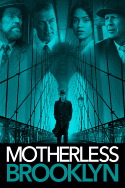
Review of Motherless Brooklyn (2019) by Bertaut1 — 21 Dec 2019
Looks great and is well-acted, but the pacing is turgid.
Jonathan Lethem's 1999 novel Motherless Brooklyn may appear to be an old-fashioned private-eye noir, but in reality, it's about gentrification, institutionalised racism, political corruption, and how such things are woven into New York City's historical fabric. It's a quintessentially postmodern narrative, fracturing the relationship between the physical and the temporal by taking the sensibilities of 1950s noir and supplanting them into an end-of-century milieu. Written for the screen, produced, directed by, and starring Edward Norton, the 1957-set film asks how much corruption are we willing to forgive in a world in which there's a confluence between power and amorality. An average noir mystery, whilst it's aesthetically impressive and the acting is universally excellent, the film can be spectacularly on the nose and didactic. It also moves at a snail's pace, and Norton is never really able to generate any sense of urgency.
New York City, 1957. Frank Minna (Bruce Willis) runs a small PI firm staffed by men whom he rescued from an abusive orphanage when they were still children. He's most fond of Lionel Essrog (Norton), who suffers from Tourette Syndrome, and who has a photographic memory. When a meeting between Minna and unidentified parties becomes contentious, tragedy strikes, and Essrog determines to get to the bottom of the case, slowly unearthing a labyrinthine conspiracy involving local government and urban redevelopment plans.
Apart from relocating the story to 1957, the most significant change to the plot of the book is the addition of Moses Randolph (Alec Baldwin), who's based on Robert Moses, the man largely responsible for New York's high-way infrastructure, the departure of the Brooklyn Dodgers to LA, the development of Long Island, and whose controversial urban redevelopment philosophies continue to be implemented all over the world. Operating with almost complete autonomy from regulatory oversight, Moses was a narcissist obsessed with power, and an amoral racist, and so too is the character in the film.
In terms of genre, the film features many of the trappings of classic noir – the world-weary private eye, the laconic voiceover speaking directly to the audience from an unspecified point in time, the seemingly important clues which ultimately lead nowhere, the seemingly irrelevant clues which ultimately lead somewhere, the smooth jazz score, the smoky jazz clubs, the chiaroscuro lighting. There's even a scene in which Essrog finds an address written on a pack of matches.
Motherless Brooklyn's most obvious strength is its aesthetic. Beth Mickle's production design, Michael Ahern's art direction and Amy Roth's costume design are all exceptional, contributing to the nuanced and immersive period-specific tone, with the milieu feeling lived-in and completely authentic. Norton's direction is, for the most part, straightforward and unfussy, but one visual motif he uses several times is shooting directly from Essrog's POV either during or immediately after the character has taken a beating. It's a nice (if somewhat unsubtle) directorial choice, drawing us directly into Essrog's experience when he's at his most vulnerable. On the other hand, the dream scenes are far less effective, feeling as if they're from another film entirely.
For all its thematic importance and laudable aesthetic aspects, however, I found Motherless Brooklyn disappointing. The pacing is so lacking in forward-momentum that the story is practically somnolent. Partly because of this, it's a good 20 minutes too long. I understand Norton wanted to let the material breath, but there's a difference between giving the characters and themes room to develop and stalling for the sake of it, and so much of the film feels like the latter. There's also a disconnect between the politics and the detective story. In Chinatown, everything feels organic – the personal and the political are intertwined. In Motherless Brooklyn, however, Norton is never really able to integrate the two. Another issue is that because the novel features 50s values displaced into the last years of the century, the endemic racism is deeply disturbing – society today is more enlightened about such things, but here's a novel in which characters are acting like it's 40 years prior. This is a vital part of Lethem's postmodernist deconstruction of power structures. However, with the film set in the actual 1950s, the racism feels like period-appropriate window dressing, losing virtually most of its thematic potency.
An old-fashioned detective story with a lot on its mind, Norton's passion for the material is self-evident. However, that passion hasn't translated into an especially good film. Void of almost any tension, although it looks great, Motherless Brooklyn is a film unsure of its own identity and unable to make us care about much of what it depicts.
This review of Motherless Brooklyn (2019) was written by Bertaut1 on 21 Dec 2019.
Motherless Brooklyn has generally received positive reviews.
Was this review helpful?