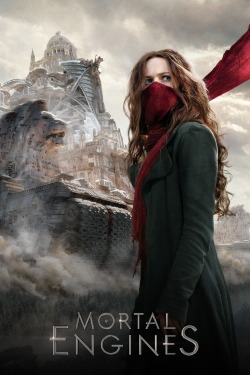
Review of Mortal Engines (2018) by Hnestlyonthesly — 12 Oct 2019
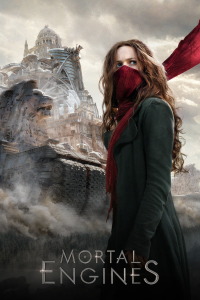
Mortal Engines resists clichés and forges ahead with some welcome changes to the YA fantasy genre, despite making new mistakes, opening the same weekend as a Marvel movie.
First and possibly last time I will have a personal story to share about a movie: when I was studying in England for a semester, I was in a place with a lot of old bookstores where famous authors would frequent and I had a chance to meet Phillip Reeve at a booksigning event where he read from a new piece he was working on and talked about making the jump from illustrator to writer. He was one of the most entertaining authors I had met and he left a big impression on me. One of the things that I remember him saying about his process was that he liked drawing scenes and then after he arranged images, he would attempt to connect a story that would make those images work. He also said he liked writing stories with people who seem like good guys reveal themselves to be bad guys and vice versa, only, I think the way he put it was, “where the baddies end up being goodies and the goodies sometimes are baddies.” That desire to challenge expectations might seem pretty simple at first glance, but its implications are deeply subversive and challenge many of the bread-and-butter stereotypes of YA fiction.
I’m not saying that Mortal Engines is a perfect film, but I think that it faithfully adapted many of the most successful, challenging aspects of the book: a skepticism of the efficacy of violence, an avoidance of the glorification of violent heroism, a resistance of lazy erotic storytelling, and a self-awareness about epic battle scenes. Any of those elements on its own should have been enough to set this punchy little tween fantasy movie apart, but unfortunate timing (on the very same weekend as Marvel’s Into the Spiderverse) may have undone this film before it even had a chance.
The film features up-and-coming actress Hera Hillmar as Hester Shaw (the first time I saw her was in the first of two different films about the Armenian genocide at the same film festival in San Jose last year–her performance was actually pretty fun) and Justin Trudeau wannabe Robert Sheehan as Tom, who lives on a rolling city-fortress of London in the distant post-apocalyptic future. There’s a betrayal or maybe a double betrayal. One of the criticisms that’s been leveled against the film is that the bad guy’s motivation is to be the bad guy, which I think is maybe fair criticism, though there’s room for apologetics about the social politics around New Colonialism and the many wide shots of cheering elites in their rooftop gardens as devastation rains down on less fortunate towns. More important, I would suggest, than the obvious villain of the film are all of the little betrayals and jarring treacheries of everyday life. The random turn of luck that happens so often in every other fantasy movie is a “hyperobject“, a thing that looks one way but is another, as Timothy Morton memorably puts its, “like the space worm in Star Wars that Han Solo docks inside thinking it a cave.”.
Some spoiler analysis: one of the breakout stars of the film is Jihae, who plays Anna Fang, part of the resistance movement of “anti-tractionists.” One of things that makes me instantly really like a story is its ability to create and then kill off compelling secondary characters, rather than encasing them in plot armor. I’m thinking of Lee Scoresby from Phillip Pullman’s His Dark Materials series (soon to be played in the BBC adaptation by none other than Lin-Manuel Miranda!) or, really, anyone in the Solo movie, Pulp Fiction flirts with the idea of eccentric secondaries who get a second chance through thoughtful editing and flashbacks, and China Miéville’s novels are replete with Hitchcockian partywipes halfway through the story. Anna Fang’s willingness to use force to spring Tom and Hester from captivity marks her ethos as different from the tortured restraint of Batmanian heroes of DC. She cuts ropes when weighed down, she shoots first and asks questions later. On a similar note, the Shrike storyline is one of the more original touches of this film, even if it mostly exists as exposition.
This review of Mortal Engines (2018) was written by Hnestlyonthesly on 12 Oct 2019.
Mortal Engines has generally received mixed reviews.
Was this review helpful?