Review of Morning Glory (2010) by Shiira — 16 Nov 2010
Contemporary films are edited to death. It's a criticism made over and over again, ad nauseum, by old people with long memories. In Robert Altman's "The Player", a security guard grouses to his much younger colleague about how "everything these days is all cut, cut, cut," citing Orson Welles' "Touch of Evil", with its long opening shot as a dramatic counterpoint to the chopping speed of modern movies, while they traverse the studio lot.
Walter Stuckel(Fred Ward) remembers "Network", a filmic augury about the encroaching sensationalizing of broadcast journalism, which "Morning Glory" clearly descends from. While the sunny child birthed from Sidney Lumet's loins may have some of 1976's looks, along with 1987's congeniality(James Brooks raised it), "Morning Glory" differs in this very important aspect: the news industry's degradation into its current information/entertainment hybrid that both "Network" and "Broadcast News" prognosticated from their own respective eras were, at the time, still a laughing matter, extrapolative art which bore the habiliments of satire.
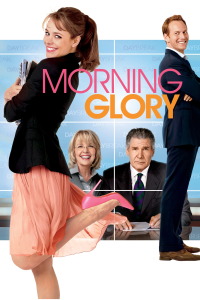
Concerning the state of the news, "Morning Glory" is post-stupid, and has no qualms about it. The devil's minion doesn't carry a pitchfork, but give Becky Fuller(Rachel McAdams) time, and she will, as the producer of "Daybreak" helps drag the low-rated morning show to hell without any regard for the hallowed industry's past that she professes to love, all in the name of the bottom line: ratings, and the glory that comes along with the territory, ephemeral as it may be.
Becky, a thoroughly modern update of the Faye Dunaway character in "Network", is a 24/7 workaholic with little room for a personal life, just like Diana Christensen, the programming chief for the UBS network, but since McAdams' character turns up in a light, breezy comedy, and can light up a room with her megawatt smile, unlike Dunaway's dour, lipsticked shark, the ramifications for the industry that follows Becky's success may not be as readily apparent.
It's a crying shame that the tenacious woman settles for being a pawn of the status quo, rather than aim to be a proponent for change, because she's clearly dynamic enough to exact a revolution. Together with Mike Pomeroy(Harrison Ford), a lion in the news biz(cut from the same mode as Walter Cronkite) who takes the "Daybreak" gig for the money, Becky could restore news to the news division.
And should their best-laid plans fail to procure traction with the general public, at least the producer can say she fought the good fight. Her utter competency, especially her hyper-ability to process information is the film's comic highlight, when Becky proves her mettle during a production meeting on her first day, in which she answers all of her staff's questions with rapid-fire economy, an exhilarating retort to the bombardment of information that seemingly overwhelms her.
The MTV-style editing that Walter Stuckel hates is a reflection of her fast mind. More often than not, the camera's reluctance to linger on a subject for any length of time is purely a commercial matter, but in "Morning Glory", the conventional editing style is predicated on an adducible tangent; it prevents Becky from getting self-introspective.
If this woman-on-the-go stopped for one second and examined the damage that she presides over on a daily basis, as the network news producer(played by Holly Hunter) does in "Broadcast News", in which the filmmaker utilizes a long take, time enough for Jane Craig to have a good cry, maybe she would have second thoughts about replacing the show's soporific segments from its prior incarnation with pure spectacle, and listen to Pomeroy's heeding for a return to old school journalism.
Since the newsman's cries fall on deaf ears, more or less(the two, however, do reach a compromise that allows for SOME substance in the program), "Morning Glory" should have forewent the motions of a romantic comedy(by dropping the needless love interest, as played by Patrick Wilson), and mirrored the May/December romance between Dunaway and William Holden, by pairing up Becky with the older man, as well.
Despite the sex, Max never compromised his integrity, as it pertained to his professional life, whereas Mike Pomeroy joins the riffraff, selling himself out through reinvention. Donning an apron for a cooking demonstration, a trusted voice in America's living rooms suddenly becomes a comradely one; he turns into Regis.
Worse than Diane Christensen, Becky has a touch of evil that's even more insidious, more far-reaching Diane captured a groin. No biggie. Becky, however, captured a soul.
This review of Morning Glory (2010) was written by Shiira on 16 Nov 2010.
Morning Glory has generally received mixed reviews.
Was this review helpful?