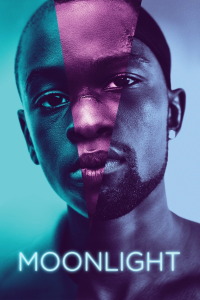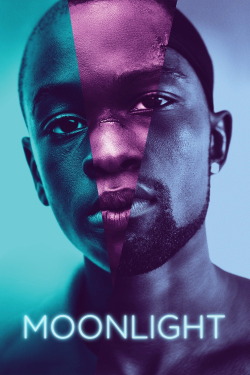
Review of Moonlight (2016) by Mikael K — 01 Mar 2017
I enjoy classic coming-of-age tales. These sorts of stories are often heartwarming and touching without feeling too sentimental, and offer a clear process of growth for the protagonist which is easy to latch onto. "Moonlight" has the framing of a coming-of-age tale, but it isn't a traditional one. It's more about metamorphosis than growing up, and while the movie employs a tight narrative focus on its main character, it's as much about the general as it is about the psychological.
The movie is based on a previously unpublished play "In Moonlight Black Boys Look Blue" by Tarell Alvin McCraney, adapted by director Barry Jenkins himself. Both men were relative unknowns before this, and the premise of "Moonlight" as a piece of queer black cinema makes it a wonder it ever got made. Let alone win three Academy Awards, including best film.
The first act, titled "Little," opens with a perfect sequence where fast, dynamic handheld camerawork draws us into the story. That camera follows Juan, a drug dealer inspecting his streets. From off-hand dialogue we find out that this is Miami 1980, just after the race riots set in motion by the acquittal of four police officers who killed an arrested black man. Juan's pose- portrayed perfectly by Mahershala Ali- is calm but weary; he seems immediately aware of the transitory nature of his day-to-day survival.
Juan notices a young boy being chased by bullies hide himself in an abandoned building. Here we have our protagonist, a boy named Chiron (Alex Hibbert, with a presence far exceeding his years). Juan follows the boy, takes him home to his girlfriend Teresa (Janelle Monáe) and feeds him. The next day Juan takes Chiron to a sunny beach, teaches him how to swim and tells him to never let anyone define him. Juan helps Chiron own the belittling name "Little" from the schoolyard. A new family of sorts is formed.
Juan keeps on dealing drugs, and Chiron's nurse mother Paula (Naomie Harris, viciously talented) keeps using them, Chiron is aware of the connection. Responsibility clashes with perceived necessity. In one scene Juan scolds Paula for using, Paula Juan for selling; jealousy and feelings of guilt surround Chiron from all sides. Among children he is an outsider, constantly threatened, friends with only one boy Kevin (Jaden Piner).
In a momentous yet subtle scene Chiron asks Juan what "Faggot" means. The conversation connects with the previous argument between Juan and Paula. They have both realized that for all the hardships Chiron faces as a black boy from a poor background he will experience sorrows of more private kinds as well.
The second act is titled "Chiron". Fittingly prosaic, as he is now in his teens, a time when childhood gives way to fragile proto-adult identity. Chiron, now played in an intensely wary manner by wonderful Ashton Sanders, is still a complete outsider at school, viciously bullied by Terrel (Patrick DeCile) and his gang. Home is as bad as school. Paula has sunk deeper into addiction, punishing her son for her lost life. Juan is dead, with only Teresa still there to keep Chiron afloat.
Most of the act is set in Chiron's school. By this point it becomes inescapably clear how predefined the life Chiron can ever have is. This is the America you rarely see in movies, the America where people aren't even bothered to be angry anymore, an America where opportunities are fairytale, something no one real has ever had.
As a film of 2016, "Moonlight" invites to find similes between now and the time it is set in. It subtly invokes images from police brutality videos that shock us, and the accompanying statistics that enrage us. But the immediate focus is still on the psychological, the immediacy of the school corridors where oppression isn't imposed by law but by the demands of masculinity. There, hierarchy is broken by Kevin (now Jharrel Jerome), popular and cheeky. Kevin dares to have a connection with Chiron, who he has begun calling "Black". The two boys share an intimate moment turned sexual encounter on the same beach Juan taught Chiron to swim. The scene is beautiful, a flicker of a dream among the cruel reality of Chiron's existence.
In a progression so like in a classic Greek tragedy, intimacy and social dissidence is punished by Terrel, who senses the forbidden connection between segregated levels of the school social order. At this point- the transition between acts two and three- it feels for a moment that the plot might fall apart. But by now the movie has transformed from a realistic deconstruction into an entity of symbolic dimensions. The visual style of the second act backs this up and sequential, some might say formulaic events become representations, accentuating the fatalistic hold a community has on the individual. Jenkins finds a careful balance with fleshed-out, urgently identifiable characters and highly representative events. And never once does he let us feel superior pity while painful compassion abounds.
The final, triptych completing act bears the name Kevin gave Chiron. "Black" has been transformed by example into a drug dealer, muscular and restrained, played by Trevante Rhodes. The theme of metamorphoses solidifies here. The transition from "Little" to "Chiron" was subtle, but the third act offers a dramatic change both in stylistic tone and in Chiron's character. He has survived as the only identity he ever had the hope of surviving in, as a thug. He still shields himself, behind gold dentures among other things.
Paula has recovered from addiction, but is lost to her son who still sees in her the broken, hateful mother. They have a reunion scene that communicates volumes. Harris never allows Paula to become a dark stereotype of a drug addict and here she shows baffling depth to her character and lets the audience see humanity Chiron no longer can.
As a grand finale, Jenkins channels Won Kar-wai in another reunion sequence, bound to become an integral part of movie history. This reunion is set mostly in a dinery at nighttime, and is between Chiron and Kevin (now André Holland). Here the harsh streets of the first act have completely given way to the glow of streetlights on wet asphalt, the hot night has transformed from a dangerous predator into a realm of beauty where you remain in long after the end titles have faded. Thus, "Moonlight" carries us through the essential forms of cinematic dimensions from relevant realism to magic, organically, as only a masterpiece can.
This review of Moonlight (2016) was written by Mikael K on 01 Mar 2017.
Moonlight has generally received very positive reviews.
Was this review helpful?