Review of Moon (2009) by Z D — 26 Apr 2017
Giant Leap for Mankind: Notions of Humanity in Duncan Jones's Moon (2009).
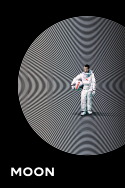
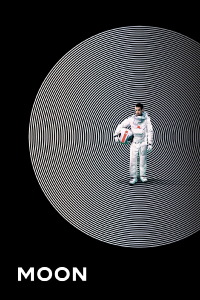
Moon (2009) by Duncan Jones is an unusual sci-fi film. It isn't about super-intelligent robots turning upon men rather men turning in to robots. The film explores the human condition in a world where human worth is determined by economic productivity. It is set in a not so peculiar futuristic era where humans have found a replacement for fossil fuels in the form of a mysterious gas, Helium 3 in the moon. The plot revolves around an astronaut miner Sam Bell who is responsible for harvesting this gas under a three-year contract with a multinational corporation- Lunar. Sam lives on an outpost on the farther side of the moon with his only company being the memories of his earthly life and his own personal robot GERTY.
The films chronicles Sam's life on the moon. The audience is exposed to the isolation experienced by the protagonist. This is facilitated by the pristine white machine filled space in which Sam lives in. The still shots capture the monotony of Sam's everyday routine. Surrounded by machines, Sam resembles a machine. Even within this mechanistic confinement, the audience gets to observe the humanity of Sam through his witty humor, his playful interactions with GERTY and his intense longing to get back to his family. Sam becomes a person to be sympathized with. The audience too, longs for Sam to be able to return to earth, to be able to be reunited with his wife and his newborn child whom he so dearly misses. The film does an incredible job of establishing a connection between the audience and the protagonist. Through witnessing Sam's dreams and hallucination, the audience becomes invested in Sam.
Through Sam the film hints at the human condition in modern society. The age of industrialization we live in is not very different from the futuristic world of the film. It questions the value of the 'human being' in a society where profit and economic productivity are given the utmost importance. In such a society does a person also become a sum of the services he/she can provide or is there more value to human life? The film sheds light on the darker aspects of capitalism and what it intends for the human race. The plot of the film shows how in a purely capitalist world human connections and relationships are just a diversion from the actual purpose of producing economic value. Sam's activities in space which include enjoying music, conversing with GERTY, carving wooden sculptures, even his video talks with his family are actually just means to keep him in a mental state in which he can be most efficient at his work. The aspects of his life other than his work are not essential rather they are distractions necessary to keep him sane. Not because Insanity is harmful for the human psyche but because it is a liability for a capitalist corporation.
Sam's story is one of enlightenment for both the audience and Sam himself. In the beginning of the film, we see Sam as compliant with the corporation's directive. He believes his work on the moon is for the greater good of humanity. With this altruistic motivation he spends day after day carrying out his job. This kind of resembles the lives of people in today's world, who are incognisant to the true motives of huge corporations and try to seek meaning in the work they do through creating a selfless justification for their toil under a system that leaves them with little fulfilment. As the film progresses, the audience witnesses the transformation of Sam, he becomes more and more dissatisfied with his conditions on the moon. He becomes growingly disillusioned with any sort of higher purpose and just can't wait to return home.
As his time to return comes closer the film takes an unexpected turn. Sam wakes up after an accident to find in his room a stranger who looks exactly like him. His meeting this strangely familiar new arrival is a turning point in Sam's life. With the arrival of this new Sam, the films atmosphere changes. A previously cold white and silent mood turns more colourful. The lighting becomes warmer to indicate the return of human spirit. The confinement becomes less bleak. The two Sam's start a friendship. As Sam becomes more in touch with his humanity, his anger, his weakness, his fondness of human interaction and love for life, he becomes more aware of the static life he has been leading up to now. Hence through the presence of the other, Sam establishes his own reality. Just like Marx in Capital (1867) - "It is with man as with commodities. Since he comes into the world neither with a looking glass in his hand, nor as a Fichtean philosopher, to whom 'I am I' is sufficient, man first sees and recognises himself in other men. Peter only establishes his own identity as a man by first comparing himself with Paul as being of like kind. And thereby Paul, just as he stands in his Pauline personality,.
Becomes to Peter the type of the genus homo." (19) Through Sam's consciousness of the true nature of his condition on the moon, the audience too realizes that their roles in the corporate world are not as innocent as they seem. Everything Sam used to believe in turns out to be illusory. It is revealed that Sam is never actually going to return home to earth. The corporation has been deceiving Sam. He is just one amongst thousands of clones created to provide labor for the company's outer space industrial unit. He is dispensable.
The film brings out oppositions and similarities between machine and human to reiterate the theme of the film. On one hand Sam undergoes a self-realization to come at a conclusion that he is not machine, his inherent spirit and values make him human and that liberates him from being confined inside a robotic life, on the other hand GERTY is a robot who is more human than the humans who run the corporation. GERTY shows compassion and servitude towards Sam and goes on to help him break free from his confinement. This provides a powerful metaphor for men. The film poses a question: In an age where even robots are more humane than humans themselves, does the human spirit hold any distinction?
The film through projecting a futuristic dystopia, send out a clear message. The forces of capitalism which are so influential in our lives should not be allowed to overpower the sanctity of our humanity. We as people should resist the pressure of becoming a commodity: simply a cog in the workings of the industrialist machine we call society. As Sam says to GERTY.
"We're not programmed, we're people" (1:28:21).
Citations.
Marx, Karl, and David McLellan. "Chapter 1." Capital (1867). Vol. 1. Oxford: Oxford UP, 2008. N. pag. Print.
Moon. Dir. Duncan Jones. Sony Pictures Classics, 2009.
This review of Moon (2009) was written by Z D on 26 Apr 2017.
Moon has generally received very positive reviews.
Was this review helpful?