Review of Monsieur Verdoux (1947) by Robert B — 17 Jul 2011
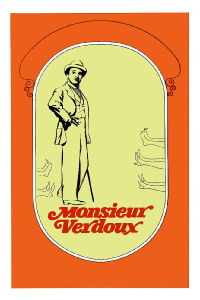
Monsieur Verdoux (Charles Chaplin, 1947).
Monsieur Verdoux, which sprang from a falling-out Chaplin had with Orson Welles (more on that in a few), was Chaplin's favorite of his films. It was his first in seven years, the longest period to date between Chaplin films (and the second-longest ever), it landed him one of his surprisingly few Oscar nominations (for Best Original Screenplay; he lost to Sidney Sheldon, of all people, for The Bachelor and the Bobby-Soxer, and the three other films nominated that year you've never even heard of), etc. For all that, it was a monumental flop at the box office, the post-WW2 equivalent of Heaven's Gate. Like that film, Monsieur Verdoux is a good deal better than you may have heard it is. On the other hand, don't go into it expecting another Modern Times, or for that matter another Heaven's Gate (a movie every critic outside the US finally seems to have given its due as one of the great American movies).
The plot of the film is based loosely on the life of Henri Désiré Landru, the Bluebeard Killer (the first of, to date, four movies based on Landru's life), who started off scamming wealthy widows he met through the lonelyhearts pages, then progressed to marrying them, getting their wills changed, and bumping them off. Before his four-year spree ended, Landru had killed eleven widows. As we open, Henri Verdoux (Chaplin), a banker who'd been laid off from his job thanks to the economic crash, has just killed one of his victims, tossed her body in the incinerator, and then gone back to happily trimming his rose bushes, avoiding stepping on a caterpillar on the way back to the house. A lovely man indeed. Once her fortune is collected (and subsequently invested; Verdoux plans to support his legitimate family through the stock market), Verdoux puts the house on the market, and we see how he interacts with other human beings. (He's not as nice to them as he is to caterpillars.) The movie is concerned with Verdoux's cycle of marrying-and-murdering, naturally, and he gets himself hitched to some real shrews for comic relief, but the real meat of the story comes when Verdoux meets the nameless woman (as so many of his female leads are) known in the credits only as The Girl (Marilyn Nash, in one of only two of her big-screen roles, the other in a forgettable sci-fi film), whom he lures back to his Paris apartment in order to experiment with a new poison he's concocting, only to let her go. (This becomes important later, for reasons that are spoilerific, but lead to a great deal of the movie's comedy.).
It's not a bad film by any means, and if you're a Chaplin fan you'll enjoy it a great deal simply because it's Chaplin (and, according to Robert Lewis, the Chaplin film over which he had the most control: he not only directed, starred, produced, casted, and composed, but supervised every other aspect, from costume design to "crawl[ing] around on the floor with a knfe, scraping up bits of old chewing gum stuck to the floor"). But the story behind the Welles/Chaplin rivalry that birthed the film in its present form is in many ways more interesting than the movie itself. Welles originally wrote the script and approached Chaplin with it; Welles was to direct, Chaplin to star. Now remember, this was still the forties, when everything Orson Welles touched turned to gold; he'd just come off Kane and The Magnificent Ambersons, and what Orson wanted, Orson got. Except Chaplin, that is. After reconsidering, Chaplin is reported to have told Welles that "no one else has ever directed me, and I'm not going to change that now". We do know that Chaplin bought the script from Welles (who would later say he parted with it because it was "one of my minor works", which may well have been sour grapes) for five thousand bucks, rewrote some of it, and made it into Monsieur Verdoux. How different would this movie have been had Welles directed it? There's no way we can ever get an answer to that question, of course, but Welles was capable of getting such greatness out of even our most iconic actors (Charlton Heston in Touch of Evil, Edward G. Robinson in The Stranger, and Anthony Perkins in The Trial are only three obvious examples) that one can only salivate while imagining what he would have done with someone as brilliant as Chaplin.
As with most black comedies, note that some of the laughs are bound to sound more like uncomfortable chuckles, especially in the first half; the second is more reminiscent of the little tramp and his slapstick days (the chase scene in the dance-hall could have been filmed in 1920, save the sound). But in the end, it's still Charlie Chaplin, and you'll still like it. ***.
This review of Monsieur Verdoux (1947) was written by Robert B on 17 Jul 2011.
Monsieur Verdoux has generally received very positive reviews.
Was this review helpful?