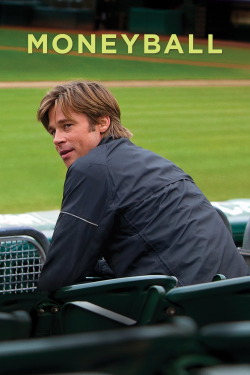
Review of Moneyball (2011) by Shiira — 05 Dec 2011
It's the pitching, stupid. If your team has an ace on the staff, then half the battle is already won. Some pop in the bat doesn't hurt either. The Bears, a motley group of little-league castoffs whom no other team in their division would ever pick, only start to win after their beer-guzzling manager Morris Buttermaker recruits Amanda Wurlitzer, a gender-breaking pitcher with a dominant curve(she's pre-Chelsea Baker, the knuckleball phenom) that the ex-professional ballplayer had decided two years ago was all washed-up as a daughter.
On-base percentage doesn't win you games, it's the sound of the ball hitting the catcher's mitt, and the umpire calling the batter out on strikes, swinging or otherwise. In contrast to their former starter Rudi Stein, Amanda is Peppermint Patty to his Charlie Brown; she's unhittable; she keeps her clothes on, but the Bears still lose 1-0, because Lupus, f*****' Lupus, that "booger-eating moron," can't hit the cut-off man from left-field, and lets the game-winning run score.
It's not all his fault, though. The Bears can't hit. Never mind the homerun, three games into the season, and the team is still searching for their first baserunner. Coach Buttermaker sees his team's offensive deficiencies, and practically invents Moneyball.
So embarrassed was Ahmad by his opening game errors to the Yankees that he hid out in a tree(after a half-inning forfeit), still can't get on base, but the coach knows that the black kid is fast, so the drunkard promises to teach him how to bunt.
Ahmad's hero should be Malcolm X, not Hank Aaron, because sabermetrics preaches the theory of "by any means necessary". In "Moneyball", you half-expect to hear a reprise of Bizet's "Carmen", when Oakland A's free-agent pickup Scott Hatteberg, previously the catcher for the Boston Red Sox(damaged goods due to a bum shoulder), makes error upon error, as if the converted first baseman was in communion with Toby Whitewood.
To manager Art Howe, he's bad news. But GM Billy Beane, acting on advice from his assistant Peter Brand, a sabermetrics guru, thinks Hatteberg can still play the game. Despite not having Ahmad's wheels, Beane's pet project has the ability to get on base.
Hatteberg walks. It's a talent which makes him proportionately more valuable than Mariners' leadoff hitter Ichiro Suzuki, because despite his annual 200 hits, the ten-time all-star swings at a lot of first pitches, resulting in a relatively low on-base percentage, the stat that trumps batting average as the real barometer of worth to the new school, founded by Brand's hero Bill James.
Hatteberg, therefore, is worth the trouble, so like Buttermaker teaching Tanner the fundamentals of shortstop, it's Ron Washington's job to make people forget about Giambi by turning the ruined catcher into a functional first baseman.
(Washington had his own demon: cocaine.) History shows that Beane's gambit paid off(Hatteberg batted .280, and had a fielding percentage of .994), but it's somewhat misleading and downright downright dishonest, narrative-wise, that "Moneyball" should cast this role player as the lynchpin to this financially-strapped team's miracle on the field(the A's sported a payroll three times less than the Yankees: $41M to $126M).
Contrary to the sabermetrics propaganda of the film, the 2002 Oakland A's did not win a MLB-high 103 games because Beane traded Carlos Pena to Detroit, which, in effect, forced Howe's hand into playing Hatteberg.
It was the pitching, stupid. Oakland had three Amandas: Tim Hudson, Barry Zito, and Mark Mulder. Heck, even the last man in the rotation, Cory Lidle, was more relevant than the pitchers "Moneyball" makes mention of: Chad Bradford, a submarine middle reliever, and late-season addition Ricardo Rincon, whose acquisition from the Indians inspires such elation in Brand, you would think that Hudson just threw another shutout.
Unlike "The Bad News Bears", where the Bears face the Yankees, the A's never did get the chance to square off with the fat cats, losing somewhat ignominiously in the ALDS to the Twins(payroll $40M), who are, perhaps, every bit the underdog that Beane's team was, in five games.
The real climax to "Moneyball", judging by the postscript, occurs in "Fever Pitch", when Jimmy Fallon and Drew Barrymore run onto the field in Yankee Stadium after the Sox clinch the pennant(en route to their World Series win over the Cards), since the film gives Beane's methods all the credit.
Does Moneyball work? Well, in the 1976 Michael Ritchie film, while the walks and hit batters keep the Bears alive in that final game with the Yanks, it's Kelly Leak's moonshot that nearly wins it all for the overachievers.
Some pop in the bat doesn't hurt. Exhibit A: Miguel Tejada, with his 34 HRs and 131 RBIs. Lucky for the A's, he just swung away, walking only 38 times in 162 games. Then again, Leak doesn't accept the free pass and ends up getting thrown out at home plate.
This review of Moneyball (2011) was written by Shiira on 05 Dec 2011.
Moneyball has generally received very positive reviews.
Was this review helpful?