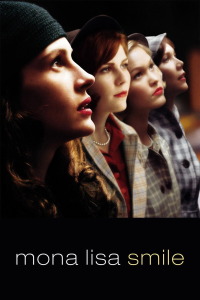
Review of Mona Lisa Smile (2003) by Kylie P — 31 Jan 2010
From December 30, 2007:
Mona Lisa Smile was too much like Dead Poets' Society to be an effective film. It's the same basic premise. Dead Poets' Society: conservative all-male prep school shaken up by outspoken, free-thinking Robin Williams, "o captain my captain," who chooses to expand the minds of his young students through poetry, despite the personal consequences of his actions. Mona Lisa Smile: conservative college, all women, Julia Roberts, art and art history.
The startling similarities to Dead Poets' Society notwithstanding, this movie suffered from poor writing. The dialog was kind of stunted; most of the students were given cheesy lines that, despite the fact that the film was set in the fifties, just felt out of place. Kirsten Dunst's dialog was the worst, and she may have been miscast as the proper Betty, hellbent on disingenously pleasing her mother and maintaining her home while her new husband philandered.
Plus, the movie presented a confusing message of girl power or even feminism. Katherine championed a woman's right to choose career or education over taking a husband and living and working at home but seemed reluctant to relinquish that choice, even when the choice was for the latter. In fact, the story presented the idea that Katherine's view was the only correct course of action rather than sufficiently allowing for the possibility that all choices can be right as long as they are actively made by the person making them. One scene with Julia Stiles' Joan presented the possibility, but Katherine never seems to accept that free thinking and free spirit can lead to many different outcomes, not just the ability to appreciate fine art and the development of a committment phobia. It's the act of choosing, not the choice itself, that should be celebrated by a truly free spirit.
Also, were the filmmakers trying to hold present day up to the past and make comparisons? Show us how far women have come? Present an interesting historical perspective? Make women feel good about themselves, or bad, depending on which character they most resemble?
Still, the film was engaging. The most interesting and relatable character was Connie, and the actress playing her gave the best performance in the whole movie, as the resident "Ugly Betty" learning to love herself. Also, Marcia Gay Harden played Katherine's landlord/roommate, a lonely spinster and the "speech, elocution, and poise" professor, too afraid to take that open-minded path but quietly supportive of Katherine, so long as it did not conflict with her television. Also, the ending shot/scene was lovely and the most poignant moment in the whole movie, though it ploddingly took some time to get there. There were no catchphrases like "O captain my captain," but if there had been, that would have been the stand-on-the-desk moment.
All in all, this film was pleasant like afternoon tea but recycled and boring-tasting, like Lipton. It is admirable that Hollywood wanted to create a palatable statement of girl power that casts all women, but this is not the first time that a plot has been retooled and a cast of characters changed from men to women (or boys to girls). Let the boys copy the girls for a change. Then, we might have something truly new and interesting for all to appreciate on many cultural levels.
This review of Mona Lisa Smile (2003) was written by Kylie P on 31 Jan 2010.
Mona Lisa Smile has generally received positive reviews.
Was this review helpful?