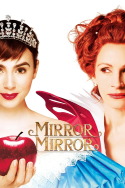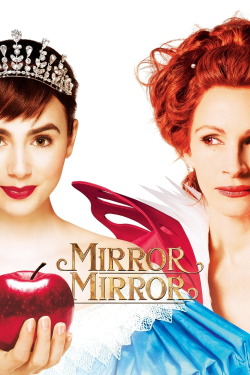
Review of Mirror Mirror (2012) by Shiira — 11 May 2012
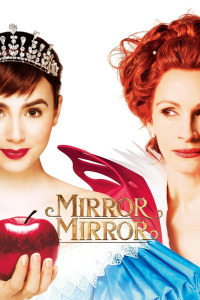
These dwarfs eat meat, and this princess is no vegetarian. In Mirror Mirror, the woodland creatures don't want anything to do with Snow White. It's an enchantless forest; not dark exactly, but it's sterile, lacking light, and especially, magic.
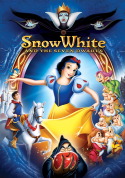
Dissimilar to the young woman's 1937 forerunner, when the huntsman, the would-be murderer, gives Snow a reprieve from her death sentence, an ordinance from the queen, the princess' wicked stepmother, the arising girl isn't greeted by any critters, following that mad dash through the woods.
As a child, her father, the king, bequeathed a dagger to his daughter. It's implied that the animals know she's armed and carnivorous. Instead of gooseberry pie, apple dumplings, and plum pudding, this Snow White prepares lamb gravy for the inaugural feast, which raises a pertinent question: Did she butcher the young sheep with her own bare hands? Outfitted with a decidedly more rugged gal, Mirror Mirror performs a sort of alchemy on Snow White and the Seven Dwarfs, whose heroine respects non-human life, a characteristic that seems more ideologically consistent with Buddhism than the Christian faith.
The remake avows for this reconstructed eastern thinking, ferreted out from the Disney classic, in a scene, where the kitchen help encourages Snow to venture beyond the palace gates, and see for the first time, the impoverished lives of the queen's overtaxed subjects, wasting away in a kingdom that the sheltered princess recalls from childhood, as being distinguished by singing and dancing.
Snow's distancing from her provincial-minded upbringing is straight of the Buddha's origin story, let alone, Little Buddha, especially in the scene where Prince Siddhartha(Keanu Reeves) encounters old age, illness, and death, setting the stage for his declination as the next sovereign, foregoing the crown in favor of asceticism, a monkhood for the ages.
On his first visit, accompanied by the king, Siddhartha observes people at leisure, an ongoing party, similar to the opening animated sequence in Mirror Mirror, narrated by the queen, who interjects about how nobody had jobs, giving young Snow a false impression about the peasants, just like the future Buddha, since his father, by decree, asked that the townsfolk banish the undesirables from plain view before their official visit.
Sound familiar? On the prince's return trip, this time, with only his driver Channa for company, he learns that people work for a living, often to the bone. Likewise, Snow, possessing the same naivety about class warfare as Prince Dharming, in hushed tones, asks a woman of modest means about the hamlet's sad state with a melancholic wonderment.
No doubt suspicious about the fine threads that adorn Snow, the starving denizen answers conservatively, informing the poorly treated, but nevertheless, privileged royal, that there hasn't been a jubilee of any sort in ages.
Was Snow's father really a benevolent ruler? Is he responsible for the dwarfs' ostracization? Perhaps, there is little difference in how both royals treated their subjects. Unlike the missing king, his second wife, the queen, never bothered with propaganda like her husband or Siddhartha's father, King Suddhodana, making the wicked stepmother, if anything, an honest monarch.
Since the queen's subjects are kept off-screen in the original, as a result, Snow is politically hard to read, but in Mirror Mirror, we know for sure that our heroine has a conscience, with nary an interest for earthly possessions.
Interestingly, one of the dwarfs, Chuck, is Chinese, giving their lair just the slightest hint of being an emblematic monastery. In Snow White and the Seven Dwarfs, Bashful describes the sleeping girl stretched out across their tiny beds as an "angel", but her high regard for animals, a tenet associated with Buddhism, makes her supposed celestial nature, strictly a byproduct of her ethereal beauty, because in a filmic sense, her latent eastern leanings casts her out of the enchanted forest for being a heretic.
The tree limbs act as wizened claws, attempting repeatedly to grab her. The elms are jealous of the Bodhi. Seemingly, the face of God manifests itself on a trunk. As for Snow White's housemates, in Mirror Mirror, the seven dwarfs are thieves, not miners, yet it's their latter incarnation in the Disney film which seems the more malevolent of the two.
Armed with pickaxes, the little men stand poised around the bed, ready to hack the stranger into pieces, until they learn that the uninvited guest is a lost girl, and not somebody who has an eye on their diamond mine.
When it comes to jewels, the dwarfs have the potential to be cold-blooded killers; they also might be lovers. While Half-Pint covets Snow, she doesn't reciprocate his affection, but does her predecessor covet Grumpy? In icing, she writes "Grumpy" on a cake as she sings "Someday My Prince Will Come".
Grumpy, who looks as old as the Buddha.
This review of Mirror Mirror (2012) was written by Shiira on 11 May 2012.
Mirror Mirror has generally received mixed reviews.
Was this review helpful?