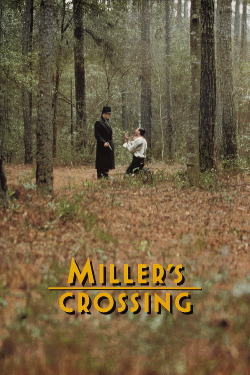
Review of Miller's Crossing (1990) by John-Michael S — 12 Jul 2009
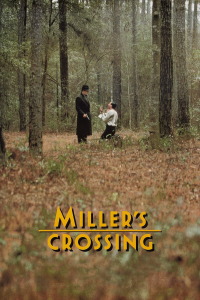
Realism isn't exactly a necessary component for successful filmmaking. In fact, a cornerstone of making movies, Hollywood or otherwise, seems to be the escape from the mundane and worldly, in favor of the exploration of the impossible and the fantastic, of distant places or long-past times. And though such imagination is commended, even celebrated, the discerning director must take great care to ensure that a world so divorced from reality remains connected to its viewers. But with "Miller's Crossing," that tenet is one terribly lost on brothers Joel and Ethan Coen, who revel in narrative sleight of hand and self-indulgent complexity, allowing their audience no closer than arm's length.
To be fair, the story they have constructed here does have its merits, ranging from its distinctive wit to its undeniable style, both evidence of its authors' skill, but they are assets trapped within the body of a film that never engages its spectators, in large part because it never attempts to. Like its spiritual, if not direct, predecessor "Blood Simple," the film displays the Coens' particular talent for constructing extremely memorable, highly-charged scenes, but the bulk of the foundation upon which they rest serves as, at best, an unsteady base.
Enter Tom Reagan (Gabriel Byrne), the always-cunning brains behind the posturing of local crime lord Leo O'Bannon (Albert Finney), a man content to remain behind the curtain, but possessing more than the intellect to run things on his own. As the key player in this tale that owes as much to film noir as it does to the work of Dashiell Hammet, particularly Red Harvest, he takes a central role in the gang warfare that will soon sweep over the face of its unnamed city. Key struggles involve the conflicting loyalties, deception, and romance surrounding brother and sister Bernie and Verna Bernbaum (John Turturro and Marcia Gay Harden), but to say any more would risk spoiling some of the turns in its labyrinthine plot.
It's a plot that can at times move at breakneck speed, and is cruelly unforgiving in its minor details. Vitally important names are dropped so casually in dialogue so fast-paced you may find yourself wishing for a scorecard, or at least something to take notes on. From the very first scene, the viewer has the sense of being unceremoniously dropped into the heart of an intricate, deceit-laden atmosphere, without so much as the faintest of lights to illuminate its complexities.
Sophistication is one thing, but to feign intricacy by obscuring what should otherwise be clear details borders on narrative dishonesty. It's a lesson that the Coens' seem not to have been taught by the resounding success of "Blood Simple," which suffered from similar storytelling duplicity. But like its forebear, "Miller's Crossing" manages to cull from its at times implausible storyline genuine moments of tension, terror, and drama. Though perhaps not quite as successful in this regard as its predecessor, these sequences offer up hard evidence that the talent behind the Coens' debut was by no means used up in one shot.
With regard to casting, Byrne can hardly be blamed for doing all that he can with a character so clearly the product of a screenwriter's pen.
Turturro, on the other hand, positively shines as Bernbaum, who appears to be the only authentic, believable character amidst a swarm of stock noir cutouts. It hardly seems surprising, then, that following this, he's become something of a Coen regular, with key appearances in both "Barton Fink" and "O Brother, Where Art Thou?" Steve Buscemi even puts in an all-too-brief appearance that will make you long for his more significant role in "Fargo.".
In so many ways, the film feels like the slow, inexorable progression of two growing filmmakers struggling to further define their strengths and vanish away their weaknesses. For the first time in their then-young careers, concrete manifestations of their distinctive grim humor, arguably among their most defining traits as directors, were beginning to emerge. Though it lacks the edge and originality of their debut, it casts off the predictable trappings of their previous "Raising Arizona" in favor of darker, more ambitious fare.
Indeed, "Miller's Crossing" makes the all-too-rare mistake of asking too much of its viewers, while so often, contemporary films rarely make so much as an attempt to intellectually challenge their audiences. And for that, despite its flaws, of which it certainly has many, one must afford its effort due respect. Though it doesn't succeed in making good on its ambitions, the Coens' attempt is to be applauded, for they reach and come up short where so few even extend a hand at all.
This review of Miller's Crossing (1990) was written by John-Michael S on 12 Jul 2009.
Miller's Crossing has generally received very positive reviews.
Was this review helpful?