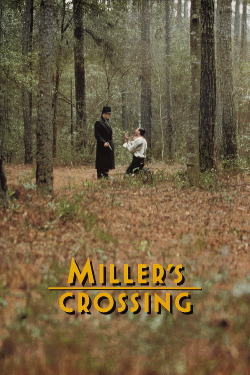
Review of Miller's Crossing (1990) by Justin H — 30 Aug 2011
Lyrical Pulp.
I've only read a smattering of Hammett. I haven't read [i]Red Harvest[/i] or [i]Glass Key[/i], the two books which most influenced this film. (It's in theory an adaptation of [i]Glass Key[/i], apparently, but it draws influence from [i]Yojimbo[/i] and therefore [i]Red Harvest[/i].) However, I think it's interesting that that most literary of pulp writers has influenced some of the most cinematic of filmmakers. I'm not sure if Joel and Ethan Coen would thank me for calling them such, and I strongly suspect Kurosawa would have asked me to define my terms. However, all three have made movies which explore the very capability of film as a medium and as an artform, and Dashiell Hammett stretched what pulp detective novels could do. I think artists are drawn to art, though I don't think that's a revolutionary thought, and I think you'll find the art to draw on even if it isn't in the medium you yourself use. It's also unsurprising that you will seek out the influences of your own influences.
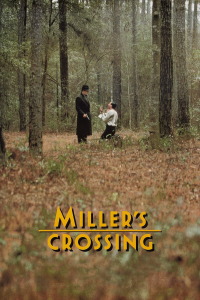
Tom Reagan (Gabriel Byrne) makes things happen for Leo (Albert Finney), who runs an unnamed town which might be in New Jersey. ("The Palisades" gets a mention.) Leo has a rivalry with Johnny Caspar (Jon Polito), who thinks he should be running the town instead. He wants to get Tom to work for him, and specifically, he wants Tom to take out Bernie Bernbaum (Jon Turturro). Unfortunately, Bernie's sister is Verna (Marcia Gay Harden), who is Leo's girlfriend. Oh, and she's fooling around with Tom. However, things get complicated, to the point where I'm not entirely sure what was going on half the time, and Tom ends up working for Johnny Caspar after all. And even though it isn't Tom's usual role, he is told to kill Bernie himself. He lets Bernie live for Verna's sake, which turns out to be a big mistake. There are layers and layers to the action, and I'm not sure the Coens themselves know what's going on at any one time.
I think many of the techniques director of photography Barry Sonnenfeld used in this film would later serve the Coens well in films such as [i]O Brother, Where Art Thou[/i]. I don't know why Sonnenfeld stopped working with the Coens, but it's worth noting that he directed [i]The Addams Family[/i] the following year. At any rate, much of the visual aesthetic of the movie was his work. He told the brothers that the scenes at the little clearing in the woods called Miller's Crossing needed to be filmed exclusively on cloudy days. Where he really lucked out, because the Coens didn't let the weather alter their filming schedule, and the fact that there is but a single scene in the movie with sun filtering through the trees is merely a quirk of fate. The clouds merely did Sonnenfeld's bidding. His use of lenses and angles are more technical than the average person cares about, but I think even the most film-ignorant viewer can feel the difference.
The Coens have a knack for the period piece. Whether it's the sweeping grandeur of [i]True Grit[/i] or the urban claustrophobia of [i]The Hudsucker Proxy[/i], the Golden Age Hollywood of [i]Barton Fink[/i] or the Depression-Era South of [i]O Brother[/i], I honestly think their best work is done in the past. I like [i]Fargo[/i] a great deal, of course, but it is actually a period piece, albeit a period perhaps ten years before the film was made. I'm a rebel in that I don't much care for [i]Raising Arizona[/i] or [i]The Big Lebowski[/i], among their films actually set in about the year they're made. I think there's something to reproducing an era that concentrates their abilities. I suppose I'll have to wait until [i]No Country For Old Men[/i] to get a full perspective, though on further thought, I don't know when that one's set, either. I don't think whimsy is enough, and I think their modern pieces are heavier on the whimsy than the character development or the artistry.
There is very little whimsy here. Oh, there's the bit about how Johnny calls Bernie "the shmatte," which is Yiddish for an old bit of rag--a piece of trash. Though how Johnny Caspar, who is played by an Italian-American actor, knows Yiddish, I don't know. There's the bit about how Bernie just appears in Tom's apartment when Tom doesn't let him in; I'm particularly amused by his statement that he didn't answer the phone because it probably wasn't for him. But this is neo-noir, driven by forces too dark to let a little silliness into the proceedings. The happiest ending possible for this movie is the one with the lowest body count. Maybe it would have been best if Tom had just walked away before all this started, but of course he couldn't. Tom is not the kind of character who knows how. What's more, he probably doesn't know how to live a normal life, one without corruption and gangsters and so forth. It's certainly not as though he'd be able to make a living at gambling, after all.
This review of Miller's Crossing (1990) was written by Justin H on 30 Aug 2011.
Miller's Crossing has generally received very positive reviews.
Was this review helpful?