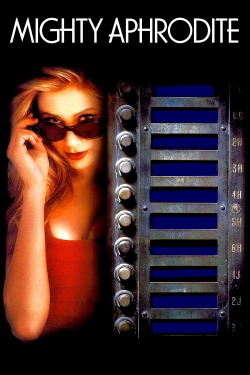
Review of Mighty Aphrodite (1995) by Paul Z — 02 Nov 2010
Woody is a realistic idealist, because to persist making contemplative films is to assert how buoyant you actually are. His buoyancy is not to be associated with that articulated by his more hopeful characters. The average rubrics of idealism and cynicism offer fertile readings of several of his later films. How best to support such analyses? The views to be favored are those that fall back neither on some proclamation of, or biographical facts about, the creator, nor to the partialities of the interpreter. Allen's work helps us sidestep both of these moves: the biographical myth and the reading of a connotation into the content instead of interpreting what it might have to say, because he presents the alternatives of optimism and pessimism in dramatic rather than discursive ways. This enables him to be detached from positions held in the material, clear in his practice of the drama of knowledge shared by the audience but not by all of the characters. It makes the assertion that getting on with one's life is a remedy for pessimism. Thus realistic idealism: It's worthwhile to carry on.
This modern playing-up of Pygmalion divulges its solemn undercurrents, with observations by the Greek chorus, which periodically bursts into song and dance, while in unison developing a plot that lends itself to farce, Woody playing a sportswriter who's initially opposed to adopting a kid despite his career-driven wife Helena Bonham Carter being unable to get pregnant for the sake of her job, yet she has her way and they adopt a boy they call Max. As Max gets older, it becomes clear he's exceedingly gifted, and Woody becomes preoccupied with learning the identity of Max's biological mother. After some tense scenes of farcical suspense, Lenny finally locates Max's mother, Linda, call girl and part-time porn actress. Lenny, never disclosing his real reason for seeking out Linda, swiftly becomes her friend and counselor, and sets about finding a nice guy for her to marry. Lenny recommends a young boxer he knows, a potato farmer from upstate, who is a good kid but not very smart.
Although the increasingly colloquial Greek chorus might sound like a cumbersome adjunct to a Woody Allen comedy about contemporary Manhattan neurotics, it truly works properly. Chorus members including F. Murray Abraham, Olympia Dukakis and David Ogden Stiers make urgent notes of the choices Lenny is making, and their peculiar counterpoint helps Allen pull off some of the more clearly perfunctory plot developments. By the end of the movie, when the deus ex machina arrives from the sky in a helicopter, it feels like an stimulation rather than what it is, an expedient plot device.
As Linda, then 29-year-old Mira Sorvino's voice is heavy Brooklyn lightened by helium and thus made comic, which mitigates the explicit casual vulgarity of her lexicon, making it seemingly naïve. Her Oscar win has apparently been subject to the same "come-on's" and "gimme-a-break's" as Marisa Tomei's for My Cousin Vinny, perhaps because young bimbo roles, including those of Brooklyn spitfires, are often so two-dimensional, they're all taken for granted as precisely that. But known for being remarkably dignified and eloquent, Sorvino goes way outside the hooker-with-a-heart-of-gold peripherals of the part in developing a genuinely sensitive and charming character.
Through events that I won't divulge, Woody brings us to an addendum set a few years later, when Lenny and Linda meet again, and there is a bittersweet development in both of their lives, although each of them is conscious of only half of it. The movie's closing scene is calmly, pleasingly poignant, and the whole movie avoids the snags of pessimism and becomes something the Greeks could never completely handle, an impending tragedy with a hopeful ending.
Feels like Woody's just treading water here, but even when it becomes unquestionably frivolous, Mighty Aphrodite remains an attractively made, swift, lighthearted dessert that transpires as pleasant mid-range Woody. He's best known for this spirit of romantic comedy, having transitioned from broad screwball to more storied and romantic films. Mighty Aphrodite, during his freshly post-Farrow period of varied sorts of works, is generally inclined at a gratifying and more or less reliable reading.
This review of Mighty Aphrodite (1995) was written by Paul Z on 02 Nov 2010.
Mighty Aphrodite has generally received positive reviews.
Was this review helpful?