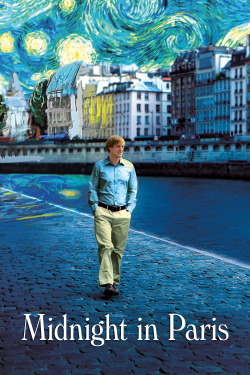
Review of Midnight in Paris (2011) by Shiira — 05 Jul 2011
Thirty years later, Luis Bunuel, no longer a young man but a Spanish ex-patriate biding his time in Mexico, reflects back on France in the 1920s, Jazz-age Paris, the time and place of his sensationalistic calling card, a short film he co-directed with Dali called "Un chien andalou", and remembers the American he met in a bar who pitched him the idea for a film, which at the time, puzzled the young surrealist.
The American said he was from the future, and being like any self-respecting dadaist, Bunuel had taken the pronouncement by the delusional man in stride. But now he wonders, after having just won the Palm d'or at the 1961 Cannes Film Festival(for "Virdiana"), if Gil was indeed a time-traveller.
To answer his own long-ago question as to why the party guests couldn't simply leave the room, it's because they're idiots, the ruling class, who in "The Exterminating Angel", celebrate their victory over the Popular Front in the Spanish Civil War to such an egregious extent, they resort to mob rule, nearly reducing a mansion to rubble.
Released in 1962, the mordant comedy shows how even the bourgeoisie could be victims of totalitarian state. In essence, the film shows them to be little children who need to be told what to do. Left to their own devices, they throw a temper tantrum.
The American, surmises Bunuel, must've had previous knowledge about Franco, the fascist dictator in cahoots with Hitler and Mussolini, the primary engineers of World War II. Gil, however, without meaning to, threatens the very existence of "The Exterminating Angel" by violating the first law of time travel.
In futurist Hans Morveac's own words: "...a message sent to the past will alter the entire history." In Bunuel's case, stealing the intellectual property of a Hollywood professional could serve as revenge for how Warner Bros.
appropriated his idea about a self-mobilizing hand("The Beast with Five Fingers") during a stint in the dubbing department. But then again, lifting the storyline from a hack writer, especially an American one, would be beneath him.
Surely, after winning the top prize at the world's most prestigious film festival, Bunuel must've had offers from Hollywood, and yet history shows, he chose to toil away in Mexico as a director for hire.
Unaware, perhaps, at the time of his first exile that American businesses supported Franco's fascist movement, Bunuel wasn't liable to sell-out his compatriots a second time around, this time knowingly.
But if because of Gil's meddling, "The Exterminating Angel" never comes to fruition, then it's reasonable to conclude that another film which lampoons the upper class, "The Discreet Charm.
..", which features the same enigmatic impotence among the rich in regard to their ability to make a decision, would likewise, disappear from Bunuel's filmography. Gil, who professes to abhor the conservative politics of Inez and his prospective in-laws, unwittingly becomes one of them by sabotaging two great leftist films that baited the rich with provocative glee.
A self-described liberal, Gil is more of the latte-sipping kind, the liberal elite, the sort who are said to be out of touch with the real needs of the proletariat. Only a chameleon could live with someone as materialistic and callow as Inez, his flinty fiance.
The milieu of "The Roaring Twenties" also provides the setting for "Zelig", the 1983 mockumentary about a man named Leonard Zelig, a mutant("X-Men", anybody?) who could blend in with people of all creeds and colors.
For the diegetic F. Scott Fitzgerald, it's deja vu all over again. In "Zelig", the narrator chronicles the famous author having met a man at a swanky party who mingled with socialites and servants alike, and now in "Midnight in Paris", "The Great Gatsby" author encounters a similarly adaptable man, a starving artist among starving artists, albeit one who could return to six or seven-figure paydays should his adventures in novel-writing not quite pan out.
"The rich are different," Fitzgerald once said, and Gil is indeed different, a poseur, whose carriage and deportment wouldn't escape the astute writer's eye. Like "Forrest Gump", this love letter to Paris is the stuff of science fiction.
Whereas the Robert Zemeckis film(infamous for its ideologically conservative subtext) presents a parallel universe, "Midnight in Paris"(like "The Purple Rose of Cairo") uses magic realism, grounded in the corporeal world.
In both films, you have rightist protagonists who act as muses for progressive icons. Turnaround, however, is fair play. Cecilia, who gets her heart broken by Tom Baxer(the actor) in the 1985 classic, is avenged, in a sense, by Marion, who leaves the Hollywood scribe before he gets the chance to do the same.
Unlike Cecilia, Gil chooses fantasy(the past) over reality(present), but like the Depression-era movielover, ends up with neither. Alas, this time, Hollywood gets burned.
This review of Midnight in Paris (2011) was written by Shiira on 05 Jul 2011.
Midnight in Paris has generally received very positive reviews.
Was this review helpful?