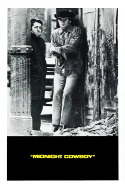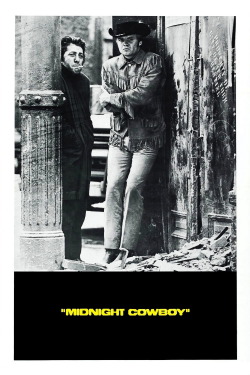
Review of Midnight Cowboy (1969) by Cole P — 25 Dec 2011
Midnight Cowboy was and remains an explicit revelation of the brewing film exploitation that arose in the 1960's. It's gritty and realistic as it exposes sex, drugs, hedonism, and alcohol in the cosmopolitan cluster New York City. It was a statement of the time and is eerily significant today.
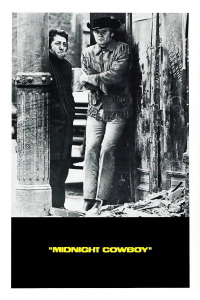
Jon Voight is Joe Buck--a hearty, naive Texan who journeys to New York City in hopes of becoming a successful "hustler". Women over there are golden and have garish lofts and tall penthouses; they're financial reimbursement is Buck's manifest destiny. There's also Dustin Hoffman as the scene-stealing "Ratso" Rizzo (I think he inspired Jim Henson's Rizzo the Rat)--a native New Yorker who yearns to voyage to the sunny beaches of Florida in the hopes that the climate will alleviate his ailment. The two form an unlikely pair, because in a city like New York that promises wealth and fame, they only have each others backs to survive. And this is why Midnight Cowboy is successful in its story (past all of the subliminal exposure). It portrays two very similar characters, paralleled with troubles and anguish.
Surprisingly, it is the friendship which drives the film--not sex. Sex is certainly an important part to Buck's character. In his desperation he subjects himself to fellatio with another man just for money; the result is a swift swindle. But, Buck must keep his image. Like any "John Wayne" inspired cowboy, he shrugs his shoulders and shuffles on to his next "client". But opposite to Buck is Enrico Rizzo, who was nicknamed "Ratso" by the New York locals. I don't think Ratso was always and forever referred to as "Ratso"--but he's the finest example of what New York City can regurgitate to those who succumb to failure. Ratso lives in a thatched, tacky apartment in the slums of the city. He frequents mediocre coffee shops and propels himself into the acquaintances of "fags" and barmen. He may not look very healthy, but Ratso knows New York City up and down. It is hardly as glamorous and immaculate as Joe Buck assumes. This, being the film's pivotal message, is something Buck learns gradually from Ratso--who progresses from a casual acquaintance to a genuine friend whom Buck supports.
It's interesting how Buck and Ratso are uncanny in their virtues but bear little to no physical resemblance. Buck is the personification of Texas (a tall rodeo man with a ten gallon hat). If he assumed his "stud" status forever, I believe he would've turned into Ratso (granted he had little brains for that ten gallon hat). Ratso on the other hand isn't the strapping man Buck is, but his dreams and aspirations are equally as integral. They are both two characters who were robbed and conned into thinking that the purity of the American Dream was a few easy steps away. Says Buck, "I'm new in town, from Texas. I'm lookin' fer the Statue of Liberty." Ratso lives there and he either never found it or determined it unreachable.
And yes, the remainder of the film is rather illustrative and gratuitous in its depiction of sex and drugs (Buck has his first blunt amid the shindig), but it should not be identified as an X-rated exploitation film. The grungy 1960's setting serves to highlight the struggles of the two main characters. It is their Hell. Their boulevard of broken dreams.
This review of Midnight Cowboy (1969) was written by Cole P on 25 Dec 2011.
Midnight Cowboy has generally received very positive reviews.
Was this review helpful?